A 73-Year-Old Mobile Man Died in a Single-Vehicle Crash Near Thomasville That Police Say May Have Been a Medical Emergency
A 73-year-old Mobile man died Saturday in a single-vehicle crash on U.S. Highway 43 near Thomasville that police believe may have been triggered by a medical emergency.
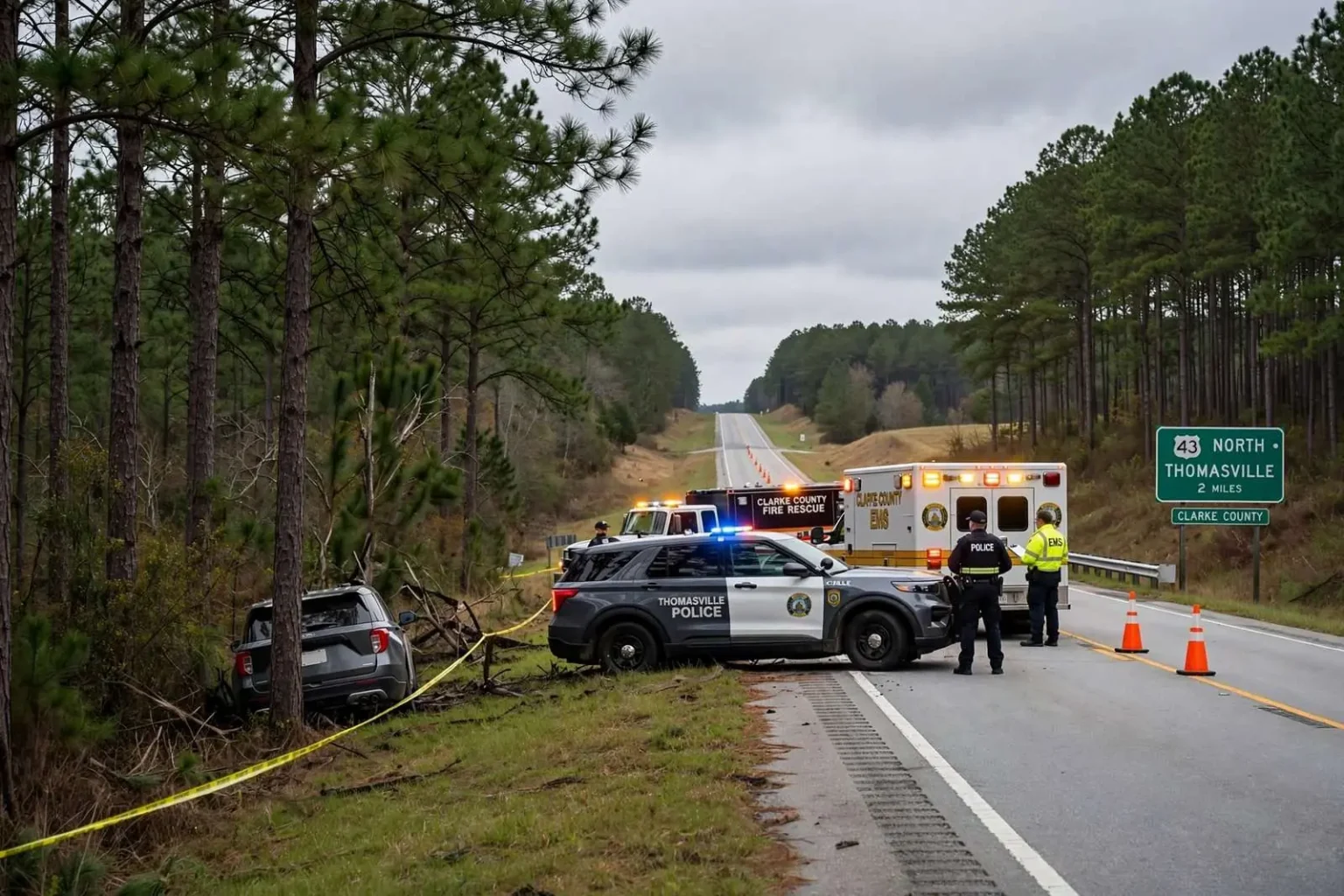
A 73-year-old Mobile man died Saturday following a single-vehicle crash on U.S. Highway 43 near Thomasville, according to Thomasville Police Chief Mitchell Stuckey. Stuckey said the crash involved only one vehicle and appears to have been related to a medical emergency rather than road conditions or another driver. The man, who has not been identified by police, was pronounced dead at the scene. Police have released few additional details as the investigation continues. The finding that a medical crisis — rather than traffic or another motorist — likely caused the wreck places the case on a path different from the ordinary collision investigation, and it is the reason the department’s public account is spare while officers work through the evidence of what happened inside the vehicle before it left the road.
The crash occurred on U.S. Highway 43 near Thomasville, a city of roughly 4,000 people in Clarke County, sitting on the highway that runs north from Mobile through Grove Hill to Thomasville and on toward Selma. U.S. 43 is one of southwest Alabama’s principal north-south arteries, carrying local traffic between the small cities of the region and the longer-haul traffic that connects Mobile’s port and suburbs with the Black Belt to the north. Near Thomasville the highway passes through gently rolling pine country, and the stretch is familiar to drivers making the trip between Mobile and the interior counties — the kind of road where a driver from Mobile, several hours’ round trip from home, would plausibly be traveling on a Saturday.
When a crash is believed to stem from a medical emergency, the investigation changes character in ways that are easy to describe and hard to execute. Standard collision reconstruction looks at speed, braking, road conditions, vehicle damage, and the movements of every vehicle involved; with a single vehicle and no other driver, several of those questions drop away, and what remains is the question of the driver himself. Investigators must weigh evidence about the driver’s health at the time of the crash alongside the physical evidence at the scene — the absence of braking, the way the vehicle left the road, the lack of evasive action — each of which can be consistent with a driver who lost consciousness or control because his body failed rather than because his driving did.
Why Medical-Emergency Crashes Are Handled Differently
Single-vehicle crashes tied to a driver’s medical emergency are typically handled differently than standard traffic collisions for reasons that go to both facts and law. On the facts, the causal chain matters: a driver who suffers a heart attack, seizure, stroke, or diabetic crisis behind the wheel is not a negligent driver in the ordinary sense, and the classification of the crash reflects that. There is no impaired or inattentive driver to cite, no second party at fault, and often no criminal dimension at all. What remains is the work of confirming the medical cause — which falls to the county coroner and, ultimately, an autopsy — and documenting the crash itself so the record is complete for the family, for insurance, and for the state’s crash statistics.
The evidence available in such cases is largely indirect. A vehicle that drifts off the roadway without braking or steering correction suggests a driver who was unconscious or incapacitated, while skid marks and swerving suggest a driver who was awake and fighting to control the car. Investigators also look at the vehicle’s mechanical condition — a tire failure or steering malfunction can mimic the effects of a medical event — and at the scene for signs of external causes, such as debris or an animal in the roadway. Ruling out those alternatives is part of establishing that the emergency was medical, which is why a case like this one stays open even when the initial assessment points strongly toward a health crisis.
For older drivers, the risk of sudden medical events behind the wheel is a recognized fact of highway safety, and it is one reason states, including Alabama, impose license-renewal requirements on older drivers rather than simply revoking privileges by age. Most older drivers manage their conditions responsibly — many voluntarily restrict their own driving, avoiding night driving, long trips, or unfamiliar roads — and crashes of this kind are rare relative to the miles older drivers travel safely. But when a medical event does strike at highway speed, the consequences are severe, because the driver cannot take the actions — braking, steering, pulling over — that would otherwise prevent a crash.
The Weekend Crash Near Thomasville
What is publicly known about the Saturday crash comes from Chief Stuckey’s account: a single vehicle on U.S. 43 near Thomasville, a 73-year-old driver from Mobile, a belief that a medical emergency was involved, and death at the scene. Police have not identified the man publicly, pending notification of family, and have released no details about the time of the crash, the direction of travel, the type of vehicle, or precisely where on the highway corridor it occurred. Those omissions are normal in the early stages of a fatal crash investigation, particularly one with no other parties involved, where there is no urgency to warn other motorists or locate a suspect.
The man’s death at the scene places the case in the hands of the county coroner as well as the police. In an Alabama county fatality, the coroner takes jurisdiction over the body, arranges for the autopsy that will establish the medical cause of death, and works with police to notify next of kin. The autopsy findings — whether a cardiac event, a stroke, or another acute condition — will supply the medical confirmation of what the initial investigation suggests. Until those findings are in, the police department’s characterization of the crash as apparently medically related remains an assessment, not a determination, and the official cause of death will be whatever the examination establishes.
For travelers on U.S. 43 through Clarke County, the crash was the kind of event that briefly slows the highway and then fades — a lane closed, emergency vehicles on the shoulder, a Saturday disrupted. The larger story it represents is one that highway-safety officials and families of older drivers know well: the miles driven between Mobile and the small cities north of the city are miles that Alabama’s older residents travel constantly, to church, to doctors’ appointments, to visit family, and the highway system serves them well until the day their health interrupts the trip. Chief Stuckey’s account of the crash — one vehicle, no other driver, a medical emergency, and a man dead at the scene — is the record of one of those interruptions, and the investigation continues until the evidence confirms what it appears to show.
The response to a fatal crash on a rural highway also draws on agencies beyond the city police. Thomasville police were the investigating agency in this case, but a fatality on U.S. 43 typically brings county emergency medical services, fire and rescue personnel for extraction and scene safety, and the coroner; state troopers with the Alabama Law Enforcement Agency may assist with documentation in fatal crashes depending on jurisdiction. Each agency’s record — dispatch times, medical findings, scene photographs — becomes part of the file that answers the question this crash presents: what happened to a 73-year-old man behind the wheel of his car on a Saturday, and why the vehicle left the road with no one and nothing else involved. The investigation continues until that question has an evidence-based answer, and the public account will remain as spare as Chief Stuckey left it until the findings are complete.
Medical-emergency crashes also raise practical questions that families of older drivers confront directly: the warning signs that should prompt a driver to give up the keys, and the conditions that can strike without any warning at all. Some acute events — a diabetic crash from unmanaged blood sugar, a seizure from an uncontrolled disorder — come with prior episodes that families and physicians use to judge whether driving remains safe, and states require physicians to report certain conditions. Others, like a sudden cardiac arrhythmia or a silent stroke, give no such notice, and no licensing rule can prevent them. Highway-safety researchers note that this uncertainty is why the question of older drivers is handled through individual assessment rather than blanket restriction: most drivers in their seventies are as safe as the general population, and the losses that do occur are concentrated in a small share of drivers with identifiable, manageable conditions.
For the family of the man who died, the path after such a crash runs through notification, the coroner’s examination, and the paperwork of settling what a sudden death leaves behind — all of it while the crash itself is summarized in a few sentences by the police chief who responded to the scene. A death that appears to have been caused by illness rather than negligence offers no one to blame, which in some ways makes it harder: there is no case to follow, no defendant, no closure of that kind. What the family can expect is a complete investigation record — the crash report, the autopsy findings, the accounts of responders — documenting that their relative died of his own health event on a highway he had likely traveled many times before, in a crash no one could have prevented.