A Prichard Mayoral Adviser Was Arrested on Warrants Tied to Traffic Violations From 2020
Prichard mayoral adviser T.J. Pettway was arrested on outstanding warrants tied to 2020 traffic violations, adding to a run of legal and administrative turbulence in the city's government.
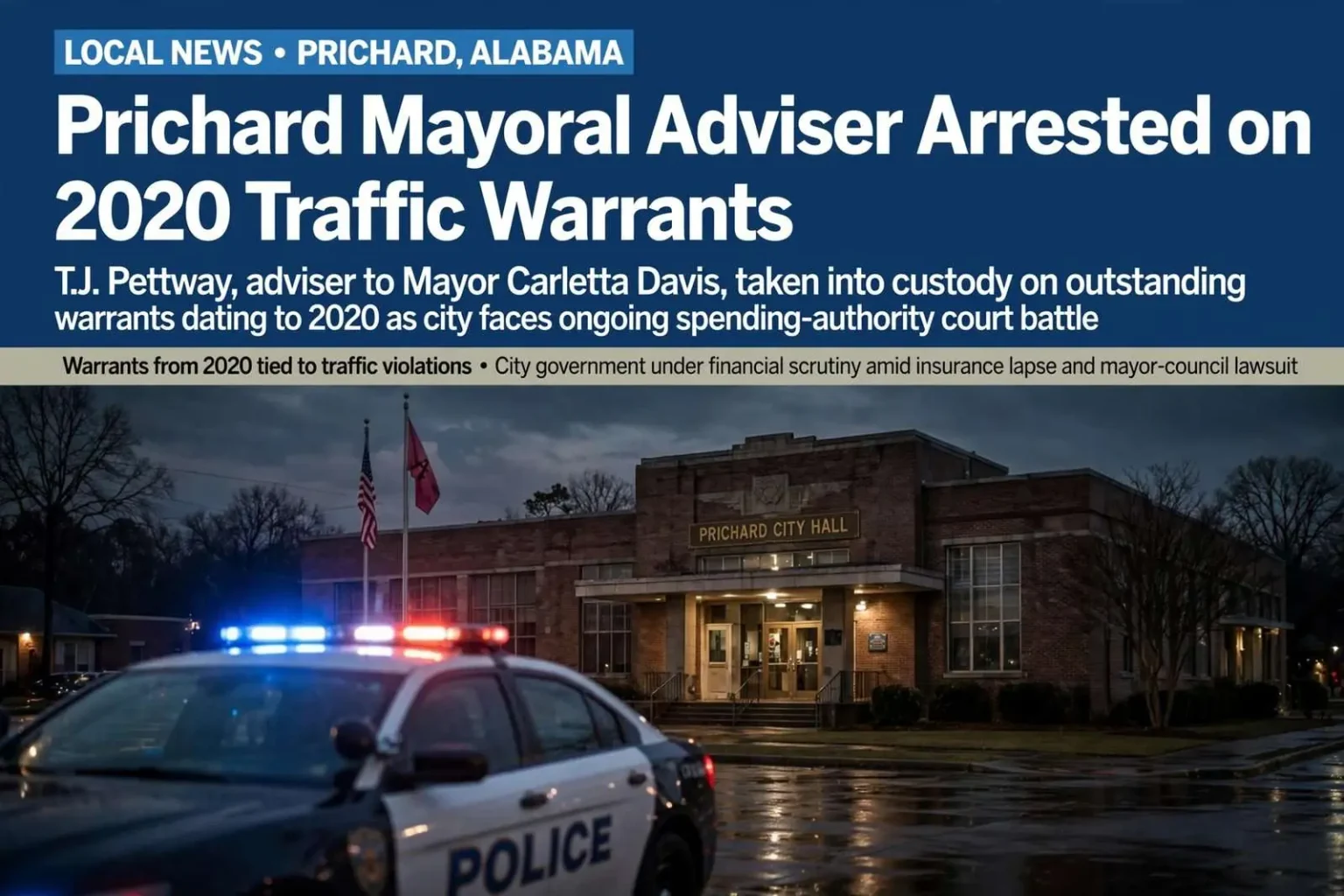
PRICHARD, Ala. — A Prichard mayoral adviser has been arrested on outstanding warrants connected to traffic violations dating back to 2020, adding another wrinkle to a city administration already tangled in a separate legal fight over spending authority.
T.J. Pettway, identified as an adviser to Prichard’s mayor, was taken into custody on the warrants, which stemmed from traffic violations that occurred in 2020. Details on why the warrants remained outstanding for roughly five years before resulting in an arrest were not immediately available. Warrants of that kind typically sit dormant when the person named cannot be located at a known address, moves out of the jurisdiction, or simply never appears in municipal court to resolve the underlying citations — and they surface, as they did here, at the moment of an encounter with law enforcement.
The arrest comes as Prichard city government faces separate, unrelated scrutiny over a court battle between Mayor Carletta Davis and the city council over control of municipal spending, along with questions about the city’s ability to pay its bills, including a recent lapse in employee dental and vision insurance.
Whether Pettway’s arrest has any bearing on his current advisory role with the mayor’s office was not addressed in initial reporting. The warrants deal with traffic offenses — matters handled in municipal court rather than questions of city business — and no allegation has connected Pettway’s advisory work to the events that produced the citations.
How Traffic Warrants Age in Municipal Court
An outstanding warrant for a traffic violation is one of the most common artifacts in Alabama’s municipal court systems. When a driver cited for an offense fails to appear in court or to pay the fine by the deadline, the judge issues a bench warrant, converting an administrative matter into an order for arrest that stays in the system indefinitely. Officers do not typically conduct dedicated sweeps for traffic warrants; the warrants are executed when the person is stopped for another violation, comes into contact with police, or is discovered during a records check.
That dynamic explains how a set of citations from 2020 can produce an arrest five years later. The warrants do not expire, and the underlying offenses do not go away; they wait. For the person named, the practical effect is a suspension of ordinary certainty — a traffic stop in any jurisdiction can end in custody for something years old — until the matter is resolved in the court that issued the warrants.
Resolution usually involves appearing before the municipal judge, addressing the underlying citations and any failure-to-appear penalties, and satisfying the court’s requirements before the warrants are recalled. The time the warrants remained outstanding can itself add costs and penalties to what began as simple traffic offenses, though the specifics of Pettway’s case — what he was cited for in 2020 and what penalties have accumulated — were not included in the initial reporting.
A City Government Under Separate Pressures
The arrest lands in the middle of a difficult stretch for Prichard’s city government, though nothing in the reporting connects Pettway’s warrants to the city’s larger disputes. The most prominent of those disputes is the court battle between Mayor Carletta Davis and the city council over control of municipal spending — a fight over who directs the city’s checkbook that has moved into the courts and framed the city’s recent political life.
Mayor-council spending conflicts are a recurring structure in Alabama municipal government, where the division of authority between an executive mayor and a legislative council is defined by state law and the city charter, and where disputes over that division end up in litigation when the two branches cannot agree. In Prichard, the fight has proceeded far enough to be described as a court battle, with the outcome bearing directly on how the city operates day to day.
Around that dispute sits a broader financial anxiety: questions about the city’s ability to pay its bills. The most visible symptom has been a recent lapse in employee dental and vision insurance — the kind of benefits interruption that signals cash-flow strain inside a municipal budget and that affects city workers directly. Coverage of that kind is modest in cost compared with core services, which is precisely why its absence draws attention: a city that cannot keep a small recurring obligation current is telling its workforce something larger about its finances.
The Adviser’s Role and What Happens to It
Advisory positions in a mayor’s office sit outside the formal structure of city departments, and the question raised by Pettway’s arrest — whether it bears on his advisory role — has not been answered publicly. Municipal advisory roles are typically appointments of the mayor rather than positions created by ordinance, which means their continuation is generally a decision that rests with the office that made the appointment. The mayor’s office had not addressed the arrest in the initial reporting, and no personnel action was announced.
For the purposes of the warrants themselves, Pettway’s position with the city is separate from the legal matter. Traffic violations are personal legal issues, handled in municipal court on the same footing as any other defendant’s, and the resolution will run through the court system rather than through city hall. What remains to be seen is whether the publicity around the arrest affects his standing in the administration, a question the initial reports explicitly left open.
Prichard’s Long Fiscal History
The scrutiny over the city’s finances lands on a community with a long institutional memory of fiscal trouble. Prichard, a city of roughly twenty thousand just north of Mobile, spent years in national headlines after its pension fund collapse led the city into bankruptcy — a chapter that made its fiscal management a matter of public record and that continues to color how its financial decisions are received. Against that history, a missed insurance payment or a budget dispute is not just an administrative hiccup; it is watched for what it might signal about the city’s underlying stability.
The dental and vision insurance lapse fits that pattern. Benefits for municipal employees are recurring obligations that a city budget either plans for or doesn’t, and a lapse in coverage — even a temporary one — tells employees that the city is managing its cash week to week. Restoring the coverage becomes both a practical matter for the affected workers and a small test of the administration’s grip on the budget.
The spending-authority lawsuit compounds the difficulty. A city whose two branches are fighting in court over who controls spending faces practical paralysis in exactly the areas where decisive action is needed: paying vendors, managing payroll obligations, and making the budget adjustments that changing revenues require. Employees and residents follow those cases closely because the answers determine who is accountable when bills go unpaid.
What Comes Next
The intersection of the arrest with city politics is the part observers will watch. Prichard’s city government has operated for months under the strain of the mayor-council litigation, and every development that touches city hall — however tangential — is read through that lens by residents and by the council members locked in the dispute. An adviser’s arrest on old traffic warrants has no direct bearing on the spending fight, but in a small city, proximity is everything: the person arrested works in the mayor’s office, and the mayor is half of the city’s central legal battle.
For Pettway, the immediate path runs through municipal court, where the 2020 citations and any accumulated penalties will be addressed and the warrants resolved. The process is routine in legal terms, even if the profile of the person moving through it is not. Whether the episode ends there — a personal legal matter closed — or produces consequences inside the mayor’s office is the part of the story that remains unwritten.
For the city, the arrest is a side story to the larger questions that will define Prichard’s near term: the court’s answer on spending authority, the restoration of employee benefits, and the council and mayor’s ability to govern through a dispute that has consumed the city’s attention. The warrants from 2020 say little about any of that. But in a city government already operating under strain, even a side story adds to the sense of an administration navigating turbulence on multiple fronts at once.
Initial reporting left the key questions open: why the warrants sat for five years, what the underlying citations involved, and whether Pettway’s role in the administration will continue. Those answers will shape how much of a mark the episode leaves on a city government that, at the moment, has larger fights to resolve — and little appetite for distractions.