Jerry Carl Takes Over as Mobile County Commission President
Mobile County Commissioner Jerry Carl has taken over as commission president, a rotating role that adds new board duties tied to BP settlement funds.
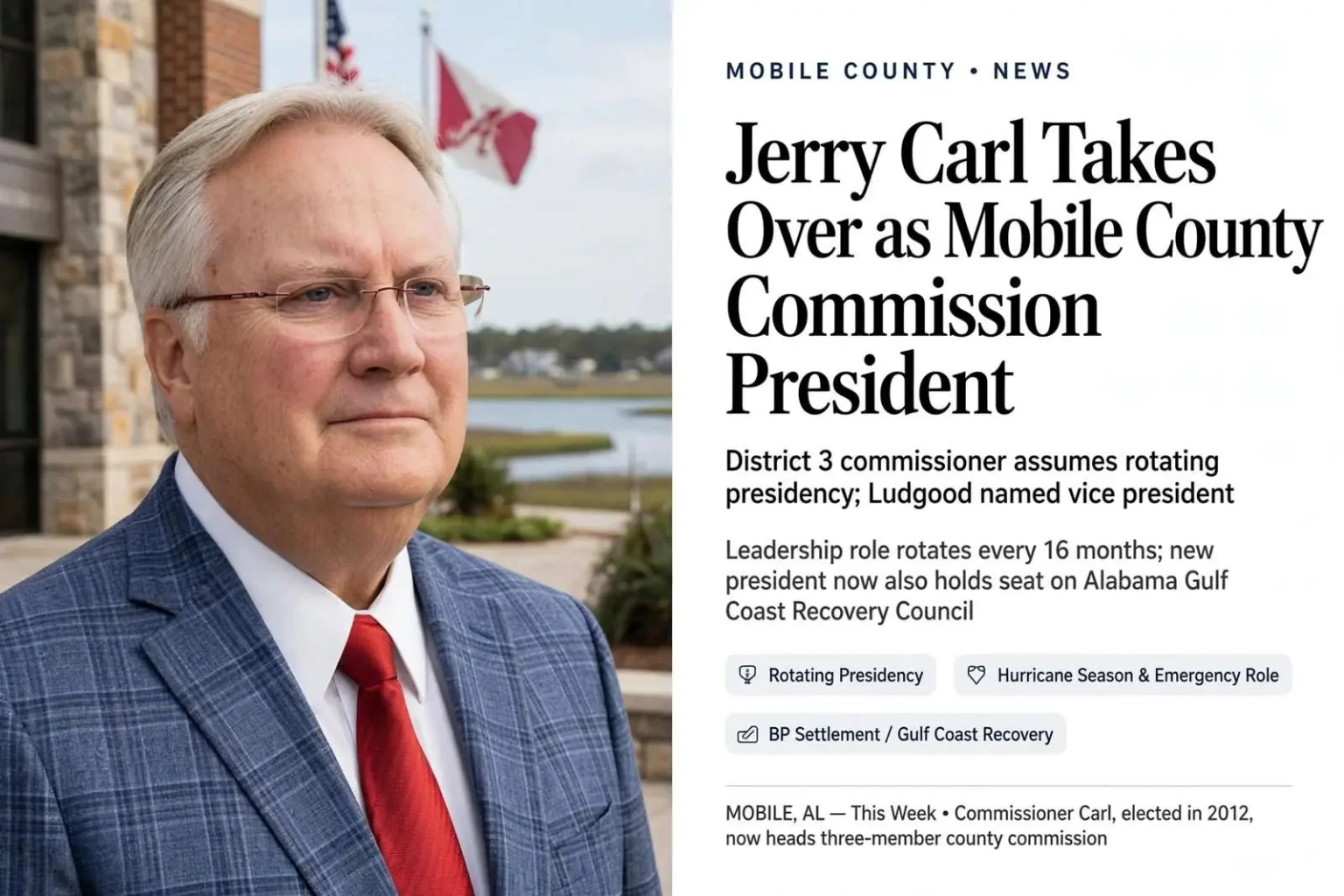
Mobile County Commissioner Jerry Carl has stepped into the role of commission president, taking over the leadership post from Commissioner Connie Hudson as part of a rotation built into the commission’s structure. The commission presidency changes hands roughly every 16 months among the three sitting commissioners, a schedule that keeps the body’s leadership fresh without the campaigning and coalition-building that leadership contests bring to larger boards.
Whoever holds the title chairs commission meetings and serves as the county’s chief elected official during declared emergencies or disasters, giving the role practical weight beyond its ceremonial duties. In hurricane country, that second responsibility is no small matter: when a storm threatens the Gulf Coast, the commission president becomes one of the public faces of the county’s response, working alongside emergency management officials through preparations, landfall and recovery.
Commissioner Merceria Ludgood moves into the vice president slot as part of the same rotation. The three-member structure means every commissioner eventually cycles through both posts, and the transitions have become routine exercises in continuity rather than shifts in policy direction.
Carl represents District 3, a sprawling stretch covering the southern part of Mobile County. He was first elected to the commission in November 2012, and his district includes some of the fastest-growing territory in the county, where development pushes south along the corridors toward the state line and the bay. District 3’s mix of suburban communities, rural crossroads and coastal areas gives its commissioner a broad portfolio of road, drainage and zoning concerns.
A new seat with regional stakes
Taking on the commission presidency also means new committee assignments; Carl will now hold a seat on the Alabama Gulf Coast Recovery Council, the federally created body responsible for directing funding tied to the multibillion-dollar settlement reached with BP after the 2010 Gulf oil spill.
That appointment places Carl in a position to help shape how a significant pool of recovery money gets spent across the region in the years ahead, at a time when local governments up and down the Gulf Coast are still working through how best to use spill-related settlement funds for economic and environmental recovery projects. The council’s decisions touch projects ranging from coastal restoration to infrastructure and economic development, and a Mobile County voice at the table matters for a county whose shoreline and economy were directly affected by the spill.
The Deepwater Horizon disaster and the settlement that followed created a generation of funding decisions that Gulf Coast officials will be working through for years. Federal law directs much of that money toward restoring the Gulf’s environment and economy, and the councils and consortia created to oversee it divide influence among the affected states, counties and parishes. A county commissioner’s seat on the recovery council gives Mobile County a direct say in how those priorities are set — which projects rise, which wait, and which regions benefit first.
What the commission does
Mobile County’s three-member commission handles a wide range of county government functions, from road and bridge maintenance to zoning matters in unincorporated areas, and the rotating presidency is designed to ensure leadership duties and the added public visibility that comes with them are shared among all three elected commissioners over time.
The commission’s agenda reaches nearly every resident of the county outside the incorporated cities. It sets budgets for county departments, oversees the engineering work that maintains hundreds of miles of roads and the bridges and culverts that cross the county’s waterways, and decides zoning and planning questions in unincorporated communities. The board also speaks for the county in state and federal matters, from legislative sessions in Montgomery to grant applications and recovery funding.
County officials said the transition took effect this week, with no disruption expected to the commission’s regular meeting schedule or ongoing business. The handoff from Hudson to Carl follows the pattern established by previous rotations, with committee assignments reshuffled and the meeting gavel changing hands at a scheduled meeting.
A long-standing structure
The commission’s rotating presidency has been a fixture of Mobile County government for decades, and it reflects a practical choice about how a three-member board should lead. With only three commissioners, any leadership arrangement concentrates power, so the rotation spreads the visibility and the workload evenly. Each commissioner takes turns chairing meetings, representing the county at ceremonial and emergency functions, and serving on the regional bodies that come with the presidency.
The system also tempers the politics of the board. Because the presidency is not contested, commissioners do not spend their terms building coalitions to win it, and voters know in advance that each district’s representative will eventually hold the post. In a county as large and varied as Mobile — home to the state’s second-biggest city, sprawling suburbs, fishing communities and vast rural stretches — that predictability has value in itself.
The rotation schedule of roughly 16 months means each commissioner typically holds the presidency more than once across a career of multiple terms. That repetition builds experience: by the time a commissioner takes the president’s chair, he or she has usually seen the role up close during hurricanes, budget cycles and major projects, first as a colleague and later as vice president.
Hurricane season and the president’s chair
The emergency role attached to the presidency deserves particular attention in a county with Mobile’s exposure. The county’s coastline has taken direct hits from major storms over the decades, and even storms that make landfall elsewhere bring flooding, wind damage and extended power outages to the area. When the county declares an emergency, the commission president becomes the formal voice of county government in the response structure, signing emergency declarations and coordinating with the state.
That duty means the president’s term covers at least one full hurricane season, and Carl’s tenure will include the months when Gulf residents watch the tropics most closely. The rotation ensures the county always has a chief elected official who has been through the drills, the briefings and the emergency operations center routine.
Looking ahead through the rotation
For District 3, Carl’s presidency means the southern county’s concerns move to the head of the agenda during his term at the top. Growth pressures, road needs and drainage issues in the southern corridors are perennial subjects at commission meetings, and the president’s role in setting the tone of those discussions gives the district’s constituents a natural advantage in being heard.
Hudson, handing off the presidency after her 16-month turn, returns to her district work and committee assignments, while Ludgood’s move to vice president positions her for the next rotation. The commission’s business — budgets, road projects, zoning cases and the county’s share of regional initiatives — continues on its regular schedule, with the leadership change noted but not felt in day-to-day operations.
The transition also comes at a moment when Mobile County is managing significant growth and the long tail of Gulf recovery funding. Between the presidency and the recovery council seat, Carl holds two of the more consequential positions in the region’s government structure, and how he uses them will shape both his district and the county as a whole over the coming years.
The BP settlement’s long tail
To understand why the recovery council seat matters, it helps to look at the scale of what the BP settlement set in motion. The 2010 Deepwater Horizon explosion and spill affected shoreline, fisheries and tourism economies across the Gulf, and the legal aftermath produced settlement structures that distribute money to the affected states and their local governments over many years. Alabama’s share flows through multiple channels, and the Alabama Gulf Coast Recovery Council is one of the key bodies deciding how a portion of it is spent.
The choices before the council are not small ones. Restoration projects can reshape coastlines, rebuild wetlands, improve water quality and restore habitat that fisheries and tourism depend on. Economic projects can support ports, seafood industries and coastal businesses. Every allocation favors one region or interest over another, which is why local representation on the council is fought for and valued by the counties it touches.
Mobile County’s coastline — from the bay’s western shore to the delta and the Dauphin Island approaches — sat in the path of the spill’s effects, and its fishing fleets, tourism operators and waterfront communities felt the consequences. A county voice in the council room means those experiences inform the funding decisions, and that locally identified projects have an advocate when priorities are ranked.
For Carl personally, the assignment pairs naturally with the presidency. County government deals daily with infrastructure, drainage and coastal resilience, the same subjects the recovery council funds. The combination means Mobile County’s top elected official is also positioned inside the flow of money that could address some of the county’s most expensive long-term needs.
What residents can expect
Day to day, residents will notice little change from the transition. Commission meetings continue on their schedule, district services continue through the same offices, and the county’s departments report through the same administrative structure. The presidency shapes who chairs the meetings and who stands at the podium in a storm — not how the road crew schedules its next paving project.
Where residents will see the difference is in emphasis. Presidents leave marks on the issues they prioritize: which road projects get pushed, which regional partnerships get county attention, and how the commission communicates during emergencies. Carl’s District 3 perspective — growth management in the southern county, coastal issues, the needs of unincorporated communities — will now carry the president’s platform.
The rotation also keeps the county’s leadership accountable to its whole geography. Over any six-year span, each district’s commissioner takes the chair, meaning residents in every corner of the county eventually see their representative leading the board. For a county government that operates largely outside the limelight between emergencies, that shared visibility is part of how it maintains public trust across its far-flung territory.
As the new term of the rotation begins, the commission’s three members settle into their adjusted roles: Carl chairing and carrying the recovery council assignment, Ludgood as vice president, and Hudson continuing her district and committee work. The county’s regular business proceeds, the hurricane season calendar ticks forward, and the structure that has governed Mobile County’s leadership for decades turns another page on schedule.