Local Pro Wrestler Denied Bail in Mobile Murder Case
A Mobile-area professional wrestler was denied bail this week on a murder charge tied to a Spanish Fort man's death years earlier.
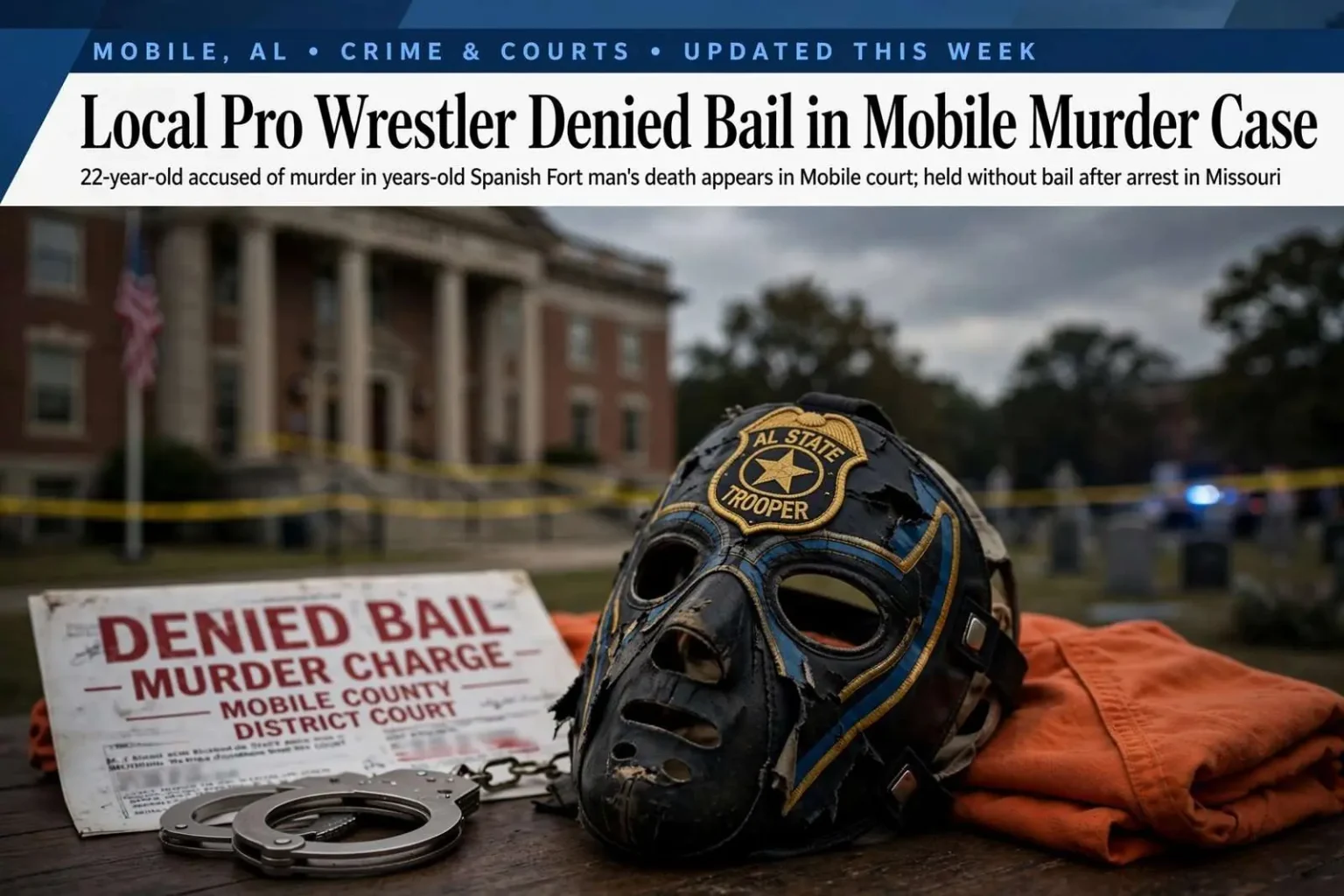
A man known to Alabama wrestling fans for his in-ring persona appeared before a Mobile County judge this week, where a district court judge denied him bail on a murder charge.
The defendant, 22, faces a murder charge connected to the death of a Spanish Fort man whose body was discovered years earlier at a cemetery on Mobile’s west side after a passerby spotted a vehicle on fire late at night. Firefighters who responded to extinguish the blaze found the victim’s body inside — a discovery that turned what appeared to be a late-night vehicle fire into a homicide investigation that has now produced its first arrest.
Denial of bail is among the most consequential decisions a lower-court judge can make. In Alabama, most defendants are entitled to reasonable bail, and judges routinely set amounts calibrated to the charge and the defendant’s ties to the community. Declining to set bail at all is an unusual step reserved for cases where the court concludes no conditions of release could reasonably assure the defendant’s appearance and the safety of the community — a standard the murder charge, the circumstances alleged and the manner of the defendant’s out-of-state capture all fed into this week.
From a burning car to a murder charge
The case traces back to the night the passerby spotted the burning vehicle at the west Mobile cemetery and emergency crews responded. Vehicle fires of that kind are treated from the first response as potential crime scenes, and the discovery of a body inside transformed the call into a death investigation. The victim was identified as a Spanish Fort man — a resident of the Baldwin County city across Mobile Bay — and the case remained open in the years that followed, the kind of investigation that proceeds quietly while detectives accumulate evidence and await the break that moves it forward.
That break, according to authorities, came with the arrest earlier this month. Authorities in Missouri arrested the defendant at a home in Cape Girardeau, where prosecutors say he had been staying with family and was found hiding at the time of his arrest. He had reportedly moved from the Mobile area to Missouri within the past year — a relocation that placed him hundreds of miles from the scene of the crime and from the investigators who had spent years working the case.
Being found hiding at the time of arrest is the kind of detail that weighs heavily in later proceedings. Prosecutors treat conduct during apprehension — concealment, flight, assuming a life under new circumstances in another state — as evidence of consciousness of guilt, and it is equally the kind of fact a bail argument turns on, because it speaks directly to whether a defendant can be relied upon to appear.
Return to Mobile and the court’s decision
After his arrest in Missouri, the defendant was returned to Mobile County to face the charge, appearing before the district court judge in jail attire and restraints. The hearing was brief by design: the charge was presented, counsel and the state were heard on the question of pretrial release, and the judge ruled that bail would be denied. The defendant is next scheduled to appear for an arraignment hearing later this month, where the formal reading of the charge and entry of a plea will move the case into the circuit court process that follows.
The wrestling life behind the charge
In the local wrestling circuit, the defendant performed under a stage persona inspired by an Alabama State Trooper character, appearing in matches around the region, including a bout in Theodore in recent months. The independent wrestling world that stretches across south Alabama — fairgrounds, armories, festival stages from Mobile County through the Baldwin County line and into the Florida panhandle — runs on larger-than-life characters and the wrestlers who portray them, and audiences along the Gulf Coast had come to know the defendant through that persona.
A promoter who trained him said the two had worked together for several years and described him as talented in the ring but known for a combative streak outside it. The account from the man who knew him best in the business captures the duality the case has forced onto the public record: an athlete with genuine ability inside the ropes, and a temperament outside them that those around him had learned to manage. Promoters in the regional circuit describe their business as a close fraternity — training schools, travel to small-town shows, the shared work of building crowds night after night — and the arrest has resonated through that community as it would through any small profession that counts one of its own among the accused.
The bout in Theodore, held in recent months before his arrest, now stands as part of the timeline investigators and prosecutors have assembled — a public appearance by the defendant in the region at a date the case’s chronology will account for.
The record that preceded the charge
Court records show the defendant had a prior drug possession charge from several years earlier, when he listed a Mobile address. The prior charge is minor relative to the murder count now before the court, but in bail arguments and trial strategy, prior records matter in specific ways: they speak to the defendant’s history with the court system, and the Mobile address of record from those years now contrasts with the reported relocation to Missouri that preceded his arrest.
His stepfather continues to live in the Mobile area, a family tie that defense counsel would ordinarily cite in arguing for release conditions and that prosecutors acknowledge as part of the defendant’s connections to the community. The judge’s decision to deny bail indicates the court found those ties insufficient, against the gravity of the charge and the circumstances of the case, to assure the defendant’s appearance through trial.
What comes next
Prosecutors have not released additional details about the evidence connecting him to the killing. That silence is standard practice in an active murder prosecution, where the state’s proof — what it believes ties the defendant to the death of the Spanish Fort man found in the burning vehicle years ago — is disclosed through the discovery process rather than the press. The arraignment later this month will mark the case’s next public step, and further hearings will build the record from there.
The case remains active, and Mobile County court officials say further hearings will determine how the prosecution proceeds. Between now and then, the proceedings will have to answer the questions the arrest raised: what evidence accumulated across the years between the burning car at the cemetery and the arrest in Cape Girardeau, what the defendant’s time in Missouri means to the state’s theory, and how a young man who performed as a lawman in the wrestling ring came to stand in a Mobile courtroom charged with murder, held without bail as the case against him begins.
Bail denial and pretrial detention in Alabama
The denial of bail places the defendant in a small category of Alabama defendants held in the county jail without the option of release before trial. Judges weighing that question consider the seriousness of the offense, the strength of the state’s evidence, the defendant’s criminal history, his ties to the community and — critically in cases like this one — any evidence of flight or concealment. Each of those factors appears in this case in a form that favors detention: a murder charge, an arrest hundreds of miles away, and a report that the defendant was found hiding when authorities arrived.
The ruling also shapes the practical course of the defense. A defendant held without bail meets with counsel in the jail rather than in an office, cannot assist in gathering evidence or witnesses on his own behalf, and faces every hearing in restraints and jail attire. Defense options at this stage focus on the arraignment ahead and, in time, motions that test the state’s evidence — but the bail decision itself, once made by the district court, sets the terms of daily life for the remainder of the pretrial process unless a higher court revisits it.
The extradition-side facts are also part of that record. Moving a defendant from Missouri back to Alabama involves coordination between the two states’ authorities and the waiving or holding of extradition proceedings, and the weeks that process consumed now stand as part of the timeline between the arrest in Cape Girardeau and this week’s appearance in Mobile County District Court.
An investigation years in the making
The arrest closes one phase of a case that began with a 911-style report of a vehicle fire at the cemetery and a discovery inside that no firefighter expects. Homicide investigations that span years depend on the patience of detectives, the persistence of the victim’s family, and evidence that ages slowly — records, forensics and witnesses whose accounts mature over time. The years between the burning vehicle on Mobile’s west side and the arrest in Missouri represent that kind of accumulation, though the state has not yet detailed what it holds.
For the victim’s family in Spanish Fort, the arrest is the first public acknowledgment that the years of waiting produced a suspect, and the months ahead will turn the case from an open file into a public prosecution — with the arraignment this month, disclosure of the state’s evidence, and the hearings that determine whether the case goes to trial in Mobile County.
A courtroom next, not a ring
The arraignment later this month will be the defendant’s next scheduled appearance, and the formal steps that follow — plea, discovery, motion practice — will set the course of a prosecution that Mobile County court officials say remains active and evolving. The wrestling circuit that knew him under his trooper-inspired persona has meanwhile lost one of its performers, with promoters and fellow wrestlers left to reconcile the in-ring talent their audiences saw with the charges now on the docket.
Whatever the trial ultimately establishes, the sequence already on the record is stark: a Spanish Fort man found dead in a burning car at a west Mobile cemetery, years of investigation, an arrest in Missouri where prosecutors say the 22-year-old was found hiding with family, and a Mobile County judge who concluded that no bail was warranted. The defendant will answer the charge in the weeks ahead, beginning at the arraignment — in a courtroom rather than a ring, facing the most serious charge the state can bring.