University of South Alabama Mobile
USA Community Plans Vigil for Nursing Student Killed in July 4 Weekend Crash
The University of South Alabama community is holding a candlelight vigil at the Moulton Bell Tower to honor a nursing student who died in a crash.
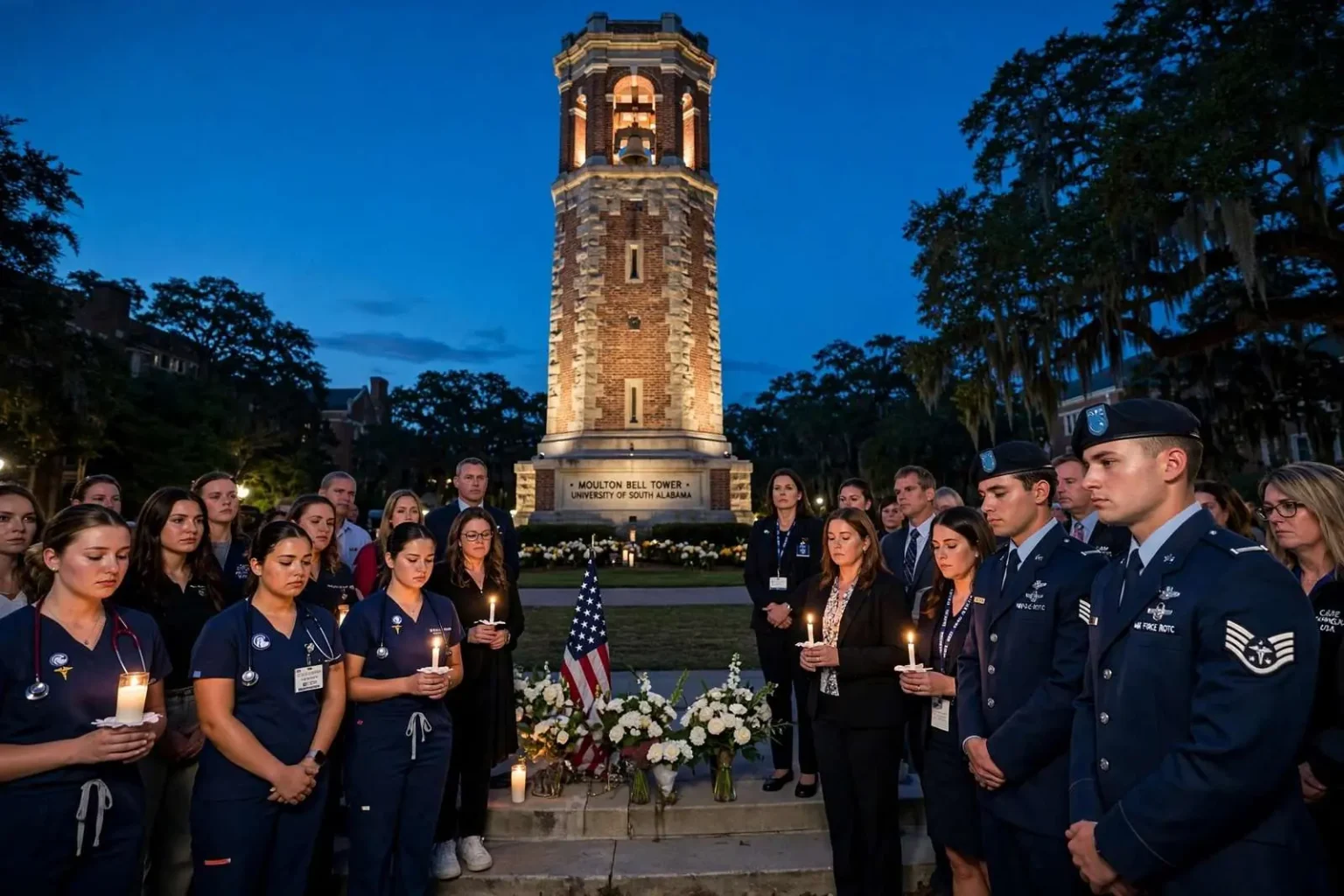
Students, faculty and family members are gathering this week at the University of South Alabama to remember a nursing student whose death in a car accident over the July 4 holiday weekend has left a deep mark on the tight-knit campus community. The student was on her way to visit her boyfriend for the holiday weekend when her vehicle was struck by a tractor-trailer while she sat in traffic, according to those close to the case. She had reportedly been on the phone with her mother at the time of the crash.
The circumstances of the crash — a sudden collision in stopped traffic, on a holiday weekend crowded with travelers — have made the loss especially difficult for those who knew her. Holiday weekends consistently rank among the most dangerous times on Southern roads, as highways fill with drivers making long trips to visit family, and crashes involving commercial trucks carry a heightened risk of fatal injury for the occupants of passenger vehicles.
A Family’s Longest Wait
Family and friends gathered at the hospital afterward, more than 40 people in all, hoping for good news that ultimately did not come.
The size of that hospital gathering said much about the reach of one young life. More than four dozen relatives and friends converging on a trauma center within hours of a crash reflects the kind of person whose loss ripples through a family, a church, a nursing cohort and a campus at once. For the medical teams who fought to save her, the presence of that crowd was a visible measure of what was at stake.
Even in the midst of tragedy, those who knew her say her generosity extended beyond her own life. She had previously registered as an organ donor, and that final wish was honored, allowing her death to save the lives of others in need of transplants.
Organ donation decisions are typically made long before any hospital stay, when a person signs up through the state’s registry or notes the choice on a driver’s license. Honoring that registration requires family consent in practice, and the family’s decision to follow through meant that in the middle of their own grief, they were also enabling transplants for strangers they would never meet. It is among the most common ways grieving families in Alabama find meaning after a sudden loss, and donation coordinators say the choice often becomes a touchstone for relatives in the years that follow.
A Vigil at the Bell Tower
A candlelight vigil is scheduled for Thursday evening at the university’s Moulton Bell Tower, a familiar campus landmark, beginning at dusk around 7:30 p.m. The event was organized by faculty members within the nursing program specifically so students and staff who were unable to travel to her funeral out of state would still have a chance to grieve together and honor her memory as a community.
The Moulton Tower has long served as the symbolic heart of the South Alabama campus, and it is a natural gathering point for moments of shared emotion. Holding the vigil at dusk, when the tower is illuminated against the evening sky, gives the ceremony a setting that students associate with some of the proudest moments of their college years — making the space fit for one of its saddest.
Those who worked closely with her in the nursing program describe an unusually close cohort of students who spent long hours together in clinical rotations and study groups, a dynamic that made her death felt especially deeply among her classmates.
Nursing programs are structured to build that closeness by design. Students move through clinical rotations in the same hospital units, face the same licensing exams, and spend semesters watching one another perform under pressure in ways classmates in lecture-based majors never see. The bonds formed in those conditions often last entire careers, which is why the death of a nursing student lands differently in a cohort than in the broader student body: her classmates are not just grieving a friend, but a future colleague they expected to graduate beside.
Military Service Alongside Nursing Studies
Beyond her nursing coursework, she was also an active member of the university’s Air Force ROTC detachment, balancing military training commitments alongside a demanding academic course load. In recognition of that service, she is set to receive a military ceremony in her honor as part of the broader remembrance efforts.
Carrying both a nursing curriculum and Air Force ROTC requirements is a heavy load in any semester. Cadets on that path juggle early-morning physical training, leadership labs and aerospace classes on top of clinical rotations and nursing exams, a schedule that leaves little unclaimed time. Those who manage it tend to be among the most disciplined students on any campus, and the combination often points toward a military nursing career — one of the most competitive and respected tracks a nursing graduate can pursue.
The military ceremony planned in her honor will follow traditions that ROTC programs observe for members of their detachment who die, recognizing her commitment to service even though her time in uniform had not yet begun in earnest. For the cadets who trained alongside her, the ceremony offers a formal way to mark a loss that standard campus memorials do not fully capture.
What the Vigil Will Look Like
Organizers say candles will be provided at Thursday’s vigil, and a chaplain with the campus Catholic Student Association is expected to offer remarks during the gathering. The vigil is open to the full university community, reflecting how far her presence extended beyond her immediate nursing cohort and ROTC unit.
Campus candlelight vigils follow a familiar rhythm: brief remarks, shared memories, and a period of quiet that gives attendees space to grieve without ceremony or obligation. University counseling staff frequently attend such gatherings, both to support students in the moment and to make themselves visible to those who may need longer-term help processing the loss. At schools the size of South Alabama, a single death can touch students who never met the person — a classmate’s roommate, a member of the same parish, a cadet from another detachment.
Grief Across a Campus Community
For a campus the size of the University of South Alabama, sudden losses like this one tend to ripple outward quickly, touching students, instructors and staff who may have crossed paths with her in classrooms, campus organizations or everyday student life. Thursday’s vigil offers the broader community a formal, shared space to process that loss together.
South Alabama enrolls students from across the Gulf Coast region and beyond, and its nursing program is among the university’s largest and most demanding. Faculty in programs like nursing often teach the same students across multiple semesters, in classrooms and hospital units alike, and the death of a student lands on instructors as well as peers. University officials in such circumstances typically make counseling resources available to any student or employee who wants them, recognizing that grief does not confine itself to the people who knew the deceased best.
The details of the crash itself — the holiday traffic, the truck, the phone call with her mother — will remain part of what her friends carry. What the university can offer this week is narrower but real: a tower, a candle, a chaplain’s words, and several hundred people standing together at dusk to say that a life cut short on the way to see someone she loved mattered to a campus that barely got to know her.
The vigil Thursday evening at the Moulton Bell Tower is scheduled to begin around 7:30 p.m., with candles provided and all members of the university community welcome.
The nursing program’s response in the days since the crash has included outreach to the students who knew her best, with faculty checking in on cohort members as news spread across campus. Classmates organized among themselves as well, sharing memories and coordinating attendance at both the out-of-state funeral and Thursday’s vigil so that no one who wanted to attend would have to travel alone.
Registered as an organ donor, she became part of a donation process that typically unfolds within days of death, when transplant teams move quickly to match organs with recipients on waiting lists. Those recipients — people waiting on hearts, lungs, kidneys, livers and tissue — are spread across the region and the country, and their families often never learn the identity of the donor. For the nursing student’s family and friends, the knowledge that her registration was honored provides a thread of purpose through an otherwise senseless loss: a future nurse whose training was aimed at saving lives ended up saving them in a way no one in her program could have imagined.
The Air Force ROTC detachment is expected to participate in the memorial activities alongside the nursing faculty, giving both communities she belonged to a formal role in saying goodbye. Together with the candlelight gathering at the Moulton Bell Tower, the week’s remembrances amount to a campus farewell conducted on her terms — among her classmates, her fellow cadets, and the university community she served in her all-too-brief time there.