Mobile County’s 2015 Budget Includes Raises but Leaves Little Room to Spare
Mobile County's proposed 2015 budget includes employee raises and modestly higher revenue, but officials say the county's finances remain stretched thin.
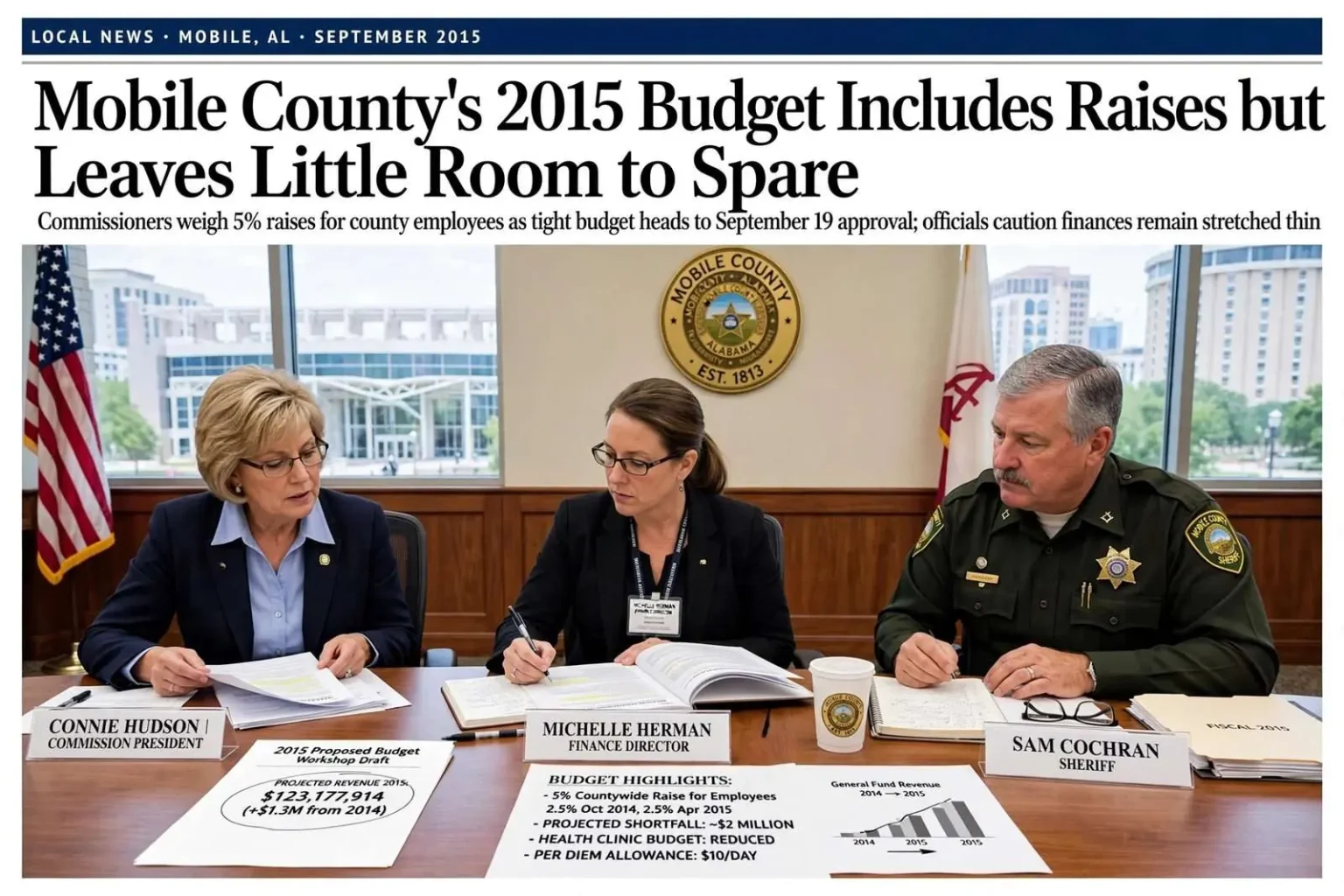
Mobile County commissioners spent Thursday morning working through the details of a proposed 2015 budget that includes across-the-board raises for county employees, even as officials cautioned that finances remain tight. The budget is scheduled to come up for formal approval on September 19, during a rare combined Friday session at Government Plaza, the downtown complex the county shares with the City of Mobile.
Projected county revenue for 2015 stands at $123,177,914, an increase of about $1.3 million over 2014 figures. Finance Director Michelle Herman told commissioners she was cautiously optimistic about the numbers, noting an uptick in sales tax revenue during the past fiscal year and pointing out that, unlike prior years, the 2015 budget does not rely on any one-time payments to balance out. The distinction matters: budgets propped up by reserves or one-time infusions tend to create worse gaps the following year, while a budget built on recurring revenue is at least standing on stable ground.
Commission President Connie Hudson said the budget remains “stretched pretty thin,” but noted it represents an improvement over the previous year, when the county faced a projected $5 million shortfall. This year’s gap, by comparison, sits closer to $2 million, which Hudson said was more manageable to close. For a general fund of just over $123 million, a $2 million hole is a serious but workable problem — the kind that can be closed with targeted trims rather than across-the-board pain.
Raises in Two Steps
Employee raises were a central piece of the discussion. Under the plan, county workers would receive a 5 percent raise spread across two increments — a 2.5 percent bump beginning with the October 2014 pay period, followed by another 2.5 percent increase in April 2015. Officials indicated the increase will likely be classified as a cost-of-living adjustment rather than a merit raise, which means every employee receives it regardless of performance review.
The two-step structure serves a practical purpose for budget writers. Splitting the raise lets the county absorb only half of the cost in the fiscal year that begins October 1, with the full annualized cost arriving in the 2016 budget — when, commissioners hope, revenue growth will have caught up. Spreading raises across pay periods is a common technique for local governments trying to reward workers without breaking a single year’s ledger.
To help fund the raises, the county trimmed spending elsewhere in the budget, including reductions tied to the county health clinic. Per diem subsistence pay for eligible employees was set at $10 a day, the allowance that covers meals and incidentals for workers traveling on county business. Each of those line items was weighed against the priority of putting more money in paychecks.
The Sheriff Makes His Case
Sheriff Sam Cochran used the workshop to press commissioners on staffing and pay issues at Mobile Metro Jail, where he said the department continues to operate with a bare-bones crew. Cochran raised concerns about employee retention, noting that new hires often start at pay levels close to those earned by employees with seven or eight years of experience — a compression problem that gives veteran corrections officers little reason to stay when neighboring agencies can offer the same money for less time served.
Jail staffing is among the most difficult line items for county governments to manage. Mobile Metro Jail operates around the clock, every day of the year, and its population fluctuates with arrests across the county and its municipalities. Understaffing raises overtime costs, burns out the officers who remain, and increases liability exposure for the county, which is why sheriffs across Alabama routinely treat budget workshops as their best annual opportunity to make the staffing case directly to the elected officials who control the purse.
Where the Money Comes From
The county’s general fund rests heavily on sales tax revenue, which rises and falls with the local economy. That dependence explains why Herman’s note about an uptick in sales tax collections carried weight in the workshop: every increase in retail activity flows directly into the county’s ability to pay for the courthouse, the jail, roads, and the health clinic. It also means the budget is exposed to the other side of that equation — a slow retail year tightens the screws immediately.
Unlike cities, counties in Alabama receive no property tax growth to speak of beyond constitutionally constrained general levies, and many of the county’s revenues are earmarked by state law for specific purposes such as roads or the courthouse. The general fund, in practical terms, is where flexibility lives, and it is also where the pressure concentrates. Mobile County’s $123 million projection should be read in that context: it is not the county’s total spending authority, but the portion officials can actually steer.
What the Budget Means for Residents
For county residents, the 2015 plan touches daily life in quieter ways than a city budget does. The county government operates the jail and the sheriff’s patrol, maintains courthouses and records, runs the health clinic program referenced in the workshop, and supports the county’s extensive road network outside municipal limits. Raises for county employees are intended to keep the people who provide those services from leaving for higher-paying government jobs elsewhere in the region.
The reduction tied to the county health clinic drew attention because health services serve some of the county’s most vulnerable residents. Commissioners weighed that cut against the raises, and the discussion reflected a broader reality of county budgets across Alabama: after decades of constrained revenue, every increase in one area arrives as a decrease somewhere else. Public health advocates have long argued that clinic spending pays for itself by keeping residents out of costlier care, a case budget writers hear every year alongside every other claim on the general fund.
The September 19 Vote
The formal approval on September 19 falls just ahead of the October 1 start of the fiscal year, the deadline by which Alabama counties must adopt a budget under state law. The combined Friday session at Government Plaza is unusual — the commission typically meets on Mondays — and signals that the board intends to finish the job on schedule. Once adopted, the spending plan takes effect immediately for the new fiscal year, with the first 2.5 percent raise arriving in the October pay period.
Between the workshop and the vote, commissioners typically fine-tune line items based on department head requests, and the sheriff’s presentation makes clear that public safety pay will remain part of that conversation. Whether the final document adds anything for jail staffing or holds the line as drafted, the framework is set: a budget built on recurring revenue, closed with trims, and sweetened with a raise that reaches every county employee in two steps.
Compared with the previous year’s $5 million projected shortfall, the 2015 exercise was positively calm. Local government finance rarely announces good news loudly; a budget that simply pays employees a little more, funds its obligations, and ends the year without a crisis counts as a success. Hudson’s “stretched pretty thin” description is likely to describe Mobile County budgets for some time, but for 2015, thin appears to be good enough.
A Season of Financial Caution
The workshop approach itself reflected the commission’s mood. Rather than presenting a finished document for a single vote, commissioners walked through the draft line by line in public, asking Herman and department representatives to justify assumptions while the proposal was still fluid. Budget workshops of this kind give taxpayers a window into the tradeoffs that final votes reduce to a footnote, and Mobile County’s decision to work through the details in open session put the tough calls — clinic reductions, jail pay, per diem rates — on the record before anything was final.
The cautious optimism Herman expressed was measured against years of recent experience. Local governments across the Gulf Coast spent the years after the recession scraping through budgets with hiring freezes, furloughs, and reserve drawdowns, and many officials learned to treat single good years as fragile. Herman’s emphasis that the 2015 plan does not lean on one-time money was a signal that the county is trying to break that pattern and build a budget that can be repeated.
The raise, too, carries a story beyond its arithmetic. County employees in Alabama went long stretches without any cost-of-living adjustment during the lean years, watching their purchasing power erode while private-sector and state positions offered more. A 5 percent raise delivered in two steps is both a recruitment tool and a retention message: the county can afford to value its workforce again. Cochran’s push on jail pay shows the limits, though — some departments started so far behind that even a healthy across-the-board raise does not close the gap, and those specific problems will have to be solved in specific ways.
As the September 19 vote approaches, the proposed budget stands as Mobile County’s most stable financial plan in several years — modest, honest about its constraints, and pointed squarely at keeping the county’s workforce intact. For the commissioners who shaped it, thin may be the new normal, but 2015’s version of thin comes with raises attached.