West Nile Virus Confirmed in South Mobile County Sentinel Chicken
Health officials confirmed West Nile Virus in a sentinel chicken in south Mobile County, urging residents to guard against mosquito bites this season.
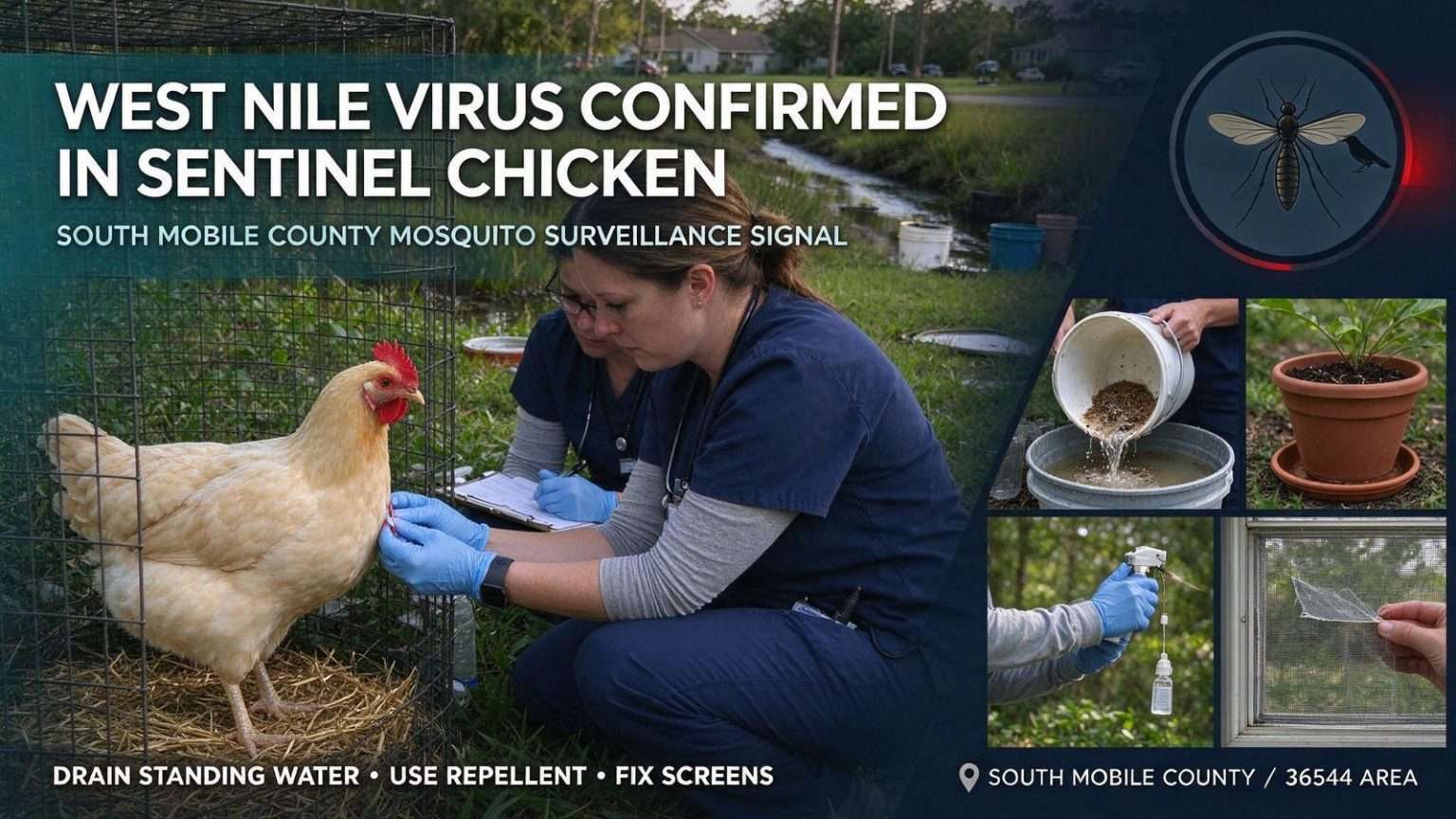
Health officials in Mobile County are urging residents to step up their mosquito precautions after a routine surveillance test came back positive for West Nile Virus. The finding came from one of the Mobile County Health Department’s sentinel chickens, birds kept specifically to help track the presence of mosquito-borne illness in the community, which tested positive in the 36544 ZIP code area in the county’s southern reaches.
Dr. Bernard Eichold, the county’s health officer, said the positive test should serve as a reminder that mosquitoes capable of carrying the virus are likely present well beyond the single location where the chicken was found. Health officials generally advise treating detections like this as a signal covering the wider area rather than a single pinpoint risk, given how mosquitoes move and breed across a region.
West Nile Virus is a mosquito-borne form of encephalitis, an inflammation of the brain that can range from a mild, flu-like illness to a severe and occasionally fatal condition, particularly in older adults and people with weakened immune systems. The virus is not spread directly between people or between humans and horses, both of which can become ill after being bitten by an infected mosquito. Instead, it cycles primarily between birds and the mosquitoes that feed on them, which is why sentinel chickens serve as an early warning system for health departments across the Gulf Coast.
How sentinel chickens work
The idea behind a sentinel flock is simple: chickens cannot develop a high enough level of the virus in their bloodstream to pass it back to mosquitoes, so they act as harmless measuring stations. When a mosquito carrying West Nile bites one of the birds, the chicken’s immune system produces antibodies against the virus. Health workers draw small blood samples from the flock on a regular schedule through mosquito season and send them for testing. A positive result means virus-carrying mosquitoes are active in that area — information the county could not gather any other way without testing thousands of wild birds.
The flocks are placed in coops at fixed locations around the county, spread across ZIP codes so that surveillance covers both urban neighborhoods and the rural stretches of south Mobile County. The 36544 ZIP code area where the positive chicken was found includes communities in the county’s southern reaches, where standing water, drainage ditches and warm Gulf Coast temperatures combine to produce ideal mosquito habitat through the warm months.
Health officials note that the risk window for mosquito-borne encephalitis in south Alabama typically runs from the height of summer through the first hard freeze of the fall, meaning residents in Mobile County are likely to face elevated risk for several more weeks. The Gulf Coast’s long warm season makes that window one of the longest in the country, stretching from early summer well into autumn in most years.
Standard precautions recommended by public health agencies include draining standing water around homes, wearing insect repellent containing DEET during outdoor activities in early morning and evening hours, and repairing torn window screens to keep mosquitoes from getting indoors. Those steps, repeated across a neighborhood, do more to reduce risk than any single measure — because the mosquitoes that carry the virus breed in containers and low spots within a few hundred feet of where people live.
What residents should know about the virus
Most people who are infected with West Nile Virus never know it. A large majority develop no symptoms at all, and most of the rest experience a mild illness with fever, headache and body aches that passes within days. The serious form of the disease — neuroinvasive illness affecting the brain or spinal cord — is far rarer but can cause lasting damage or death, and the risk of severe disease rises sharply with age. People over 60 and those with conditions that weaken the immune system are the groups health officials worry about most when a positive chicken signals active transmission.
Because there is no vaccine for people and no specific treatment for the virus itself, prevention is the entire defense. That is why a single positive surveillance result triggers the county’s public messaging: the cheapest and most effective response is convincing residents to protect themselves before infections occur. Horses, unlike people, do have an available vaccine, and veterinarians in the region generally recommend that horse owners keep vaccinations current during mosquito season.
Mobile County’s long surveillance tradition
Mobile County’s mosquito surveillance program is one of the longest-running in the region, a reflection of the Gulf Coast’s history with mosquito-borne disease. The county operates mosquito control efforts that include testing, larvicide treatments of standing water, and spraying when conditions warrant. Sentinel chickens have been a part of that picture for years, valued because they give a reliable, repeatable reading of virus activity in specific neighborhoods.
The county’s environment makes the work necessary. Warm, humid weather lasts more than half the year, and the landscape — marshes, tidal creeks, ditches, and drainage basins — offers mosquitoes ample breeding ground. Population growth into formerly rural areas of south Mobile County puts more homes closer to that habitat, which raises the stakes of surveillance in ZIP codes like 36544.
Health officials also track other mosquito-borne illnesses alongside West Nile, including Eastern equine encephalitis, which circulates in the same bird-mosquito cycle and appears in the region most summers. The same precautions protect against all of them, which is why the county’s advice does not change with each new positive result: drain the water, repel the mosquitoes, and repair the screens.
The weeks ahead
With the positive result confirmed, residents in the southern part of the county should treat the finding as local, not abstract. Mosquitoes carrying the virus are active now, and the season has weeks to run before the first hard freeze ends the risk for another year. Simple habits — emptying flower pot saucers, buckets, gutters and pet bowls twice a week; wearing repellent at dawn and dusk; keeping screens in good repair — cut the chance of a bite dramatically.
County officials will continue testing the sentinel flocks through the season, and additional positives, if they occur, will extend the advisory rather than change it. For now, the message from the health department is the same one it delivers every time a chicken tests positive: the virus is in the environment, the mosquitoes are flying, and a few minutes of prevention around the house is the best protection available.
Why standing water is the battleground
The mosquitoes most responsible for passing West Nile Virus to people thrive in the small, stagnant water sources that collect around homes: clogged gutters, old tires, buckets, bird baths and neglected pools. Unlike the large salt-marsh mosquitoes that draw complaints along the coast, these container-breeding species live close to people, which makes the backyard the front line of prevention. Dumping out water twice a week interrupts the breeding cycle before larvae mature, and it is more effective in the places the virus actually spreads than any broad spraying program.
Public health agencies emphasize the “tip and toss” habit because a mosquito needs only a bottle cap’s worth of standing water to complete part of its life cycle. After summer thunderstorms, which arrive almost daily on the Gulf Coast, containers refill quickly. Residents who keep yards free of standing water protect not only their own household but the neighbors within a few hundred feet, since the adult mosquitoes produced in one yard fly to the next.
Who is most at risk
The people health officials most want to reach with this advisory are those spending time outdoors during the peak mosquito hours — early morning and evening — and those most vulnerable to severe disease. Older residents, people with chronic illness, and anyone whose immune system is compromised face the highest risk of the serious neuroinvasive form of West Nile. Outdoor workers, gardeners, athletes and families at evening ballgames can reduce their exposure with repellent containing DEET, long sleeves and pants, and by avoiding the hours right after dawn and before dusk when possible.
Pet and livestock owners have their own checklist. Horses should be current on vaccinations against West Nile and other mosquito-borne encephalitis, and water troughs should be refreshed regularly. Dogs and cats are not significant carriers of the virus, but mosquito bites affect them in other ways, so the same yard maintenance that protects people protects them too.
Reading the signal correctly
A positive sentinel chicken is a measurement, not an outbreak report. The chicken was bitten by an infected mosquito at some point in the weeks before its blood draw, and that infected mosquito’s relatives are flying now across the surrounding area — not just at the coop. Health officials deliberately avoid describing the risk as confined to one location, because the bird-mosquito cycle covers whole neighborhoods and shifts as birds and insects move.
That is also why a single positive does not mean every neighborhood is equally affected, and why the county continues testing throughout the season. Each blood draw updates the map of virus activity. In a typical year, some flocks stay negative from spring to fall while others test positive more than once, and the pattern helps mosquito control target treatments where the virus is actually circulating.
For residents of the 36544 area and the rest of south Mobile County, the practical response to this positive test is straightforward. Drain the standing water this week and keep draining it. Wear repellent outdoors, especially in the early morning and evening. Fix the torn screens. Those three habits, kept up through the weeks until the first hard freeze, are the best available answer to the virus the sentinel chickens have confirmed is present.