Second Sentinel Chicken Tests Positive for West Nile in Mobile County
A second sentinel chicken in Mobile County's mosquito surveillance program tested positive for West Nile virus this week, health officials said.
MOBILE, Alabama — For the second time in a week, a sentinel chicken used by the Mobile County Health Department to track mosquito-borne illness has tested positive for West Nile virus, this time in the Mount Vernon community. The confirmation, reached through laboratory testing, marks another signal that the virus is actively circulating in the local mosquito population. Health officials said the back-to-back results underscore that the risk season is fully underway across south Alabama. The findings come during the stretch of the year when Mobile County’s mosquito-borne disease surveillance program is at its most active.
How the county tracks the virus
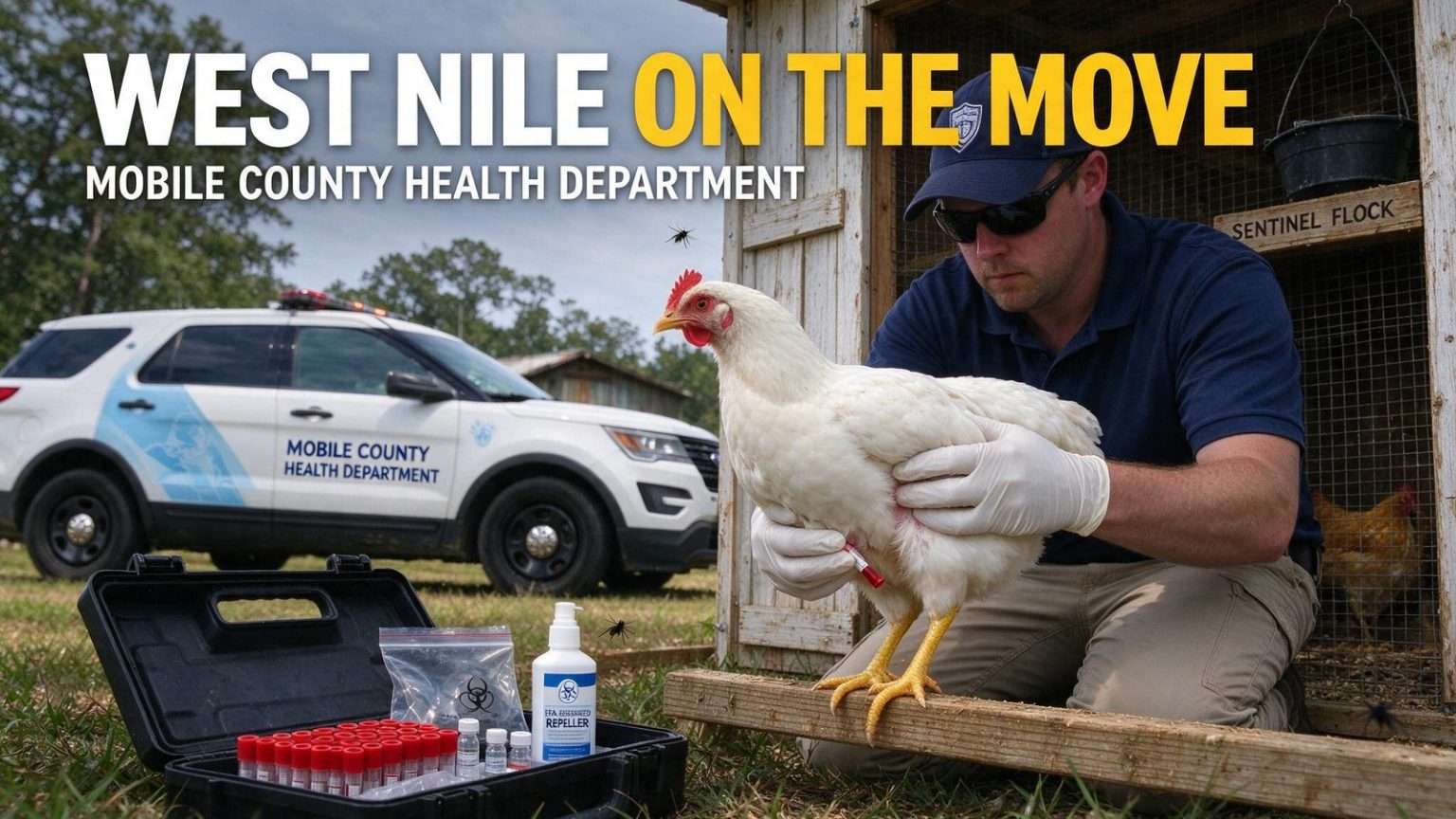
The health department maintains flocks of chickens at various points around the county specifically to monitor for mosquito-borne diseases. Because the birds are regularly bitten by local mosquitoes but do not get sick from West Nile virus themselves, testing their blood gives health officials an early warning system for how widely the virus is circulating in the mosquito population before human cases appear. Sentinel flocks have long been a cornerstone of mosquito-borne disease tracking in the Gulf Coast region, where the warm, humid climate allows mosquito populations to thrive for much of the year.
The approach works because chickens, while susceptible to infection, typically develop antibodies without becoming ill, which makes them reliable living indicators rather than reservoirs of serious disease. When a bird in a particular location tests positive, it tells officials that mosquitoes carrying the virus are feeding in that area. Surveillance teams can then intensify testing of mosquito pools nearby and adjust control efforts accordingly, targeting the specific zones where the virus has been detected rather than spreading resources thinly across the entire county.
Mobile County’s health officer said the latest positive result, confirmed through laboratory testing, means residents throughout the county should assume infected mosquitoes are present, not just in the Mount Vernon area where this particular bird was located. Mount Vernon sits in the northern reaches of Mobile County, a rural and semi-rural part of the county where wooded terrain and standing water can give mosquitoes ample room to breed. The health officer’s message was clear that residents from the state line down to Mobile Bay face the same basic risk, because mosquitoes and the wild birds that carry the virus do not respect neighborhood boundaries.
Risk peaks through the fall
Health officials said the risk of mosquito-borne encephalitis in the Mobile area is highest from August through the first hard freeze of the fall, meaning residents could face elevated risk for at least another month or two depending on the weather. In south Alabama, that first killing frost often does not arrive until well into November or even later, stretching the mosquito season longer than in most of the country. The pattern means that just as much of the nation is closing the book on mosquito season, Gulf Coast residents are typically entering its most dangerous weeks.
Mosquito activity tends to peak at dawn and dusk, so people spending time outdoors during those hours were urged to take extra precautions. Early morning joggers, evening gardeners, parents at youth sports practices, and anyone working outside around sunset are all exposed during the windows when the mosquitoes most likely to carry the virus are feeding most aggressively. Officials stressed that the risk is not limited to wilderness areas or undeveloped land, since the mosquitoes that transmit West Nile often breed and feed in residential neighborhoods.
Steps residents can take
Recommended steps include wearing insect repellent any time someone is outside, especially during peak mosquito hours, and taking basic steps around the home such as eliminating standing water where mosquitoes breed. Repellents registered with the Environmental Protection Agency, applied according to the label directions, remain the most effective personal defense against mosquito bites. Long sleeves and long pants during early morning and evening hours add another layer of protection, particularly for people who spend extended periods outside.
Eliminating standing water is equally important because even small amounts can support mosquito breeding. Homeowners are encouraged to empty and refresh water in birdbaths, flowerpot saucers, pet bowls, and children’s toys, to clean out clogged gutters, and to discard old tires or containers that can collect rainwater. Water that sits for more than a few days can produce a new generation of mosquitoes, so a weekly walkthrough of the yard has become standard advice from vector control professionals across the Gulf Coast.
Residents with swimming pools are advised to keep them chlorinated and circulating, since neglected pools are among the most productive mosquito breeding sites in any neighborhood. Screened windows and doors in good repair also help keep mosquitoes out of living spaces, which matters most during the dawn and dusk hours when the insects are most active.
How West Nile spreads
West Nile virus spreads in a cycle between birds and mosquitoes, with mosquitoes picking up the virus by feeding on infected birds and then transmitting it to other animals, including humans and horses, through subsequent bites. Certain bird species serve as the primary reservoirs that keep the virus circulating in nature, while mosquitoes act as the bridge that carries it to mammals. People and horses are considered dead-end hosts for the virus in most cases, meaning they can become seriously ill but generally do not develop high enough virus levels in their blood to pass the infection back to mosquitoes.
Because the cycle depends on both birds and mosquitoes, the intensity of a given West Nile season can swing sharply from year to year. Weather patterns, bird migration, and the size of local mosquito populations all influence how much virus circulates in any given summer. That unpredictability is a major reason health departments rely on continuous surveillance rather than assuming that a quiet year means the threat has passed.
No vaccine available for humans
While both humans and horses can become seriously ill from West Nile virus, health officials noted that the disease cannot spread directly from an infected person or horse to another person, since transmission requires a mosquito as the carrier. There is currently no vaccine available for humans, making prevention of mosquito bites the primary defense against the virus. Most people who are infected never develop symptoms, and many others experience only a mild, flu-like illness that resolves on its own.
A smaller share of infections, however, develop into severe neuroinvasive disease, including encephalitis or meningitis, which can lead to long-term complications or death, particularly among older adults and people with weakened immune systems. The absence of a human vaccine or a specific antiviral treatment is what makes the county’s surveillance work so important, because the only practical way to reduce severe cases is to identify viral activity early and reduce mosquito exposure across the community.
Horse owners face a different situation, since veterinarians have long had access to effective vaccines for equine West Nile virus and generally encourage owners in mosquito-prone regions like south Alabama to keep animals current on their boosters. Livestock and backyard poultry owners are also encouraged to reduce standing water around barns and pens for the same mosquito-control reasons that apply in residential yards.
Health officials also remind residents that mosquito-borne risk is a shared neighborhood concern, since mosquitoes travel only a few hundred feet from where they hatch. A single neglected container in one yard can produce biters for an entire block, which is why local officials ask neighbors to look out for one another and to point out potential breeding sites to friends and family. Community-wide participation in standing-water cleanup is widely credited in Gulf Coast communities with measurably reducing mosquito pressure during peak season.
What comes next
The Mobile County Health Department said it will continue regular testing of mosquitoes and sentinel chickens throughout the county as the risk season continues, and will notify the public of any additional positive results. Surveillance teams collect mosquitoes from traps across the county and submit pools for laboratory analysis, while the chicken flocks are bled on a regular schedule to check for the antibodies that signal viral activity. Together, the two methods give health officials one of the most complete pictures available of where the virus is moving.
Positive results typically prompt vector control staff to step up mosquito control activities in the surrounding area, which can include treating standing water with larvicide and conducting targeted spraying to reduce adult mosquito populations. The goal is to interrupt transmission before the virus can move from the bird-mosquito cycle into the human population. Officials emphasized that residents’ own prevention efforts remain a critical part of that equation, since no surveillance program can reach every backyard in a county this size.
For now, the message from the health department is the same one issued at the start of every Gulf Coast mosquito season, delivered with renewed urgency: assume the virus is present, protect yourself and your family with repellent and common-sense habits, and stay alert for additional announcements as the fall progresses. With weeks of warm weather still ahead, officials said vigilance through the first hard freeze is the county’s best tool for keeping West Nile from causing human illness.