Owner Sells Off Furnishings From Historic Magee Farm Civil War Surrender Site
The owner of Kushla's Magee Farm, one of only three Civil War surrender sites still standing, is selling its antiques after years of financial strain.
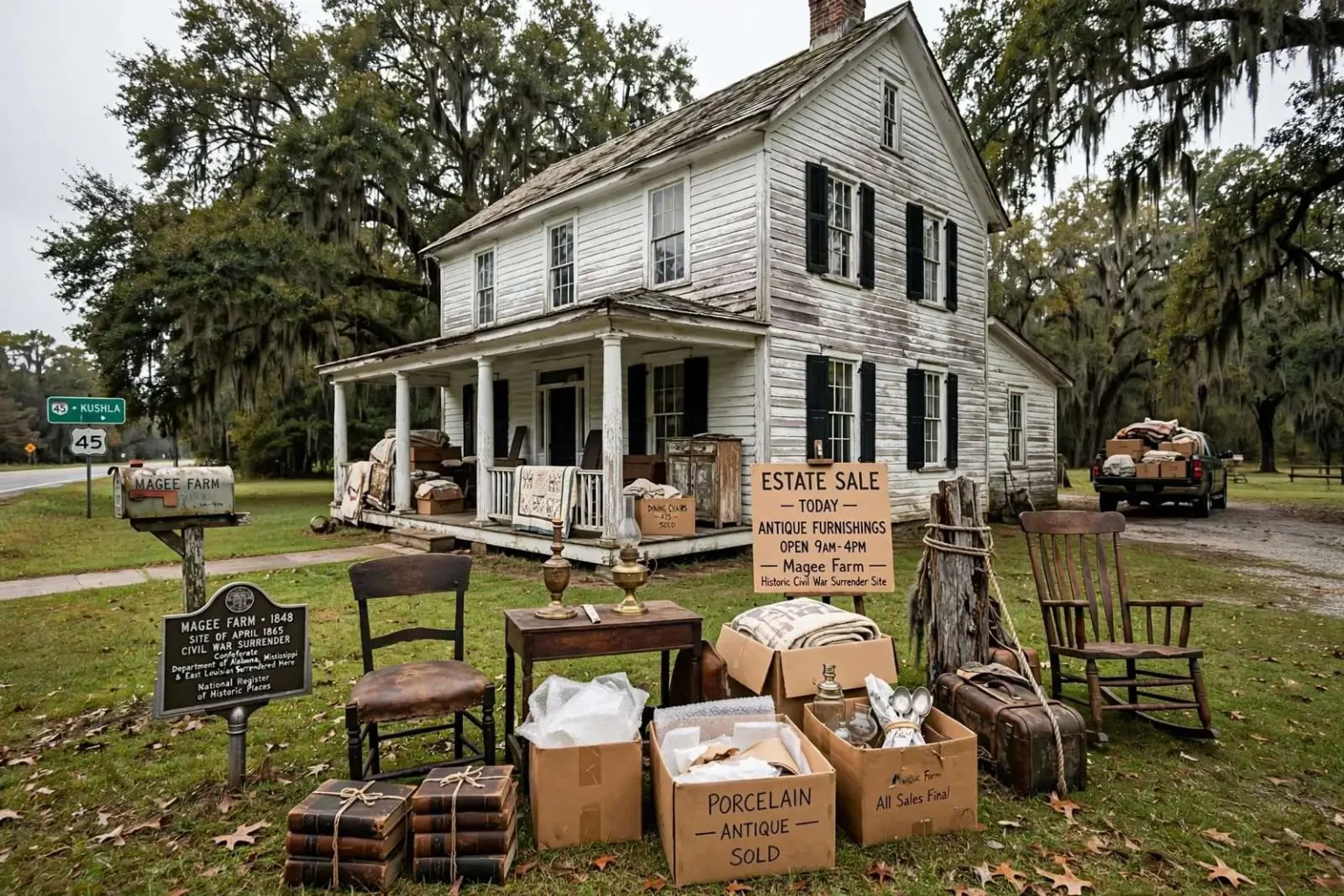
A rare piece of Civil War history in north Mobile County is being broken apart piece by piece, as the owner of Magee Farm in Kushla moves to sell off the home’s antique furnishings after years of trying and failing to keep the historic property afloat as a museum.
The farmhouse, built in 1848 and located along U.S. 45 near Alabama 158, is one of only three sites in the country where a major Confederate surrender took place at the close of the Civil War. In April 1865, Confederate and Union generals met in the home’s front parlor to negotiate a cease-fire and surrender covering tens of thousands of troops from Alabama, Mississippi and Louisiana, effectively ending the war in the region.
Unlike the other two surrender sites, which were later altered, destroyed or rebuilt, Magee Farm remains fully intact, still holding many of its original furnishings. Historians have pointed to that authenticity as what makes the property nationally significant, and the home has previously been named one of Alabama’s most endangered historic places.
The surrender meeting came at the tail end of a campaign that had already decided Mobile’s fate. Union forces had taken Mobile in the spring of 1865 after victories at Spanish Fort and Fort Blakeley on the eastern shore of Mobile Bay, leaving the remaining Confederate forces in the region with no realistic path to continue the fight. The parlor negotiation at Magee Farm formalized what the battlefield had settled, arranging the surrender of the Confederate Department of Alabama, Mississippi and East Louisiana and the tens of thousands of soldiers under its command.
From Family Home to Museum
The current owner, a Saraland veterinarian with a longtime interest in Civil War history, purchased the property and its contents years ago after developing a relationship with the family that had owned Magee Farm since the late 1800s. He later opened the home as a nonprofit museum, hosting school field trips and staffed tours highlighting its history.
For a time, the arrangement worked as intended. Students from across Mobile County walked the same rooms where the generals negotiated, and the antique furnishings — the pieces that made the house more than an empty shell — remained in the places they had occupied when history passed through. Volunteer and staffed tours kept the story alive for visitors who might never have known a surrender of that scale happened on a quiet stretch of U.S. 45.
But running a small historic house museum proved financially unsustainable. Annual operating costs ran tens of thousands of dollars, and while Mobile County provided occasional funding in past years, that support eventually dried up. The nonprofit running the museum closed, leaving the owner personally responsible for mortgage and upkeep costs on the property.
The math that sank the museum is familiar to preservationists across the country. A historic house generates revenue from admissions, gift shop sales and tours, but those streams rarely cover the cost of insurance, maintenance, climate control and staffing — and a house of this age demands constant attention. Roofs, foundations, painting and pest control on an 1848 structure are not occasional expenses but permanent ones, and a museum open only seasonally or by appointment has little chance of closing the gap.
Public support, which often makes the difference for such properties, proved intermittent here. County funding that had helped in earlier years ended, and without an endowment or a steady institutional backer, the nonprofit had no cushion. When it folded, the private owner was left carrying the burden alone, a position few individuals can sustain for long regardless of their devotion to the history involved.
The Sale of a Collection
After listing the home for sale without success, the owner has taken it off the market and is now renting it out instead. Facing repeated offers for the antique furniture inside, he ultimately decided to part with the collection — the latest turn in a long struggle to find a sustainable future for the property.
The decision to sell the furnishings strikes preservationists as a painful but predictable outcome. Original contents are what give a historic house its ability to tell its story; a museum without its collection becomes an architectural relic rather than an immersive record of the past. Each piece that leaves takes a layer of authenticity with it, and once dispersed, a collection rarely comes back together.
At the same time, the alternative — watching the owner absorb losses indefinitely — was never a plan. Selling the furnishings recovers some of the investment he made and eases the carrying costs on a property he still owns. Buyers of period antiques exist across the region, and pieces with documented provenance to a surrender site would draw serious interest from collectors and institutions alike, raising the possibility that some items could end up in museums where they would be preserved and interpreted for the public.
Why Magee Farm Matters
The house’s significance rests on a combination of rarity and integrity. Only a handful of sites nationwide can claim a major Civil War surrender on their grounds, and of the three comparable surrender sites, Magee Farm is the only one that survives essentially as it was in 1865. Where the others were altered, destroyed or rebuilt, the Kushla farmhouse still stands with its parlor intact — the room where the end of the war in this region was arranged.
Its listing among Alabama’s most endangered historic places reflected the fear that the state could lose that connection entirely. Preservation groups have long warned that unprotected historic properties in growth corridors face pressure from development, and the land around U.S. 45 and Alabama 158 has seen substantial commercial growth as the Mobile area expands northward. A farmhouse in the path of that growth needs either a mission that pays for itself or a protective steward — and Magee Farm has found neither.
The Challenge Facing Historic House Museums Everywhere
Magee Farm’s troubles are not unique; they are the leading edge of a nationwide problem. Historic house museums across the United States have closed, merged or converted to limited operations as visitation declines and operating costs climb. The model that sustained such museums a generation ago — a devoted local board, modest admission fees, volunteer docents — has struggled against rising insurance, maintenance and utility costs, and against competition for leisure time that small-town attractions cannot always win.
Preservation professionals increasingly argue that houses like Magee Farm need institutional anchors: universities, historical societies, government partnerships or endowments large enough to absorb annual deficits. Some communities have succeeded with creative approaches — heritage tourism trails, event rentals, school partnerships that bring steady group traffic. Others have watched properties slip away when no partner stepped forward in time.
Mobile County has a strong appreciation for its history, from the colonial period through the Civil War and the civil rights era, and its museums and historic sites draw visitors throughout the year. Whether a public-private partnership could still emerge for Magee Farm — with the house rented and generating income, perhaps part of the needed stability could be found — remains the open question that preservationists in the region will be watching.
What Comes Next
The short-term future is now settled in practical terms: the house will be a rental, the furnishings will be sold, and the nonprofit museum era at Magee Farm has ended. The longer-term question — whether the surrender site can be protected for the generations of students who once toured its rooms — depends on whether an institutional buyer or preservation partner emerges before the pressures that consumed the museum consume the property itself.
For now, the sale of the collection proceeds piece by piece, and with each item that leaves, the direct physical link to April 1865 grows thinner. The house itself remains, its parlor still the room where two armies’ representatives ended a war in the region, and its status as one of the nation’s rare intact surrender sites is still unchanged. What happens next will determine whether that remains true for another century — or whether one of Alabama’s most significant historic places becomes another cautionary tale told by the state’s preservation community.
Local historians say the story of Magee Farm carries a lesson worth heeding regardless of the outcome: that significance alone does not protect a historic property, that maintenance and mission both cost money every single year, and that the window to save places like this one is always open — until, suddenly, it is not.
The setting adds to the stakes. Kushla sits in the corridor where Mobile County is growing fastest, as development pushes north along U.S. 45 from Saraland, Satsuma and Creola. Historic properties in growth corridors face the twin pressures of rising land values and changing land use, and those pressures rarely favor a farmhouse that no longer has an operating purpose. Preservation groups note that once surrounding land is redeveloped, the context that gives a site its meaning becomes far harder to recover.