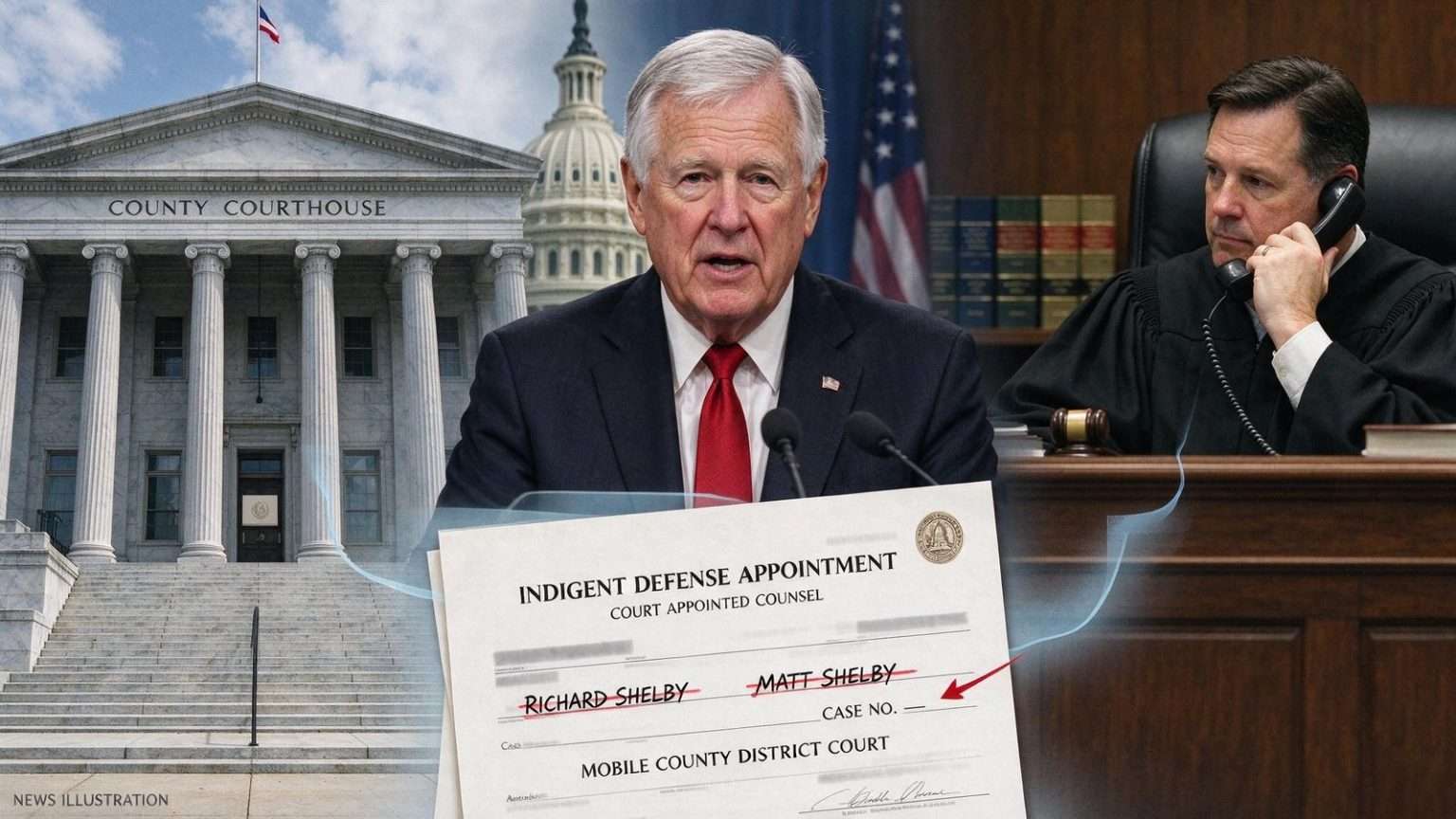
The unthinkable nearly happened in Mobile County District Court on Tuesday: a sitting United States senator was very close to representing a poor person. U.S. Sen. Richard Shelby, R-Ala., who counts a law degree and membership in the Alabama State Bar among his many credentials, received notice that he had been appointed by the court to provide criminal defense counsel to William Clyde Kelly, a 46-year-old Saraland man accused of possessing a controlled substance.
The appointment was, of course, a mistake of the most harmless and most remarkable kind. District courts across Alabama appoint counsel for defendants who cannot afford lawyers every day, and those appointments are ordinarily routine administrative acts. In this instance, however, a paperwork error in the clerk’s office sent an indigent defense appointment out of a busy Mobile County courthouse and onto the desk of one of the most prominent elected officials in the state, prompting a phone call between Washington, D.C., and a district judge’s chambers that neither man is likely to forget.
Mobile County District Judge Mike McMaken assumed his secretary was pulling his robe when she told him Shelby was on the telephone and wished to speak with him. “I said ‘no, you’ve got to be kidding,'” McMaken said.
But it was, in fact, arguably the most powerful political figure in Alabama calling a district judge to discuss the matter of an indigent defendant and a drug charge — and to sort out a misunderstanding that had rather less to do with Kelly’s guilt or innocence than with the senator’s sudden new client. The exchange, McMaken said afterward, was friendly and brief, and it resolved the confusion the same day it surfaced.
How it happened
When Kelly made his initial appearance, he told McMaken he intended to hire a lawyer but had not yet done so. The judge temporarily appointed Matt Shelby, a young attorney with the Greene & Phillips firm on Florida Street, under the court’s indigent defense provisions. Matt Shelby trails his more famous namesake in bar membership by roughly 47 years and in office space by about a thousand miles.
The clerk’s office, however, apparently entered the identifying number for Richard Shelby rather than Matt Shelby in the case file. In due course, the notification made its way to Washington.
According to McMaken, the senator conceded that his criminal defense skills, if they had ever existed, had probably eroded across a long career in politics. Legal malpractice, Shelby suggested, would not do anyone any good — not the senator, not the judge and certainly not the defendant.
The episode illustrated how dependent Alabama’s trial courts are on accurate data entry in even the smallest matters. Indigent defense appointments in district court are made in a matter of minutes, often from a rotating list of local attorneys willing to take the cases, and the identifying numbers used to track them differ by only a digit or two. A single keystroke can send a court order to the wrong person entirely — and in Mobile County that week, it nearly did.
Under Alabama law, defendants who cannot afford counsel are entitled to court-appointed representation in criminal cases, and district judges handle those appointments on the spot at first appearance. The system relies on local attorneys, many of them young lawyers building their practices, to accept the appointments. Greene & Phillips, where Matt Shelby practices, is among the firms whose attorneys take such work in Mobile County.
Old acquaintances
“It was a refreshing break in the action,” McMaken said. “Just when you think you’ve seen it all. And people wonder why I find District Court so addicting.”
The judge said he and Shelby became acquainted on the campaign trail nearly 25 years ago, when both were seeking office as Democrats — McMaken for the district judgeship, Shelby for the U.S. Senate. Both are now Republicans.
The shared history gave the phone call an easy familiarity that it otherwise might have lacked. McMaken said the senator took the mix-up in stride, joking about the unexpected addition to his client list and asking only that the record be corrected so that the young Mobile lawyer could get on with representing the defendant.
“We bumped into one another in 1986,” McMaken recalled. “We saw each other at a bunch of places. He was running statewide but he did a good bit of campaigning in Mobile.”
Shelby’s 1986 Senate campaign was among the harder-fought races in modern Alabama political history, and candidates in statewide contests of that era spent long stretches courting voters in county seats across south Alabama, Mobile included. It was on one of those swings that the future judge and the future senator first crossed paths, a decade before either had reached the offices they hold now.
“A good while after that, we were in D.C. getting the Capitol tour that Jeff Sessions had arranged for us. We were walking across the rotunda and ran into Shelby. He remembered who I was. He’s a sharp guy,” McMaken said.
The reference to Sessions was a reminder of how small Alabama’s delegation to Washington was, and how often its members’ paths crossed with those of visiting constituents. Groups of Alabamians traveling to the capital routinely received Capitol tours arranged through the state’s senators and representatives, and chance meetings in the rotunda were a common enough occurrence for visitors from the state.
Shelby’s own path to the Senate ran through law and politics long before his move to the Republican Party. A graduate of the University of Alabama and its law school, he practiced law in Tuscaloosa, served as a city prosecutor and as a commissioner, and spent four terms in the U.S. House before winning his Senate seat. His membership in the Alabama State Bar has remained current throughout his decades in Washington, which is precisely what allowed the clerk’s error to put a sitting senator’s name on a criminal appointment list in the first place.
By the time McMaken took the call, the court had already begun correcting the record. The judge said the fix was straightforward once the source of the confusion was clear: the appointment belonged to Matt Shelby, the mistaken number belonged to Richard Shelby, and the two men had never met.
The defendant, meanwhile
Kelly remains in Mobile Metro Jail. He is charged with two counts of having an expired tag, no insurance, failing to have his driver’s license in his possession, possession of a controlled substance, driving with a suspended license, and running a red light.
Possession of a controlled substance is the most serious count in the case, a felony charge that carries the potential for prison time and that keeps a defendant in the custody of the sheriff while the case moves through the system. The remaining counts are traffic offenses of the kind that fill Mobile County district courtrooms daily.
His representation, one way or another, will be handled by the other Shelby. Matt Shelby, the attorney originally tapped for the assignment, remained on the case after the record was corrected, and the matter was expected to proceed through the district court’s ordinary calendar without further incident.
For the senator’s part, the misunderstanding ended with a phone call and a laugh. Aides in his Washington office confirmed that no action would be required from the senator’s side of the appointment, and the case file was amended to reflect the correct attorney.
The episode is a small window into the ordinary machinery of a busy district court, where indigent defense appointments are made in volume, often within minutes, and where a single mistyped identification number can travel from a courthouse clerk’s terminal in Mobile all the way to a United States senator’s office. Judges and clerks process hundreds of cases a week in Mobile County, and the system works overwhelmingly because the paperwork is right. When it is not, the consequences are usually mundane — a delayed hearing, a corrected order, an apologetic call between offices.
What made this instance memorable was simply the destination of the error. Most mistaken appointments land on the desk of another local lawyer, who forwards the notice with a shrug. This one landed on a senator who happened to hold a law license, happened to know the judge from a campaign a quarter century old, and happened to have a sense of humor about the whole affair. In a courthouse where nothing about a Tuesday docket is usually worth retelling, the story of the appointment that nearly went to Washington will likely circulate for some time.
Judges and clerks who work in district court buildings describe a culture in which flexibility is the norm. Calendars shift as defendants fail to appear, attorneys run between courtrooms, and interpreter schedules change by the hour. Against that backdrop, a wrong number on an appointment sheet is the sort of thing most courthouse veterans correct without a second thought. What almost no one expects is for the wrong number to belong to a man whose signature appears on federal legislation, whose face is on the evening news, and whose bar card has been active longer than many of the attorneys practicing before the court have been alive.
As for Kelly, his case remains pending, his appointment now correctly recorded, and his lawyer — the younger of the two Shelbys — free to get to work on the charges that actually brought him before the court in the first place.