Baldwin County DA Appeals Dismissal of Manslaughter Case Against Fairhope Man
Baldwin County's district attorney is appealing a judge's decision to toss a manslaughter indictment tied to a fatal 2010 crash near Rosinton.
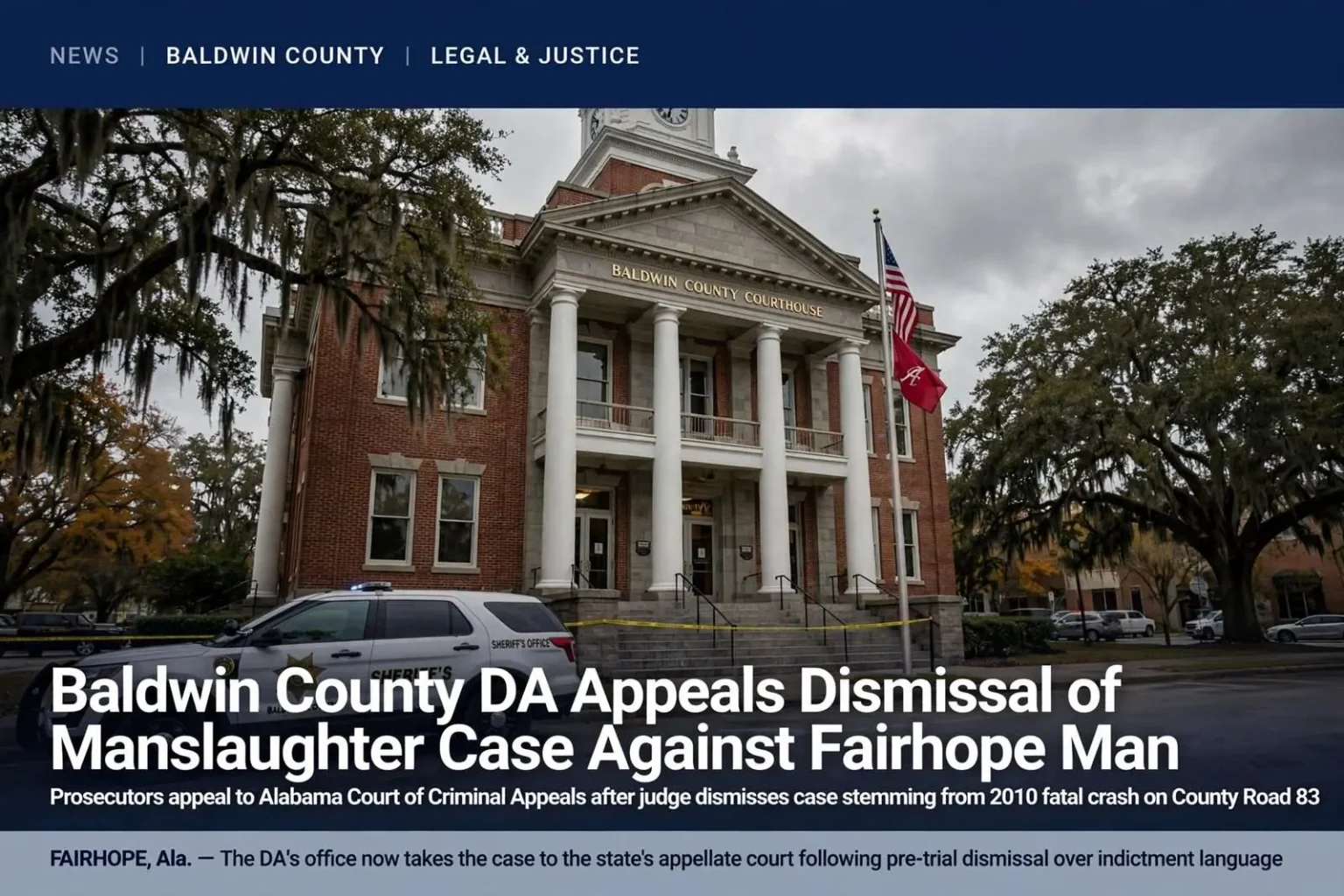
Prosecutors in Baldwin County are pushing back after a circuit judge threw out a manslaughter case against a Fairhope man just before his trial was set to begin, taking the fight to the state’s appellate court. Baldwin County Circuit Judge Langford Floyd dismissed the indictment against 27-year-old Kevin Davis earlier this month, ruling on a technical question about how the charge itself was written.
The Legal Question Behind the Dismissal
According to court filings, the central issue was whether the indictment’s language clearly enough spelled out the accusation against Davis so that he could adequately prepare a defense. The Baldwin County District Attorney’s Office has now filed an appeal with the Alabama Court of Criminal Appeals, asking the higher court to reinstate the case and allow it to proceed to trial.
The rule at stake is a foundation of Alabama criminal procedure: an indictment must give a defendant fair notice of the charge against him, with enough specificity about the alleged act that he can prepare a defense and, if convicted, rely on the same charge in any later proceeding. Defense attorneys press this requirement hard, and judges who find an indictment defective have little choice but to dismiss it, however strong the underlying evidence may be. The dismissal says nothing about Davis’s guilt or innocence; it says the paperwork, in Judge Floyd’s view, did not meet the standard.
The timing sharpened the stakes. With the trial set to begin, the dismissal erased years of preparation on both sides just as the case was about to reach a jury, forcing the District Attorney’s Office to decide between accepting the loss and taking the fight to the appellate court. Prosecutors chose the appeal, a route that keeps the case alive but adds months of uncertainty for everyone involved.
The Crash That Started the Case
The charge stems from a crash that happened back in March 2010 on County Road 83 near the Rosinton community. Davis was accused of driving a Chrysler Sebring while speeding and under the influence of alcohol when the vehicle left the roadway, according to accident investigators. The Alabama Highway Patrol reported that the car drifted onto the shoulder, struck a ditch, became airborne and ultimately collided with a utility pole.
A passenger in the vehicle, 23-year-old Randall McKenzie of Foley, was killed in the crash. Davis was indicted on a manslaughter charge in connection with McKenzie’s death, and the case had been working its way through the Baldwin County court system for several years before reaching the trial stage this fall.
The crash’s mechanics — a car leaving a two-lane rural road, hitting a ditch and going airborne into a fixed object — fit a pattern that highway safety investigators see repeatedly in Alabama’s rural counties. County Road 83 runs through the Rosinton area east of Robertsdale, a stretch of rural roadway where speed and impairment investigations of this kind depend on the Highway Patrol’s reconstruction work: measuring the vehicle’s path, the ditch strike and the final collision to establish what the driver was doing in the moments before impact.
The DA’s Response
District Attorney Hallie Dixon said her office intends to use every available legal option to keep the case alive, framing the appeal as a matter of accountability for the defendant’s alleged actions and closure for McKenzie’s family. In a public statement, Dixon said her staff remains committed to continuing the fight on behalf of the family as the case moves through the appellate process.
For a district attorney, a pre-trial dismissal on indictment grounds presents both a legal and a political test. The family of the victim has waited years for a trial, and watching the case end on a technicality before a jury ever hears it is among the hardest outcomes to explain. Dixon’s statement put the office’s position plainly: the appeal is for McKenzie’s family as much as for the case record, and the office will pursue every option the law allows.
Appealing to the Alabama Court of Criminal Appeals keeps the prosecution’s theory of the case in play. If the appellate court agrees that the indictment, read as a whole, gave fair notice of the charge, it can reinstate the case and send it back to Baldwin County for trial. If it finds the indictment fatally vague, prosecutors would need to seek a new indictment with corrected language — a path that restarts the clock but does not necessarily end the prosecution.
How the Appellate Process Works
The Alabama Court of Criminal Appeals, seated in Montgomery, hears appeals in criminal cases from the state’s circuit courts, with a panel of judges reviewing the trial court’s legal rulings. Appeals of pre-trial dismissals move on the written record: the indictment, the motions, the hearing transcript and the judge’s ruling. Neither side presents witnesses; the question is purely legal — whether Floyd correctly interpreted the requirements for a valid manslaughter indictment.
The court’s decision matters beyond this case. Indictment-language challenges recur across Alabama’s courts, and an appellate ruling clarifying how specifically a manslaughter indictment must describe the alleged impairment and driving conduct would guide prosecutors drafting charges and defense attorneys testing them. Both sides in Baldwin County are, in effect, litigating a precedent as much as a prosecution.
Timelines in the appellate system run in months. Briefing schedules, potential oral argument and the panel’s deliberation mean the case’s future will not be resolved quickly, and the possibility of further review — by the Alabama Supreme Court if the parties seek it — extends the horizon further. For the families on both sides, the appeal reopens a wait they had expected to end in a courtroom this fall.
Manslaughter Law in Alabama
The manslaughter charge at the heart of the case carries its own legal architecture. Under Alabama law, manslaughter covers homicides committed recklessly or under circumstances short of intent to kill — and it is the charge most commonly brought against impaired drivers who cause deaths on the state’s roads. Prosecutors must connect the driver’s conduct, the impairment and the death in a way the law recognizes as reckless disregard for human life, a burden that rests on the accident reconstruction, the toxicology evidence and witness accounts.
A conviction for manslaughter in Alabama carries a potential sentence of up to 20 years in prison, which is why the stakes in the Davis case extend far beyond the paperwork question. The charge is serious enough that the state’s courts demand precision in how it is charged, and serious enough that the District Attorney’s Office judged an appeal worth years of additional litigation.
Cases Dismissed on Indictment Grounds
Cases dismissed on indictment-language grounds can sometimes be revived on appeal or recharged through a new indictment, which is why dismissals of this kind rarely end a prosecution permanently. The appellate route Davis’s case has taken preserves the existing indictment if the higher court disagrees with the trial judge; the reindictment route would start fresh with corrected language if it does not. Prosecutors weigh both against the strength of the evidence, which in this case — years old by the time of trial — adds its own pressures.
Defense attorneys, for their part, treat indictment challenges as a fundamental protection. A defendant facing a vague charge cannot prepare a defense, cannot evaluate a plea and cannot know what the state must prove. Courts that dismiss defective indictments are enforcing that protection, even when the underlying evidence is strong and the family of a victim is watching.
A Case Years in the Making
From the March 2010 crash on County Road 83 to the fall trial date, the case against Davis had already stretched across years of pre-trial litigation — the pace familiar to anyone who follows felony prosecutions in Alabama’s courts, where accident investigations, toxicology records and motion practice accumulate slowly. McKenzie’s family has followed that timeline from Foley, waiting for the trial that was scheduled to begin before Judge Floyd’s dismissal intervened.
The appeal now moves the question from Baldwin County’s courthouse to Montgomery, where the Court of Criminal Appeals will decide whether the manslaughter indictment survives. Dixon’s office has committed to the fight; Davis’s defense will answer on the appellate briefs. Whenever the appellate court rules, the case will return to where it started — a rural stretch of County Road 83, a utility pole, a 23-year-old from Foley who never came home, and the legal system’s long effort to say what happened and what the law requires for it.
Until then, the case stands as a reminder of how Alabama’s criminal process works at its most technical: a trial that never began, an indictment judged insufficient, a district attorney determined to continue, and an appellate court holding the future of a manslaughter prosecution in its written record.