Baldwin County Schools Move to Trademark ‘Digital Renaissance’ as Support Fades
Baldwin County schools are close to trademarking the 'Digital Renaissance' name even as district leaders quietly step back from the branded laptop program.
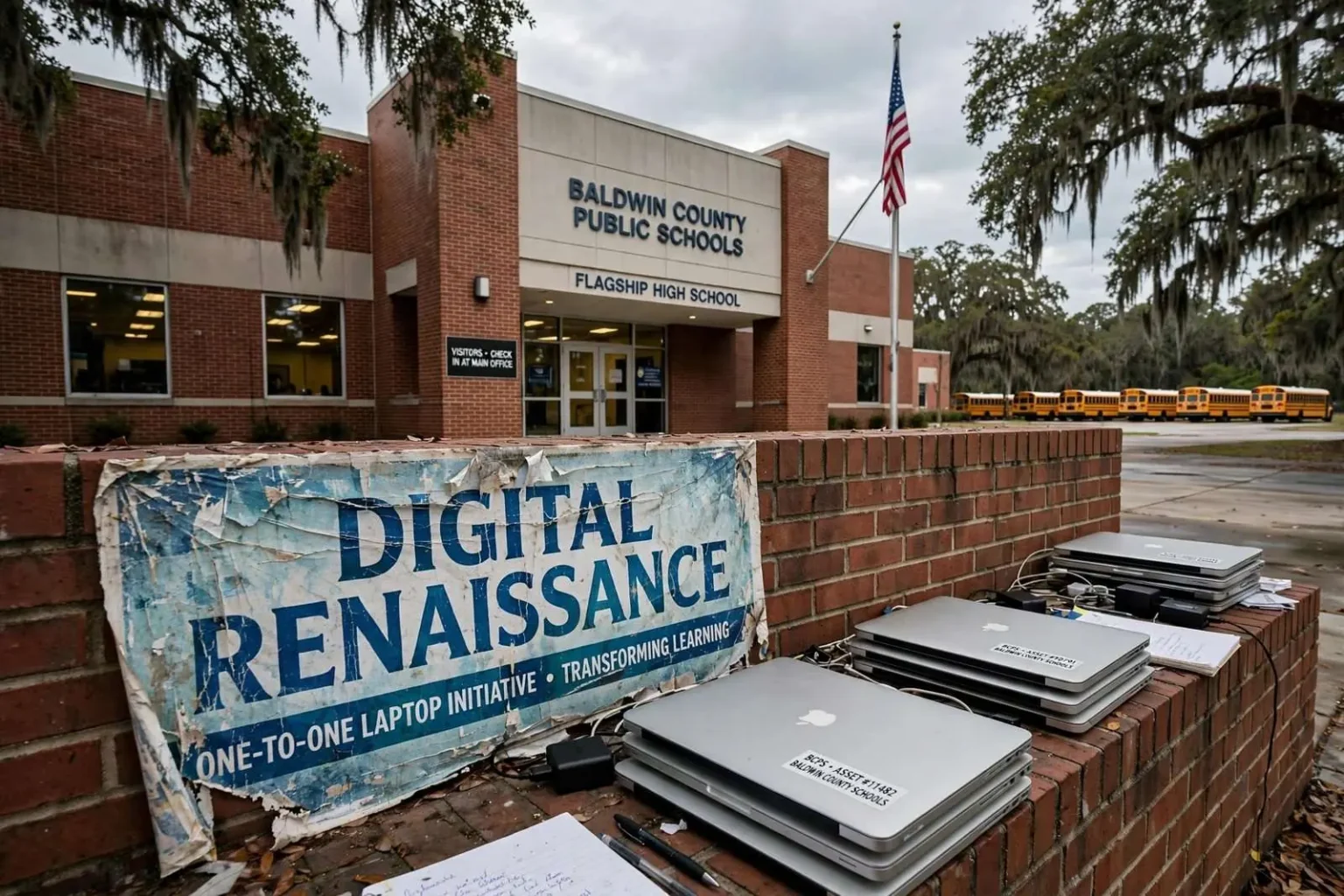
Baldwin County Public Schools is on the verge of locking down a legal trademark for the phrase that once defined the district’s signature technology push, even as the branding itself appears to be falling out of favor with current school leadership. The one-to-one laptop initiative, which put MacBook Air computers in the hands of students across the district, was launched under the banner of what administrators dubbed a technology-driven overhaul of instruction.
The “Digital Renaissance” label arrived with considerable fanfare when it was introduced, casting the district as a pioneer in Alabama’s effort to move classroom instruction into the digital age. At the time, few school systems in the state had attempted anything on the same scale: every student and teacher at the flagship high school received a laptop, with the stated goal of transforming lessons from lecture-and-textbook routines into interactive, media-rich instruction. The idea drew attention from educators across the region and made Baldwin County a frequent stop for administrators from other districts curious about how a large, mostly rural-suburban system could fund and manage such a program.
District records show the effort to formally trademark that branding began more than a year ago, and the legal process is now expected to wrap up within roughly two months. The timing is notable because the push to protect the name came from previous district leadership, which has since departed. The former superintendent who championed the laptop rollout resigned last month, with an interim superintendent now steering the district.
Federal trademark registration is a slow, procedural business even under the best of circumstances. Applications filed with the United States Patent and Trademark Office typically spend months in examination, during which an examining attorney reviews the mark for conflicts with existing registrations and for distinctiveness. Rejections are common, responses and amendments take additional time, and a mark can spend well over a year in the pipeline before it is either published for opposition or finally abandoned. That timeline explains how a trademark case begun under one superintendent can arrive at its conclusion under another who had no role in starting it.
The initial filing did not sail through. The trademark application itself hit early resistance from federal officials, who initially rejected the filing over concerns it could be confused with an existing trademark held by an out-of-state education software company. Such determinations are among the most frequent hurdles in the registration process, and applicants generally respond by narrowing the classes of goods and services covered, arguing that the markets are distinct, or amending the description of the mark. The district’s application evidently survived that challenge, since the process is now described as nearing completion.
Current school board members have signaled they see less value in preserving the branded name going forward. One board member said the district’s focus should stay on classroom instruction rather than promotional labels, adding that schools are not in the business of pushing marketing campaigns. The board president acknowledged that the decision to move away from the name reflects how far the program has come since it started three years ago at the county’s flagship high school before expanding system-wide.
That evolution is a familiar arc for large technology initiatives in public education. What begins as a branded, high-visibility pilot often settles into routine infrastructure once the novelty fades. Laptops that once required special announcements and training events become ordinary tools issued at the start of each school year, and the slogan that launched the program can start to feel like a relic of an earlier phase. Several board members appear to view the name that way — as a chapter marker rather than a living identity — even as lawyers finish the work of making the district its legal owner.
There is practical logic in completing the registration anyway. Holding the federal mark gives the district exclusive legal rights to the phrase within education, preventing outside vendors, consultants or other systems from marketing services under a name Baldwin County created. Even if the branding is retired from daily use, the registration protects the district against confusion and preserves its options should leadership ever want to revive the identity for a new phase of the technology program. Trademarks can be maintained for years with modest renewal filings, so the cost of ownership after registration is minimal compared with the expense of the legal process already underway.
Baldwin County schools serve roughly 30,000 students and employ around 3,100 people, and the laptop program itself costs the district an estimated $15 million annually to keep computers in the hands of students and teachers. School officials say that ongoing cost, not the branding fight, is where the harder financial decisions lie ahead.
That $15 million annual obligation is significant for a district of Baldwin County’s size, and it recurs every year regardless of economic conditions. The expense covers far more than the devices themselves: laptop programs carry costs for software licensing, wireless network upgrades, device repair and replacement cycles, insurance against loss and damage, and the technical staff needed to keep thousands of machines running across a county that stretches from the Mobile city limits to the Florida line. School systems that adopt one-to-one computing frequently discover that the initial purchase is the smallest part of the long-term commitment, and Baldwin County’s experience fits that pattern.
Leadership Change and the Road Ahead
The departure of the program’s champion adds a layer of uncertainty to those budget conversations. Superintendents leave signatures on districts, and large multi-year commitments like a one-to-one laptop program are among the most visible. An interim superintendent tasked with steadying the system must weigh the program’s demonstrated instructional value against an annual cost that competes with teacher salaries, transportation and facility needs. Board members’ comments suggest the technology itself retains support even as the branding is set aside — a distinction between what the program does and what it is called.
The transition also illustrates how quickly institutional priorities can shift in public education. Less than two years ago, the district was preparing to defend its signature phrase before federal trademark examiners; today, its elected board describes marketing labels as a distraction from teaching. Neither position is unusual. Districts that pioneer visible programs attract scrutiny and praise in equal measure, and the politics of a school board — five to seven members elected from distinct districts — ensures that enthusiasm for any single initiative will vary over time.
What the Program Meant for Baldwin County
Whatever happens to the name, the underlying change to classrooms in Baldwin County is durable. Thousands of students across the county’s communities — from Bay Minette and Fairhope to Foley, Gulf Shores and Daphne — now learn in environments where digital resources, online coursework and device-based assignments are routine. Teachers hired by the district in recent years have never worked in the pre-laptop environment that older staff remember. In that sense, the Digital Renaissance accomplished what its architects intended, even if the phrase itself may soon disappear from letterheads and gymnasium banners.
For other Alabama systems watching from the outside, Baldwin County’s experience offers a case study in both ambition and follow-through. The district demonstrated that a large county system could finance and sustain universal student computing, and it also demonstrated the political reality that such programs must survive leadership turnover, tight budgets and the inevitable question of whether the spending could be better used elsewhere. The trademark expected to be finalized in the coming months will memorialize the name; the $15 million-a-year decision about the machines themselves will matter far more to the 30,000 students who carry them.
The Trademark Fight Behind the Scenes
The earlier federal rejection over the out-of-state software company’s mark offers a glimpse into how crowded the education-technology branding field has become. As districts and companies nationwide rushed to name their digital learning initiatives over the past decade, the trademark office saw a wave of similar applications built around technology, learning and renaissance imagery. Overlapping names are inevitable in that environment, and examiners routinely force applicants to distinguish themselves from prior registrations in the same classification. For Baldwin County, working through that objection added months to a process that had already outlasted the administration that began it.
Observers of school governance note that trademark disputes of this kind are rarely about money in the near term. The district did not launch the registration to license the phrase for revenue; it filed to protect a name tied to a program it had spent millions building. The irony now is that the legal protection is arriving precisely as the district’s elected leadership concludes the name is no longer worth promoting. Still, letting the application lapse this close to completion would surrender work already paid for, and interim leadership has given no indication it intends to withdraw the filing.
The program’s origins at the county’s flagship high school remain a point of local pride even among skeptics of the branding. When the rollout began three years ago, it was one of the most aggressive device deployments in Alabama, and the expansion system-wide required planning on a scale few districts attempt: devices for every school, teacher training across dozens of campuses, and infrastructure upgrades in buildings that had never been wired for that density of wireless traffic. The fact that the program now operates as ordinary infrastructure is, in the view of many educators, the truest measure of its success.
In the coming weeks, the district will complete the trademark process with little fanfare, and the name it secures may quietly fade from official use. The interim superintendent’s task is to keep the laptops functioning, the budgets balanced and the classrooms staffed — the unglamorous work that follows any renaissance. Board members have made clear their standard going forward: instruction first, labels last. For the families of the roughly 30,000 students the district serves, that focus matters more than any phrase, registered or otherwise, ever printed on a brochure.