Baldwin County Commission Approves $124.87 Million Budget
Baldwin County commissioners approved a $124.87 million budget with a small pay raise for county workers amid ongoing debate over road repair funding.
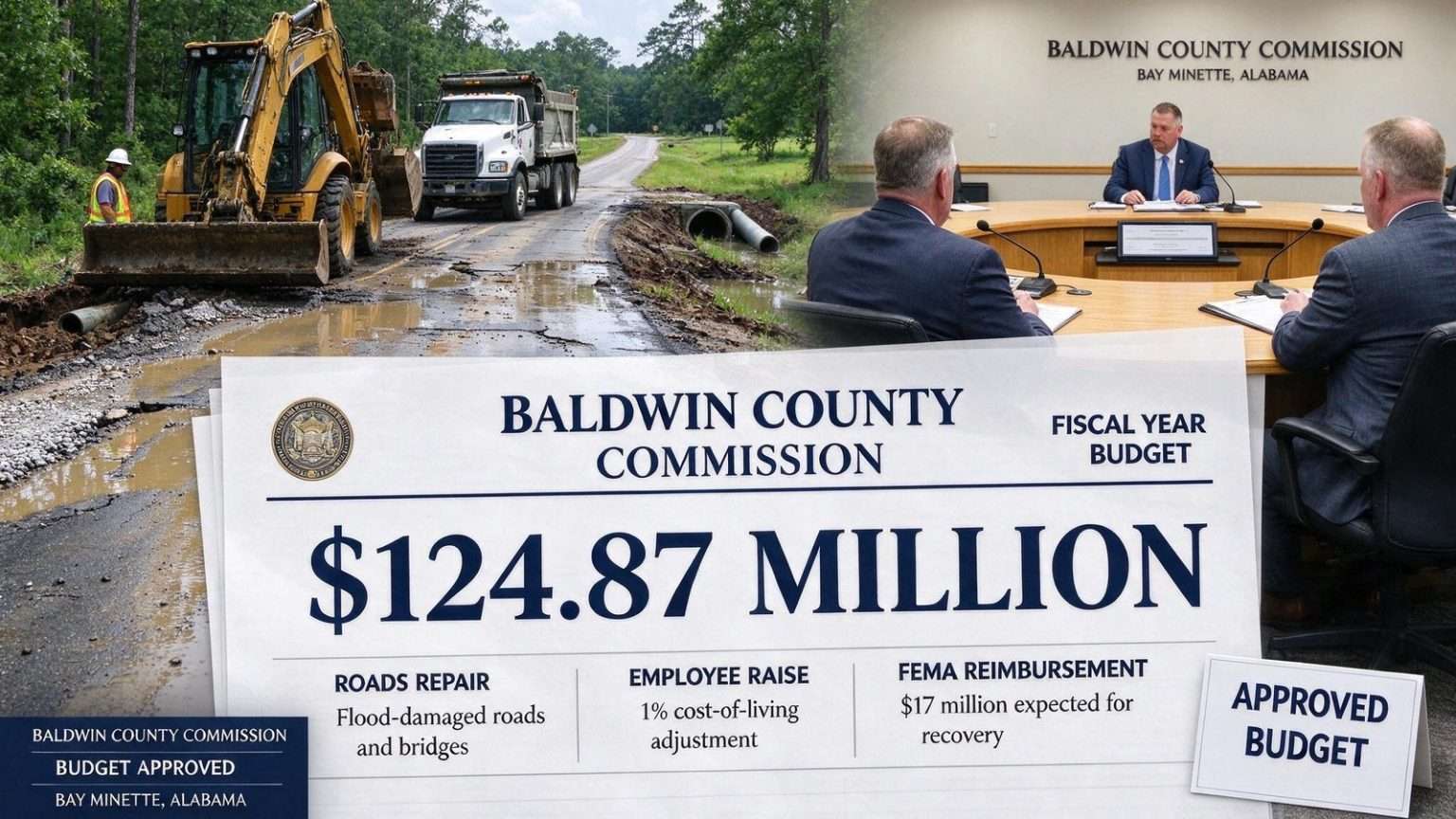
Baldwin County commissioners closed out a lengthy budget season this month by giving final approval to a $124.87 million spending plan for the coming fiscal year, capping weeks of debate over how to pay for road repairs still lingering from spring flooding.
The vote in Bay Minette split the five-member commission slightly, with three members voting in favor while one commissioner was absent recovering from minor surgery. The makeup of the vote mattered: with a member away, the adopted plan carried the backing of a clear majority of those present, but the split underscored how much disagreement remained over the budget’s most contested piece — what to do about roads the final document left unfunded.
A raise for county workers
Supporters of the plan pointed to a modest cost-of-living increase built into the budget for county workers, including sworn and non-sworn staff at the sheriff’s office, as a sign the county is trying to hold onto employees during a tight budget year. The raise, worth about 1 percent, is expected to cost the county roughly $145,000 once it takes effect next spring.
Commissioners who backed the increase said it recognized the extra strain county staff have been under, even as revenue projections remained tight heading into the new fiscal year. The sheriff’s office in particular has felt the pressure of Baldwin County’s growth, with deputies patrolling a county that has expanded in population faster than almost any other in Alabama. Departments across the county have watched employees leave for higher-paying positions in neighboring Mobile County and along the coast, making retention a recurring theme in budget discussions.
Local government pay raises of this size rarely settle the retention question on their own, but budget officials treat them as a signal. A 1 percent cost-of-living adjustment across the workforce preserves the county’s position relative to inflation without forcing cuts elsewhere, and it applies uniformly to sworn deputies and civilian staff alike — a distinction that matters, since both groups have faced the same rising cost of living along the Eastern Shore.
The road funding fight
Much of the pre-vote debate centered on how to fund road, drainage and bridge work that was left out of the final budget document. One commissioner argued that millions of dollars earmarked as matching funds for federal grants should instead be pulled from the highway department’s emergency reserve, which holds around $4 million.
Other commissioners pushed back, arguing the emergency account needed to stay intact and that the matching money should instead come out of the county’s general operating fund. The disagreement was less about whether damaged roads should be repaired than about which pot of money should absorb the cost — a familiar standoff in county budgets, where every dollar committed to one purpose is a dollar unavailable for the next emergency.
Emergency reserves exist for precisely the kind of unpredictable events that strike a county of Baldwin’s size and geography: another flood, a hurricane landfall, a bridge failure. Commissioners who defended the reserve pointed out that draining it to cover repairs the federal government will eventually reimburse would leave the county exposed if a new disaster arrived before the money came back. The counterargument — that sitting on reserves while residents drive on damaged roads is its own risk — gave the debate its edge.
Commission budgets are annual documents, but their consequences last longer. Baldwin County maintains hundreds of miles of roads and dozens of bridges spread across one of Alabama’s largest counties by area, and the pace of resurfacing and drainage work depends directly on how much money the commission commits each year. A single budget season that skips those projects pushes maintenance schedules back, and deferred maintenance compounds: a road that needs resealing this year may need full reconstruction two years from now.
The flood that shaped the budget
That disagreement traces back to flooding that hit Baldwin County earlier in the year, damaging roads and bridges across the county and triggering a federal disaster response. The county is in line to receive roughly $17 million in FEMA reimbursement money to help cover repair costs, but commissioners noted that reimbursement often lags well behind the actual repair work, forcing the county to front costs out of its own coffers in the meantime.
The gap between spending and reimbursement is one of the most persistent frictions in disaster recovery. Federal public assistance programs repay counties for eligible debris removal, emergency protective measures and permanent repair work, but the repayment follows a cycle of project applications, inspections, documentation and review that can stretch many months beyond the day the construction crews leave. In the interim, the county must finance the work — paying contractors, meeting payroll for road crews and covering materials — while its reserves stand in until federal dollars arrive.
For a county of Baldwin’s size, that timing gap is manageable but not painless. Roughly $17 million in expected reimbursements represents a substantial share of the $124.87 million budget, and the commission must plan around money it is owed but has not yet received. Auditors and finance staff track those receivables carefully, and each reimbursement cycle that completes frees capacity for the next round of repairs.
The spring flooding itself was a reminder of the county’s exposure. Low-lying terrain, frequent heavy rains and a road network threaded with creeks and drainage channels make Baldwin particularly vulnerable when storms stall over the region. Flood events in recent years across south Alabama have repeatedly damaged culverts and shoulder sections that are expensive to replace and rarely make headlines until a school bus route or an emergency response is affected.
Repairs delayed, not abandoned
Leaving specific resurfacing and drainage projects out of the adopted budget does not mean those repairs are shelved, according to commission leadership. Officials said additional road projects are expected to be approved throughout the year as FEMA reimbursements come in, allowing the county to keep pace with repair needs without waiting for the full budget cycle to catch up.
That rolling approach has become standard practice in disaster-affected counties. Rather than amending the annual budget each time a reimbursement check arrives, commissions can approve projects as funding materializes, treating the federal money as a separate stream that runs alongside the ordinary budget year. The method keeps the adopted plan honest — it contains only money the county actually has — while allowing repair work to continue on its own schedule.
Commissioners emphasized that maintaining road quality across Baldwin County remains a shared priority, even if members differed on the mechanics of financing it. Whatever the disagreements of budget season, the pressure to keep up with infrastructure is constant in a county adding residents, subdivisions and traffic by the year. Growth brings its own demands: new roads must eventually be resurfaced, drainage systems sized for older neighborhoods strain under newer development, and the county’s public works department has had to expand its ambitions to keep pace.
A bigger challenge behind one budget
The debate reflected a broader challenge many fast-growing Gulf Coast counties face: balancing near-term budget discipline against the reality that storm recovery and infrastructure repair often outpace the standard annual budgeting process. Counties along the coast budget in a climate where a single storm season can reorder priorities overnight, and where federal relief money — welcome as it is — arrives on a timeline no county controls.
Baldwin’s experience illustrates the squeeze. The county’s tax base has grown with its population, but revenues that rise steadily are no match for costs that arrive suddenly: a flood season that damages dozens of road segments at once, a hurricane that consumes an emergency reserve in weeks, or the compounding effect of putting off maintenance year after year. Budget officers describe the problem as managing two calendars at once — the fiscal year on paper and the much longer calendar of physical infrastructure.
The commission’s decision to protect its reserves while awaiting federal reimbursements will likely be judged by what happens next. If the roughly $17 million arrives on schedule and repair projects proceed, the county will have navigated the year without weakening either its roads or its safety net. If reimbursement stalls, the pressure to revisit the budget’s choices will return, and the roads-versus-reserves debate will resume with sharper urgency.
What residents should watch
With the budget now adopted, county department heads will begin operating under the new fiscal year plan, and residents can expect additional road and infrastructure announcements in the coming months as reimbursement funds continue to flow in from federal disaster relief programs.
For residents of south Baldwin — from Foley to Fairhope, Gulf Shores to Spanish Fort — the practical stakes show up first on daily routes: which roads get resurfaced, which drainage ditches get cleared before the next heavy rain, and how quickly washed-out shoulders near their neighborhoods make the repair list. County road crews prioritize based on damage assessments completed after the flooding, with the most heavily used and most severely damaged segments generally first in line for federal reimbursement money.
The $124.87 million plan that emerged from Bay Minette sets the county’s course for the year ahead, but the loudest argument of budget season — over emergency reserves, matching funds and the pace of road repair — remains unresolved in the sense that matters most. It will be settled gradually, project by project, as federal money arrives and commissioners decide what to do with it.