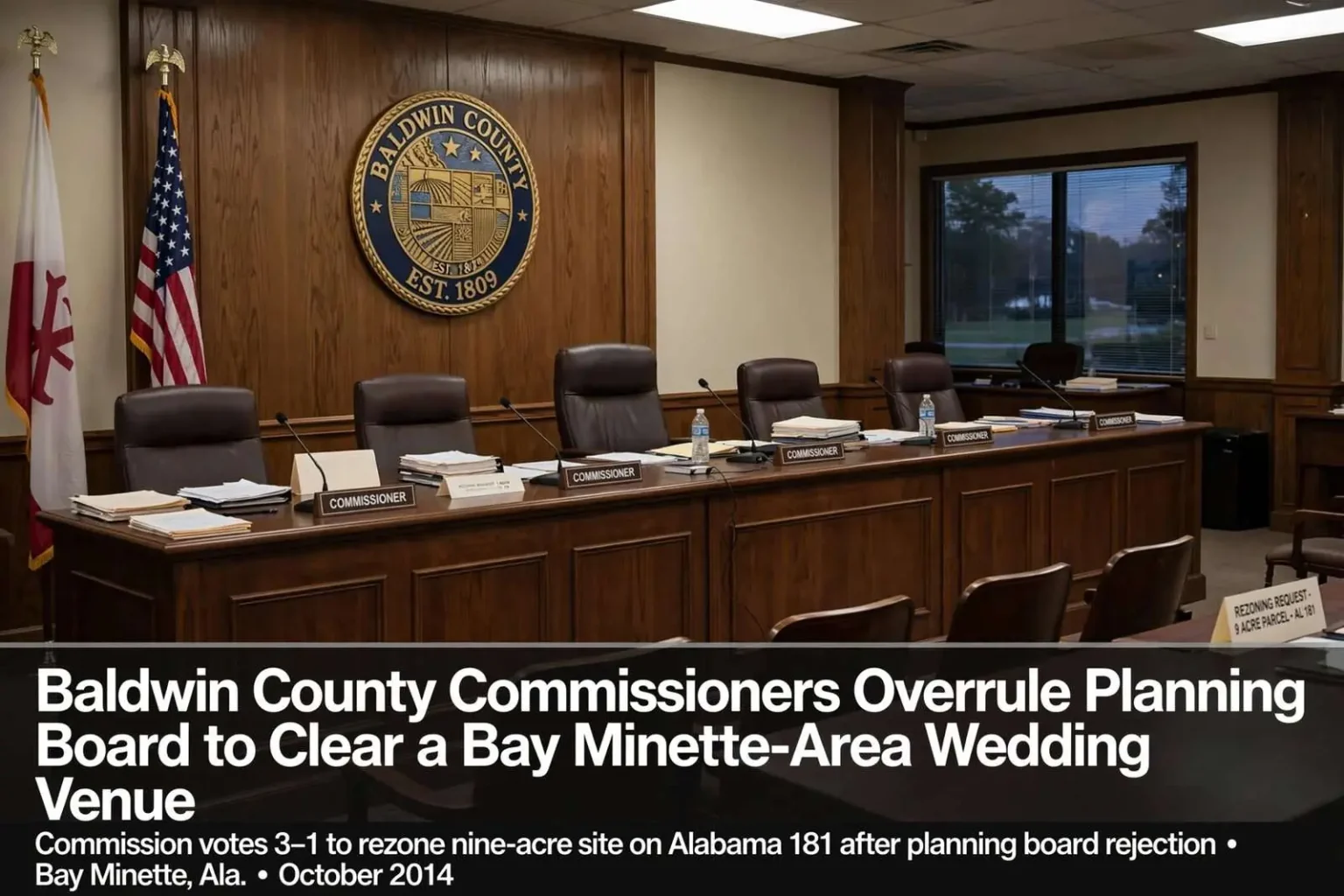
When the Baldwin County Commission convened in Bay Minette on a Tuesday in October 2014, the item before it was small in acreage but large in ambition: nine acres of quiet ground on the west side of Alabama 181, just north of Baldwin County 64, that one resident hoped to turn into a wedding rental facility.
By the end of the meeting, the commissioners had done something county boards rarely do. They reversed a decision handed down by their own planning authority and cleared the path for the project to move forward.
A reversal in Bay Minette
The commission voted 3 to 1 to rezone the property from a residential designation to general business, the classification the venue needed before construction could begin. The vote overturned the recommendation of the Baldwin County Planning and Zoning Commission, which the previous month had rejected the same request on a 4-to-2 count.
For Danny Bebe, the man behind the proposal, the outcome removed the last major obstacle standing between an idea and a building. This project has been a dream of mine for quite some time now, he told the commission, framing the rezoning as far more than a line on a zoning map.
The drainage question
The story of the venue was, in many ways, a story about water. When the planning board met in September, neighbors had turned out to voice concerns, and the loudest of them centered on drainage, and where stormwater would go once a commercial building and its parking replaced open residential land.
Planning Director Vince Jackson said those worries had shaped the board’s earlier denial. But by the time the request reached the commission, the tenor of the room had changed and no residents rose to object.
Jackson told the commissioners the county intended to keep a close watch on the issue. There will be a thorough and timely look at the drainage issues, he said, adding that officials did not believe drainage should be a problem for the project.
What the vote meant for Baldwin County
The approval reflected a pattern that was becoming familiar across Baldwin County in the mid-2010s, as one of Alabama’s fastest-growing regions wrestled with how to fit new commercial uses into landscapes that had long been rural or residential. The corridor along Alabama 181 was a frequent flashpoint, prized for its accessibility and its open acreage.
A wedding venue occupied a middle ground in those debates. It promised:
- A new small business and the vendors and jobs that tend to cluster around event spaces
- A destination that could draw couples and their guests from across the Eastern Shore and beyond
- A relatively low-intensity commercial use compared with heavier retail or industrial development
Against those benefits, neighbors weighed the familiar costs of growth: traffic on rural roads, evening events near homes, and the ever-present question of what happens to the water.
A dream cleared for construction
With the rezoning secured, Bebe could begin the work of turning nine acres into a place where families would one day gather to mark the biggest days of their lives. The commission’s 3-to-1 vote did not build the facility; it simply gave permission for the building to start.
But for a project its owner described as a long-held dream, permission was the milestone that mattered. In a county still learning to balance its rural past against its rapidly commercial future, the Bay Minette-area venue became one more example of how those competing visions were settled, one parcel and one Tuesday vote at a time.
Baldwin County sits directly east of Mobile County across Mobile Bay and is the largest county in Alabama by land area. It encompasses the Eastern Shore communities of Daphne, Fairhope, Spanish Fort, and Foley and stretches south to the beaches of Gulf Shores and Orange Beach along the Gulf of Mexico.
Long among the fastest-growing counties in the state, Baldwin blends suburban development near the bay with tourism-driven coastal economies. Its proximity to Mobile and its position on the Eastern Shore make it a recurring subject of regional news covering growth, infrastructure, schools, and the balance between development and coastal preservation.
Alabama is a state in the southeastern United States bordered by Tennessee, Georgia, Florida, the Gulf of Mexico, and Mississippi. Often called the Heart of Dixie, it spans Appalachian foothills in the north and flat coastal plains in the south. Its largest cities include Birmingham, Montgomery, Huntsville, and Mobile.
Alabama’s history encompasses Indigenous roots, Spanish and French colonial settlement, a cotton-plantation economy, the Civil War and Reconstruction, and the Civil Rights Movement of the 1950s and 1960s, followed by a shift toward manufacturing, aerospace, and technology. Local news across the state frequently reflects this mix of tradition and change.
Local government in the Mobile area operates through a combination of mayor-council or commission structures at the municipal level and a county commission in Mobile County, with elected officials handling budgets, public safety, infrastructure, and zoning. Baldwin County has its own commission and a collection of incorporated municipalities.
Decisions made in council chambers and commission meetings affect roads, school funding, economic development, and quality of life, which is why coverage of local government is a staple of regional journalism. The interplay between city, county, and state authorities often determines how effectively the area can address shared challenges.
Because many services residents rely on are delivered at the local level, the choices of elected officials have direct, everyday consequences. Budget priorities, in particular, reveal a community’s values and shape the trajectory of growth and public welfare for years to come.
The natural environment is central to life on the Gulf Coast, where barrier islands, bays, rivers, and wetlands support fisheries, recreation, and storm protection. Coastal Alabama faces challenges common to low-lying regions, including hurricane exposure, erosion, and the management of fragile ecosystems.
The Mobile-Tensaw Delta, one of the largest river deltas in the country, is a particularly significant natural asset. Conservation efforts, fisheries regulation, and shoreline restoration are frequent points of collaboration among state agencies, federal bodies like the Army Corps of Engineers, and environmental groups.
How the region plans for growth while protecting its natural assets is a recurring theme in local reporting. The tension between development pressure and ecological stewardship plays out in zoning fights, infrastructure projects, and disaster-recovery decisions that shape the coast for generations.
The economy of the Mobile region is diversified across shipping and logistics, aerospace and shipbuilding, healthcare, tourism, and manufacturing. The Port of Mobile is one of the nation’s busiest seaports and a cornerstone of the local and state economy.
Major employers in aviation and defense contribute to a skilled workforce, while economic-development organizations aim to attract investment and jobs through incentives and infrastructure improvements. Small businesses, from restaurants to professional services, form the backbone of neighborhood commerce.
The health of the regional economy is a frequent subject of public discussion and reporting. Workforce development, recruitment of industry, and the fortunes of local retailers all feed into a broader picture of how the Gulf Coast competes and adapts in a changing national economy.
Mobile is the county seat of Mobile County in southwest Alabama and the state’s only saltwater port. Situated where the Mobile River meets Mobile Bay near the northern Gulf of Mexico, the city has long served as a commercial and cultural gateway between Alabama and the wider Gulf Coast. Founded in 1702 as Fort Louis de la Louisiane and ruled in turn by France, Britain, and Spain before joining the United States in 1813, Mobile carries a layered heritage distinct from the rest of the state.
Today Mobile anchors a metropolitan area spanning Mobile County and neighboring Baldwin County, and it remains a center for shipping, aerospace, healthcare, and higher education in the region. Its downtown and waterfront have seen sustained revitalization, while historic neighborhoods preserve architecture from its colonial and antebellum past. The city’s identity is shaped as much by its working port and industrial base as by its festivals and food culture, making it a frequent focal point for news about growth and change in southern Alabama.
Mobile Bay is a shallow estuary in southern Alabama where freshwater from the Mobile, Tensaw, and other rivers mixes with saltwater from the Gulf of Mexico. It is among the largest estuarine systems in the United States and supports commercial and recreational fishing, shipping through the Port of Mobile, and wetlands that buffer the coastline from storms.
The bay’s Eastern Shore, in Baldwin County, includes Daphne, Fairhope, and Spanish Fort, while the Western Shore lies in Mobile County. Its ecology and economy have guided settlement for centuries, and the bay figures in regional debates over development, navigation, and conservation. Events on either shore are routinely covered as part of the interconnected life of the Mobile metro area.
The Gulf of Mexico borders Alabama’s southern edge and defines much of the state’s coastal identity. Alabama’s Gulf coastline, centered on Dauphin Island, Gulf Shores, and Orange Beach, supports a tourism industry built around beaches, charter fishing, and marine recreation, while offshore waters host shipping lanes and energy interests.