Two Attorneys, One Bench: Thomason and Poynter Faced Off for a Baldwin County District Judgeship
Ahead of the November 2014 election, incumbent Michelle Thomason and independent challenger Ginger Poynter competed for Baldwin County's Place 1 District Court judgeship, a six-year seat.
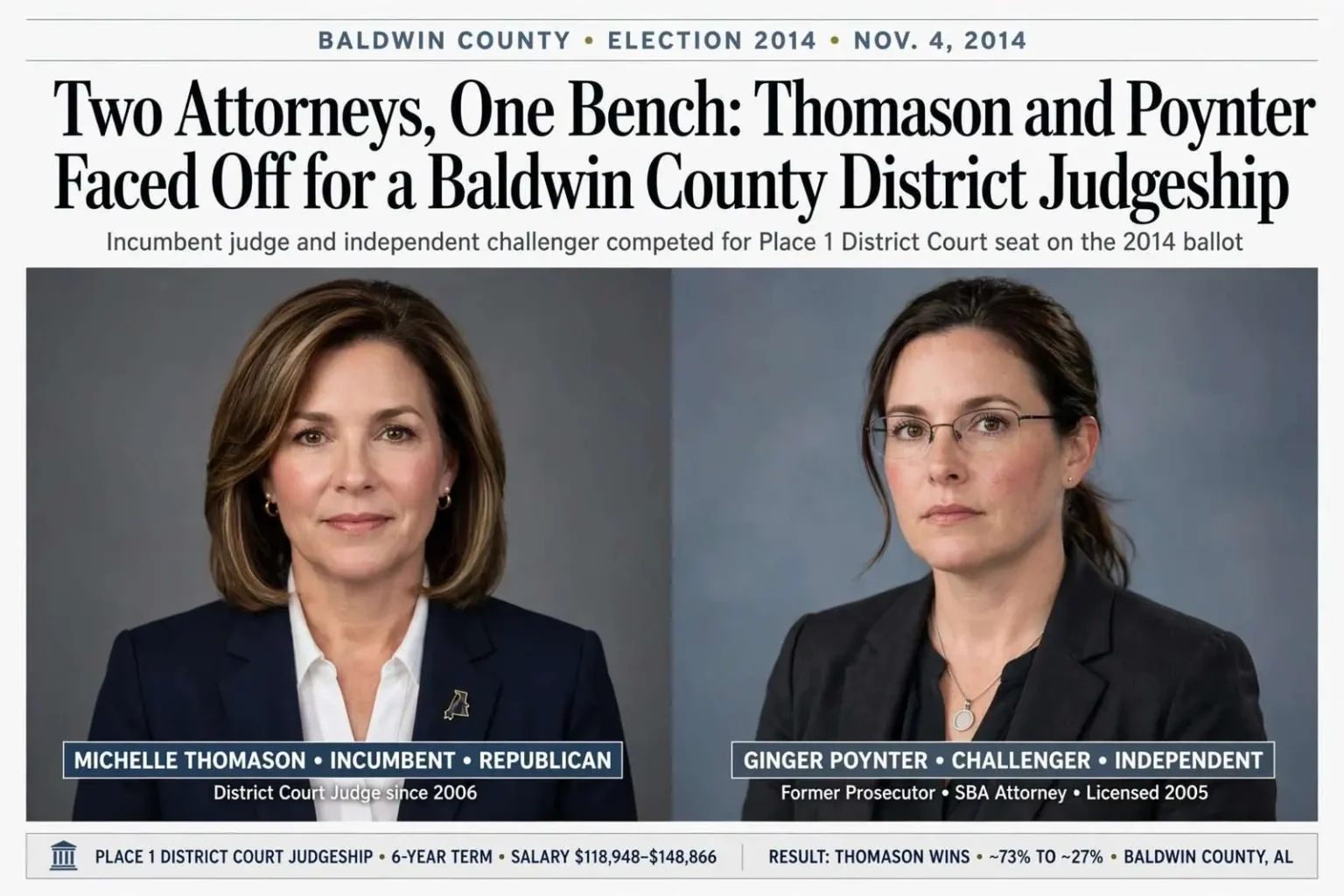
On the ballot Baldwin County voters would fill out on Nov. 4, 2014, one contest asked them to weigh two very different legal careers against each other. The race for the county’s Place 1 District Court judgeship pitted a sitting judge against a challenger who had built much of her experience far outside Alabama.
The incumbent
Michelle Thomason, a Republican, came to the election with the advantage of the bench already beneath her. She had served as a District Court judge since 2006, when Gov. Bob Riley appointed her, and she won the seat outright in the 2008 election.
Her resume traced a path rooted in the region. Thomason earned a bachelor of science in business from Mobile College in 1992 and a law degree from Tulane Law School in 1995. Before joining the bench she had been a partner at the firm of Pearson, Cummins and Hart.
The challenger
Ginger Poynter ran as an independent, a notable choice in a county where partisan labels often shape judicial contests. She had been licensed to practice law in Alabama since 2005, and her background carried an unusual chapter: a stint in Texas as a prosecutor assigned to domestic violence cases from 2003 to 2005.
Poynter had also served as a Small Business Administration attorney between 2004 and 2005. Her academic path led from a bachelor of arts in history at Elizabeth City State University in 1997 to a law degree from Regent University School of Law in 2003.
What the seat carried
The office the two women sought was no minor post. The Place 1 District Court judgeship came with a six-year term and an annual salary set between $118,948 and $148,866.
In Alabama, district courts sit close to the daily lives of residents. Their dockets include:
- Misdemeanor criminal cases and preliminary hearings in felony matters
- Civil disputes below a set dollar threshold, including many small-claims cases
- Traffic offenses and other matters that bring ordinary citizens into contact with the courts
Alabama elects its judges in partisan races, and district judges, like circuit judges, serve six-year terms. District courts are the lower tier of the state’s trial courts; more serious criminal cases and larger civil lawsuits go to circuit court.
The result
Thomason won a new term easily on Nov. 4, taking about 73 percent of the vote to about 27 percent for Poynter.