Seventeen Attorneys Line Up for Mobile County District Court Vacancy
Seventeen Mobile attorneys applied to fill the Mobile County District Court seat being vacated by retiring Judge Mike McMaken, launching a selection process overseen by a five-member commission.
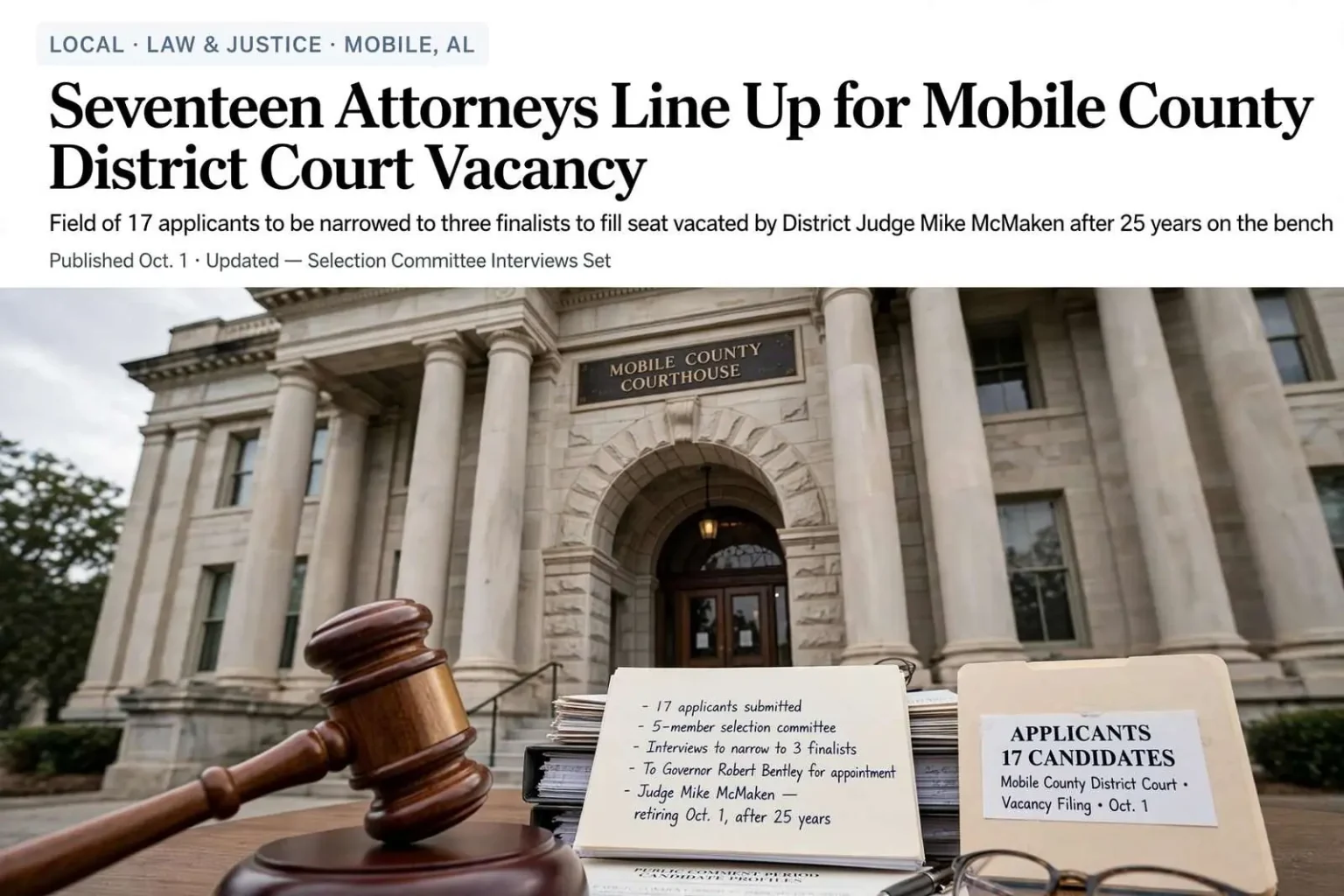
Seventeen Mobile attorneys applied for an impending vacancy on the Mobile County District Court bench, setting up a competitive selection process to replace veteran District Judge Mike McMaken, who would end a 25-year career on the district bench on Oct. 1.
A crowded field
The applicants seeking to succeed McMaken were Walter Honeycutt, Barney March, Jill Phillips, Jay York, Vaughn Drinkard, Ed Blount, Lars Granade, Randy Crane, Jean Powers, Matt Green, Kevin Boucher, Stuart Luckie, Brian Pugh, Joe Basenburg, Jene Owens, Teresa Heinz and Adam Bourne. The size of the field reflected both the prestige of a judgeship and the relative rarity of an opening on the local bench.
Seventeen names is an unusually deep bench even by the standards of a large county bar. Judicial vacancies in Mobile typically arrive only through retirement, death or elevation, and a quarter-century tenure like McMaken’s comes along once in a generation. The applicant list drew from every corner of local practice — prosecutors and defense lawyers, civil practitioners and government counsel — a reminder that district court touches nearly every kind of law a Mobile lawyer might handle.
For each applicant, the calculus differed, but the prize was the same: a seat that combines trial experience, administrative authority and community standing, with a docket that puts a judge at the center of the county’s daily legal life. District court is where most Mobilians encounter the justice system — as traffic defendants, small-claims plaintiffs, jurors or witnesses — and the judge who holds the seat becomes a familiar public figure in a way few legal jobs allow.
How the choice will be made
A five-member judicial selection committee was charged with interviewing the applicants and submitting the names of three finalists to Gov. Robert Bentley, who would then have 90 days to appoint one of the three. In the unlikely event that the governor failed to act, the authority to appoint would shift to the chief justice of the state Supreme Court.
The committee was headed by presiding Circuit Court Judge Charlie Graddick and included two representatives from the legal profession, attorneys Billy Bedsole and Danner Frazer, along with two representatives from the public at large, former state Rep. Chris Pringle and businessman Harris Morrissette. The mix of lawyers and lay members was designed to balance professional judgment with community perspective.
That structure reflects Alabama’s unusual judicial landscape. Most judges in the state reach the bench through partisan elections, but a mid-term vacancy leaves the seat without an occupant until the next election cycle — a gap the appointment process exists to fill. The committee-and-finalist system gives the governor a vetted short list rather than a raw field of seventeen, blending merit screening with executive choice.
The lay members’ role matters more than their number. Attorneys on a selection committee can probe doctrine and courtroom temperament; the public representatives ask the questions citizens would ask — how a candidate treats litigants, whether they can manage a relentless docket, and whether they bring patience and common sense to the bench. Between the four members and the presiding judge who chairs it, the committee was built to weigh both competence and character.
Graddick presses for speed Graddick made clear he intended to move quickly. “The District Court handles thousands of cases and we need it fully staffed,” he said. “There may be a period between Mike’s retirement date and the Governor’s appointment. I will appoint lawyers to fill in as special sitting District Court judges in the interim, at no additional cost.”
That interim plan addressed a practical concern. A busy district court cannot afford to leave a seat empty, and Graddick’s willingness to draft temporary judges signaled a determination to keep the docket moving while the formal process played out. Borrowing sitting lawyers for occasional dockets, at no added expense to the county, meant litigants would not pay for the transition in delays.
After the applicants were interviewed, Graddick said, the committee would allow a couple of weeks for public comment before deliberating and settling on the three finalists. The list would then be sent to the governor immediately. The public-comment window gave residents, bar members and anyone with direct knowledge of the applicants a chance to weigh in confidentially — a step that has become standard practice in local judicial screenings and one that committee members treat as seriously as the interviews themselves.
The seat and its history
District judges in Alabama serve six-year terms. McMaken, 65, first took office in January 1987 and was last re-elected in 2010. The post paid about $112,000 annually. His departure closed out a quarter-century of service that had made him the longest-serving judge in Mobile County.
A generation on the district bench spans an enormous change in the court’s work. When McMaken took office in 1987, the docket was dominated by traffic cases, misdemeanors and small claims; the decades since have added crowded drug dockets, domestic violence dockets and the preliminary hearings for felony arrests that funnel cases toward the circuit court. The judge who inherits the seat inherits all of it — a volume of work that makes temperament and stamina as important as legal brilliance.
Longevity like McMaken’s also carries institutional value. A judge who has served 25 years knows the prosecutors, defense bar, clerks and law enforcement officers by name, knows which docket management practices keep the courthouse moving and remembers how the court has handled every crisis from hurricanes to budget shortfalls. Replacing that institutional memory is the quiet challenge beneath the formal selection process — and part of why Graddick pressed for a swift, orderly transition.
The salary figure, about $112,000 a year, is set by state law rather than county budget, and the six-year term means whoever is appointed will stand for election to keep the seat when the term expires. That election cycle looms over every appointment: a governor’s choice must not only satisfy the committee’s finalists but face the voters within a few years, which pushes the selection toward candidates with both courtroom credentials and community roots.
What the applicants are facing
For the 17 applicants, the process ahead promised interviews, public scrutiny and a winnowing to three names, followed by a wait on the governor’s decision. The interview stage alone winnows quickly: seventeen candidates competing for three finalist slots means the committee must distinguish, in a matter of minutes per candidate, between lawyers who would be adequate judges and lawyers who would be exceptional ones.
Public comment adds a second filter. Members of the Mobile bar know their colleagues’ courtroom habits firsthand, and the confidential comment process invites them to share what transcripts do not show — how a candidate deals with pro se litigants, whether they are punctual with rulings, how they treat witnesses and staff. In a bar as interconnected as Mobile’s, that feedback arrives in volume.
For the court itself, the goal was continuity — filling the seat efficiently enough that the thousands of cases flowing through the district court each year would not stall. The interim judges plan holds the docket harmless during the appointment window, but every participant in the process understands that a district court seat is not a prize to be admired; it is a position the county needs filled and filled well.
As the committee prepared to begin its work, the coming weeks would determine which member of the local bar would inherit McMaken’s place on the bench. Seventeen lawyers applied; three names would go to Montgomery; one would take the oath, inherit a 25-year legacy of service, and begin building a record the next selection committee — whenever it convenes — will measure.
The stakes extend beyond one seat. Mobile County’s district judges collectively preside over one of the busiest limited-jurisdiction courts in Alabama, and each vacancy resets the court’s internal balance — which judges handle which dockets, how quickly cases cycle, how the court absorbs the next surge in filings. A poor appointment ripples through that system for years; a strong one often goes unnoticed precisely because the docket keeps flowing.
The process itself has become a point of local pride. Not every Alabama county screens its judicial applicants through a public comment window and a mixed citizen-lawyer committee before the governor ever sees a name. In jurisdictions without such a system, mid-term vacancies can be filled with little vetting at all, leaving the first real test of a new judge to the ballot. Mobile’s version gives the eventual appointee a public vetting before taking the bench — and gives the seventeen applicants their first experience of the scrutiny that judgeship, at whatever level, always brings.
Wherever the decision lands, the machinery now in motion — interviews, comment period, finalist list, governor’s 90-day clock — is designed to end the same way every judicial transition should: with a qualified judge on the bench and a docket that never knew the seat was empty.