A Bed for the Night: How Mobile and Baldwin Counties Sheltered Their Homeless
A 2013 count found 493 people homeless on any given night in Mobile and Baldwin counties. This is a look at the network of shelters and day centers that stood ready to take them in.
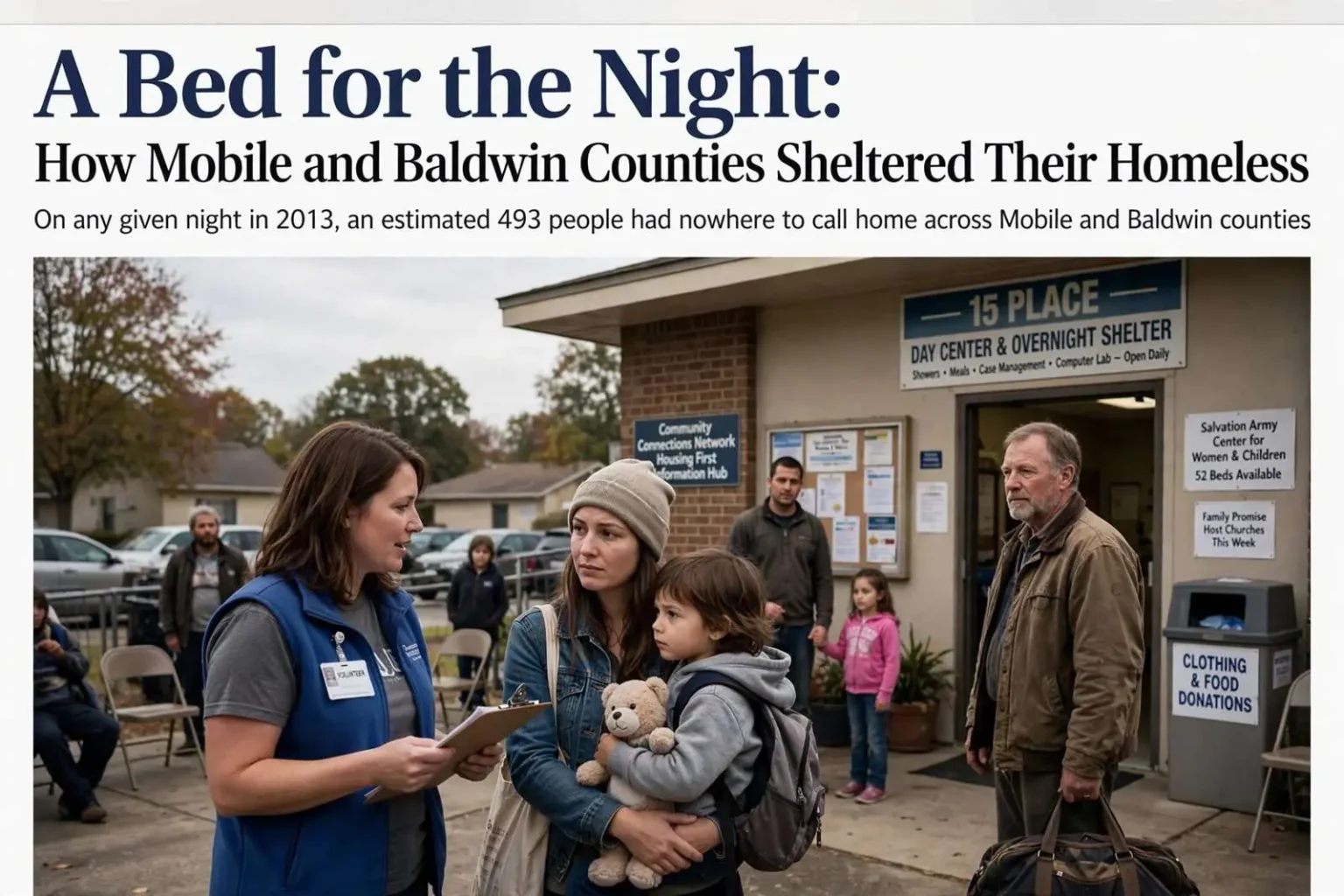
On any given night in 2013, an estimated 493 people had nowhere to call home across Mobile and Baldwin counties. The figure came from the homeless coalition Housing First, drawn from its annual Point in Time survey, and it formed the backdrop to a network of shelters that stood ready to take people in.
Rethinking the face of homelessness
For the advocates who ran that survey, the number carried a lesson about assumptions. The face of homelessness is not what we think about, said Krulewicz-Dees of the coalition. What we think about, she explained, is the person who does drugs and drinks and lives on the street and does not work, and that, she said, was certainly not the face of homelessness in Mobile and Baldwin counties.
Instead she described a population living on the edge. Most of our population is only one or two paychecks away from homelessness, she said. The Point in Time count did not even include homeless students, of whom the two counties had more than 6,000.
Shelters for women and children
Among the region’s anchors was the Salvation Army Center for Women and Children, which housed 52 women and children. A family could stay up to 90 days, receiving a private room, meals, case management, education referrals and access to a computer lab and laundry. The center accepted women at least 19 years old with at least one child, though boys older than 14 could not be admitted.
McKemie Place offered temporary overnight shelter for women, with 69 beds and no limit on how long a woman could stay. Residents were shuttled to the 15 Place day center each morning and back in the afternoon, and the shelter did not publicize its location. Executive Director Jessica James oversaw the program.
Shelters and day centers for men
The Mobile Rescue Mission provided overnight and short-term shelter for homeless men, offering two meals a day, showers, clothing and lodging for stays of up to a week within 60-day intervals.
The 15 Place day center served as a hub for the wider system. Its overnight shelter for men offered 125 beds, including respite beds, with stays of three nights per month plus bad-weather nights, those with extreme temperatures or a greater than 40 percent chance of rain. The day center provided showers for men and women, a television, phones, a computer lab and lunch, with local churches often supplying breakfast.
Families and transitional housing
Family Promise took a different approach, receiving four families at a time, or up to 14 individuals in a homeless crisis. Families needed at least one child under 18. A day center anchored the program while 14 local church congregations took turns hosting families overnight and providing meals. Residents gained transportation help and a physical mailing address so they could receive mail.
For families ready to move toward stability, the Sybil H. Smith Family Village offered transitional housing by referral from 15 Place. The Dumas Wesley Community Center program could serve 17 families at once in one-, two- and three-bedroom units, each with a kitchen, bathroom and living area. Families could stay up to two years, drawing on a food pantry, clothes closet, case management, life-skills classes and support services such as daycare. The head of household had to be at least 24.
A connected safety net
What tied the shelters together was a shared goal of moving people quickly toward the services they needed. Several sites took part in a Community Connections Network that allowed referrals to pass from one shelter to another, so a person who arrived at one door could be routed to the help waiting behind another.
Housing First maintained offices in Mobile that served as informational entry points into that network.
Why the count leaves students out
The Point in Time count is a federal requirement. The U.S. Department of Housing and Urban Development asks each local homeless coalition to count, on a single night in the last 10 days of January, everyone staying in shelters and transitional housing, and to count people sleeping outside or in places not meant for habitation at least every other year. The count uses HUD’s narrower definition of homelessness, so families who have lost their housing and are staying with relatives or friends generally are not included.
Schools use a broader definition. Under the federal McKinney-Vento Homeless Assistance Act, a student who lacks a fixed, regular and adequate nighttime residence is considered homeless, including children whose families are doubled up with others because of economic hardship or are living in motels. School districts identify those students over the course of the year so they can receive services such as transportation, which is why the student figure for the two counties was so much larger than the one-night count.