Wrestling the Bear: A Baldwin County Retiree’s Plan to Trade His Way to Disney World
With the market falling and a promised family trip on the line, a retired paper mill manager in Baldwin County laid out the leveraged ETF trading system he used to generate income in a bear market.
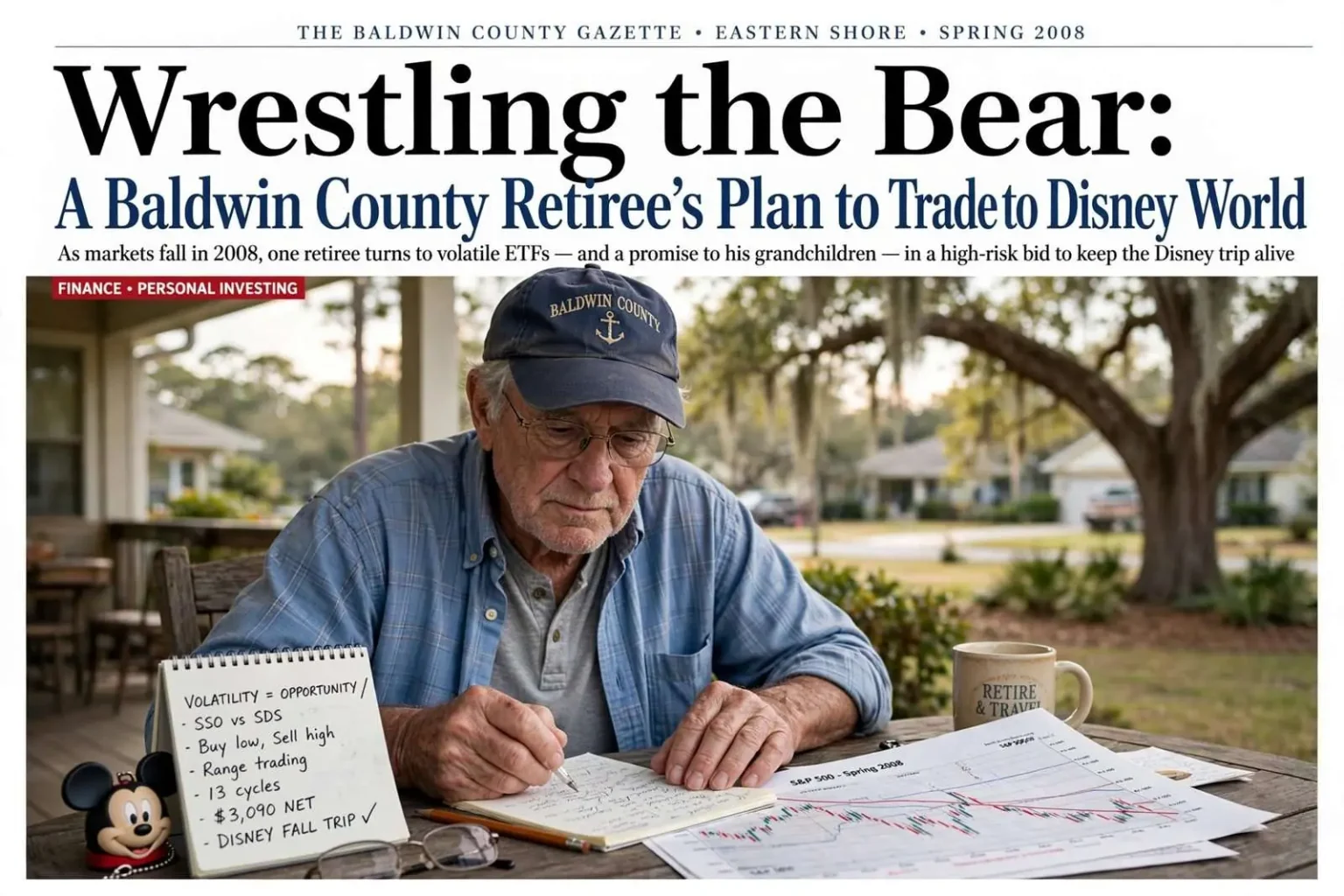
In the spring of 2008, the American stock market was doing what it had not done in a generation, and a great many retirees in Baldwin County were doing arithmetic they did not enjoy. One of them, a retired paper industry manager writing under a pen name, decided to explain what he was doing about it.
His situation was, as he described it, typical. He had left a large corporation eight years earlier than planned. A stripped-down company pension, Social Security, an enjoyable part-time job, stock dividends and some bond income covered the household’s base costs. He counted himself fortunate.
But the base costs were not the whole story. He relied on the stock market for appreciation to cover inflation, and he was specific about what inflation meant to him in 2008: gasoline, groceries, homeowner’s insurance escalation and, he added pointedly, the Baldwin County tax assessor.
The market also funded what he called the special projects, the new car, the kitchen remodeling, the daughter’s wedding. Quoting the late Congressman Frank Boykin, who represented south Alabama for decades on the slogan “Everything’s made for love,” the writer suggested an amendment: everything’s made for love, in a bull market.
When the cheese binds
In a bear market, he wrote, the cheese binds. The retirement fund shrinks. Special projects are either deferred or funded by selling equities at a serious discount, sometimes well below what was paid for them.
He knew the standard advice. Certified financial planners tell clients to build a hefty cash position before a bear market begins. His objection was practical and a little rueful. “Bear Markets are not pre-announced with trumpet blares on CNBC,” he wrote. “And, besides, I’m a good, patriotic American – I like to spend money!”
So when the market turned south, he was stuck. He had promised his wife, daughter and grandchildren that Grandpa would pay for a trip to Disney World that fall. Then he heard a television commentator say something that stuck: it was a lousy market for investors, but a great one for traders. The light came on.
The system
What followed was an unusually candid explanation of a strategy, laid out for readers step by step.
- Volatility as raw material. Over the preceding 90 days, he noted, the S&P 500 had swung an average of more than five percent between its weekly high and low.
- Leveraged instruments. He used two exchange-traded funds keyed to the index: a long fund (SSO), which rises about two percent for every one percent gain in the S&P 500, and a short fund (SDS), which rises about two percent for every one percent decline. Their weekly spreads averaged more than ten percent.
- Trading the range. Observing that the two funds moved in close inverse correlation and had stayed within a price band, he bought the long fund near the bottom of the range when the short-term cycle was rising, and the short fund near the bottom of its range when the cycle was falling, selling each after a satisfactory gain.
- Discipline. He quoted Jim Cramer: “Bulls make money; Bears make money; Pigs get slaughtered.”
- Costs. Frequent trading demands cheap execution, either a fee-based platform at roughly one percent of principal annually, or an online discount broker at about ten dollars a trade.
The results, and the risk
Over 13 weeks and 13 buy-sell cycles, he reported gross earnings of 3,350 dollars on a maximum initial investment of 7,000 dollars. Charging discount commissions of about twenty dollars per round trip, he calculated a net gain of roughly 3,090 dollars, which he called a very tidy sum.
To his credit, he did not pretend the strategy was safe. “Is this strategy risky? You bet it is,” he wrote. If the trading range broke out to a new level, he could be left holding a loss. If he substantially increased the size of the stake, he would be putting the retirement fund itself into a higher tier of risk.
His defense was that the alternatives had costs too. Try telling your wife and daughter the Disney World trip is off because of a bear market, he suggested. Try that one for a high-risk enterprise. Or sell good stocks at a steep discount, which he dismissed with a single syllable.
What happened next
The column ended in high spirits: “Hi Ho … Hi Ho … To Disney World we go … during a Bear Market!”
History supplies the epilogue he could not. The market of May 2008 was not at the bottom. Within four months Lehman Brothers had failed, and the S&P 500 fell roughly half from its 2007 peak before it turned in March 2009.
Trading ranges did not hold. Regulators and the funds’ own sponsors would later warn repeatedly that leveraged ETFs, which reset daily, are designed for short holding periods and can behave unpredictably over longer ones in volatile markets.
The daily reset is the reason. A fund like SSO aims for twice the index’s return for a single day, not over weeks or months. If an index rises 10 percent one day and falls 10 percent the next, it ends down 1 percent; a fund delivering twice each day’s move would rise 20 percent and then fall 20 percent, ending down 4 percent. In June 2009, the Financial Industry Regulatory Authority told brokers that leveraged and inverse ETFs are typically unsuitable for retail investors who plan to hold them for longer than one trading session.
Read today, the piece is valuable less as advice than as testimony. It captures, with unusual honesty, what an ordinary retiree on the Eastern Shore was thinking in the last calm months before the financial crisis: that the market had become a problem to be outmaneuvered, that the grandchildren had been promised a trip, and that somebody had to figure something out.