Baldwin County Nonprofit Launches Monthly Giving Drive to Attack the Roots of Homelessness
The Sea Glass Initiative has launched Light the Way, a $19 monthly giving program that funds one-on-one case management for Baldwin County residents working their way out of homelessness.
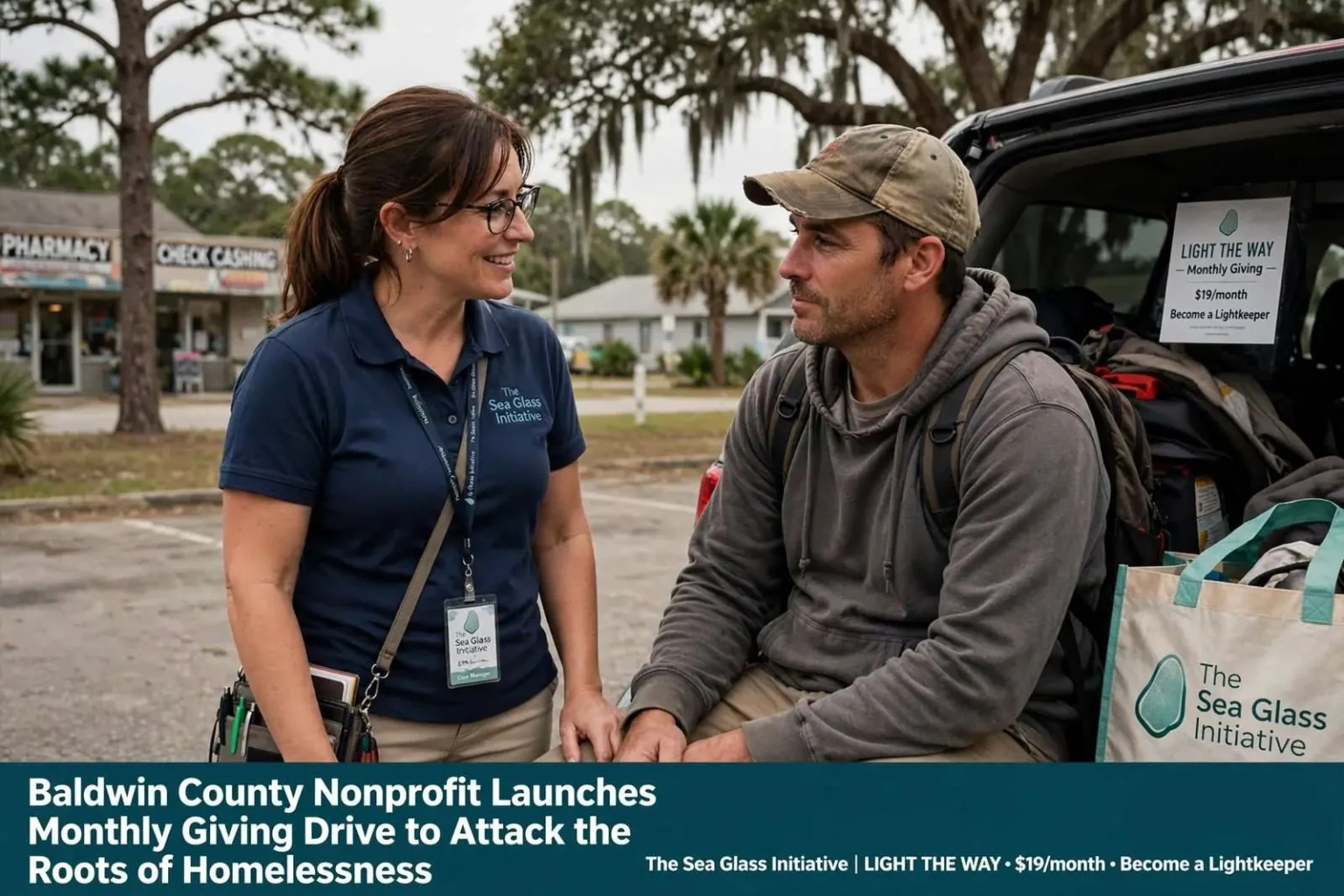
Homelessness in Baldwin County rarely looks the way people expect it to look. It is not concentrated in a visible downtown encampment. It is spread across a fast-growing county of small cities and rural stretches, hidden in cars parked overnight, in extended-stay motels, on the couches of relatives who are themselves stretched thin. It is easy to drive past and never see.
A local nonprofit is asking residents to stop driving past. The Sea Glass Initiative has launched a campaign called Light the Way, a monthly giving program built around a single, modest commitment: $19 a month. Donors who sign on are called Lightkeepers, and the organization says the predictable revenue is what allows it to do the slow, unglamorous work that actually moves people out of homelessness for good.
Case Management, Not Just Crisis Relief
The organization draws a sharp distinction between what it does and what many charitable efforts do. Emergency assistance, a night in a shelter, a bag of groceries, a tank of gas, meets an urgent need and then ends. The Sea Glass Initiative instead assigns individualized case management to each client and works with that person in the long term.
Staff members meet clients face to face and map out the specific obstacles standing between them and stability. Those obstacles vary enormously from person to person and often stack on top of one another:
Missing identification, which can make it impossible to apply for a job, sign a lease or open a bank account.
Lack of transportation, a decisive barrier in a county where public transit is minimal and jobs may be many miles from available housing.
Unemployment or underemployment.
Mental health challenges.
Addiction.
The absence of permanent housing itself, which makes solving every other problem harder.
Each of these is removed one at a time. The identification comes first because nothing else works without it. Then transportation. Then employment. It is a sequence, and it takes time.
Why the Organization Rejects a Single Template
Michelle Hillman, Executive Director of The Sea Glass Initiative, described the reasoning plainly. “We believe homelessness isn’t a one-size-fits-all problem, so it doesn’t have a one-size-fits-all solution,” she said. “Every person who walks through our doors has a unique story and unique obstacles. Our role is to walk beside them, helping remove those barriers one by one so they can regain stability, dignity, and independence.”
That premise, that no two people arrive at homelessness the same way and therefore no two should be handed identical plans to leave it, is the organizational core of the group’s model.
The Case for Monthly Giving Over One-Time Gifts
Penny Hughey, Director of Community Development, explained why the organization is specifically pursuing recurring donors rather than lump sums. A one-time gift can meet an immediate need. Consistent monthly funding is what allows a caseworker to stay with a client across the many months a full rebuild requires.
“Homelessness is rarely the result of someone simply making bad choices,” Hughey said. “More often, it’s the result of circumstances that snowballed beyond a person’s ability to recover alone. That’s why we don’t spend our time judging someone’s past; we spend our time helping them build a better future.”
She also addressed the residents who want to help but freeze at the question of how. “People ask us all the time how they can help,” she said. “The answer is simple. Become a Lightkeeper. For less than the cost of a few specialty coffees each month, you can become part of someone’s journey from homelessness to hope.”
What $19 a Month Buys
The figure was chosen to be genuinely accessible. It is a deliberately low threshold, positioned as an amount most working households can absorb without strain. The organization frames the gift less as a transaction than as a standing promise: a person in crisis knows that a reliable source of support exists while they do the hard work of getting back on their feet.
Recurring revenue also solves a real operational problem for small nonprofits. Case management requires paid staff, and staff require payroll that arrives on a schedule. Donations that spike at the holidays and vanish in February make it nearly impossible to keep a caseworker employed year-round. A base of Lightkeepers smooths that curve.
The Local Landscape of Need
Baldwin County’s growth, while a point of civic pride, has sharpened the pressures that contribute to homelessness. As more people move to the Alabama Gulf Coast, housing demand has risen, and with it rents and home prices. When wages do not keep pace with the cost of shelter, working households can find themselves one missed paycheck or one medical bill away from losing their footing. The county’s geography compounds the problem: with limited public transportation, a person without a car can be effectively cut off from both employment and services.
That is precisely why the Sea Glass Initiative emphasizes identification, transportation and employment in that order. None of these is solved by a single act of charity. Each requires sustained, hands-on work with a caseworker who knows the client’s situation in detail.
How Residents Can Engage Beyond Donation
While the Light the Way campaign centers on monthly giving, the organization’s broader message is that the community can engage in more than one way. Residents who cannot give at the $19 level can still contribute by spreading accurate information about the program, by volunteering time, or by connecting neighbors in crisis to the services the organization provides. The model depends on the community treating homelessness as a shared problem rather than a distant one.
How to Get Involved
Baldwin County residents who want to join the Light the Way campaign, or who simply want to understand more about how the organization operates, can find details at seaglassinitiative.com/how-you-can/light-the-way.
The organization’s message to the county is not that homelessness will be solved by any single donation. It is that the problem is solved the way it is created, one person and one circumstance at a time, and that the community can either fund that work or not.
For a county whose identity is built on its natural beauty and its growing population, the visible signs of need along Highway 59 or behind the strip malls in Foley and Gulf Shores are easy to overlook if you are not looking. The Sea Glass Initiative’s pitch is that residents should look, and that once they do, the response can be as simple and consistent as $19 a month, repeated for as long as a neighbor needs the support.
Why Baldwin County’s Geography Shapes the Work
Baldwin County stretches from the Eastern Shore communities of Daphne, Fairhope and Spanish Fort south past Robertsdale, Foley, Gulf Shores and Orange Beach, with a long rural middle that includes towns like Bay Minette, Stockton and Loxley. That geographic spread, combined with limited public transit, makes case management unusually demanding. A client in need of an ID, a job interview and a medical appointment may need to be driven to three different locations across the county on three different days, and the caseworker relationship is what keeps that work moving forward when the alternative, for many clients, is simply to give up.
The organization has built relationships with employers, government offices, mental-health providers and housing authorities across that geography, and that network is what allows case managers to make referrals that actually stick. Without sustained staff time to navigate the system on a client’s behalf, the same obstacles that produced homelessness in the first place tend to keep the person stuck in it.
What the Numbers Reveal About the Local Need
Baldwin County’s continued growth, by every available measure, has produced both prosperity and pressure. Housing costs in the county’s coastal cities have risen sharply over the past decade, and wages in the service and tourism sectors that employ a large share of the local workforce have not kept pace. The result is a working population that is, on paper, employed, but one missed paycheck or one medical bill away from a crisis that pushes a family into a motel, a car, or a couch.
The Sea Glass Initiative’s case management model is built specifically for that profile of homelessness, which does not match the stereotypes many residents hold. The work the organization does is not glamorous, and the people it serves are often not the people donors expect. That is part of why the Light the Way campaign is so explicit about how the money is used and why monthly giving matters so much.
For donors weighing a one-time holiday gift against a recurring monthly commitment, the organization’s argument is straightforward. A one-time gift can keep a family in a motel for a week. A year of monthly giving at $19 a month can keep a caseworker on the job for the months it takes to move that family from crisis to stability. The math is not complicated, and the model rewards the kind of patience that emergency relief alone cannot.