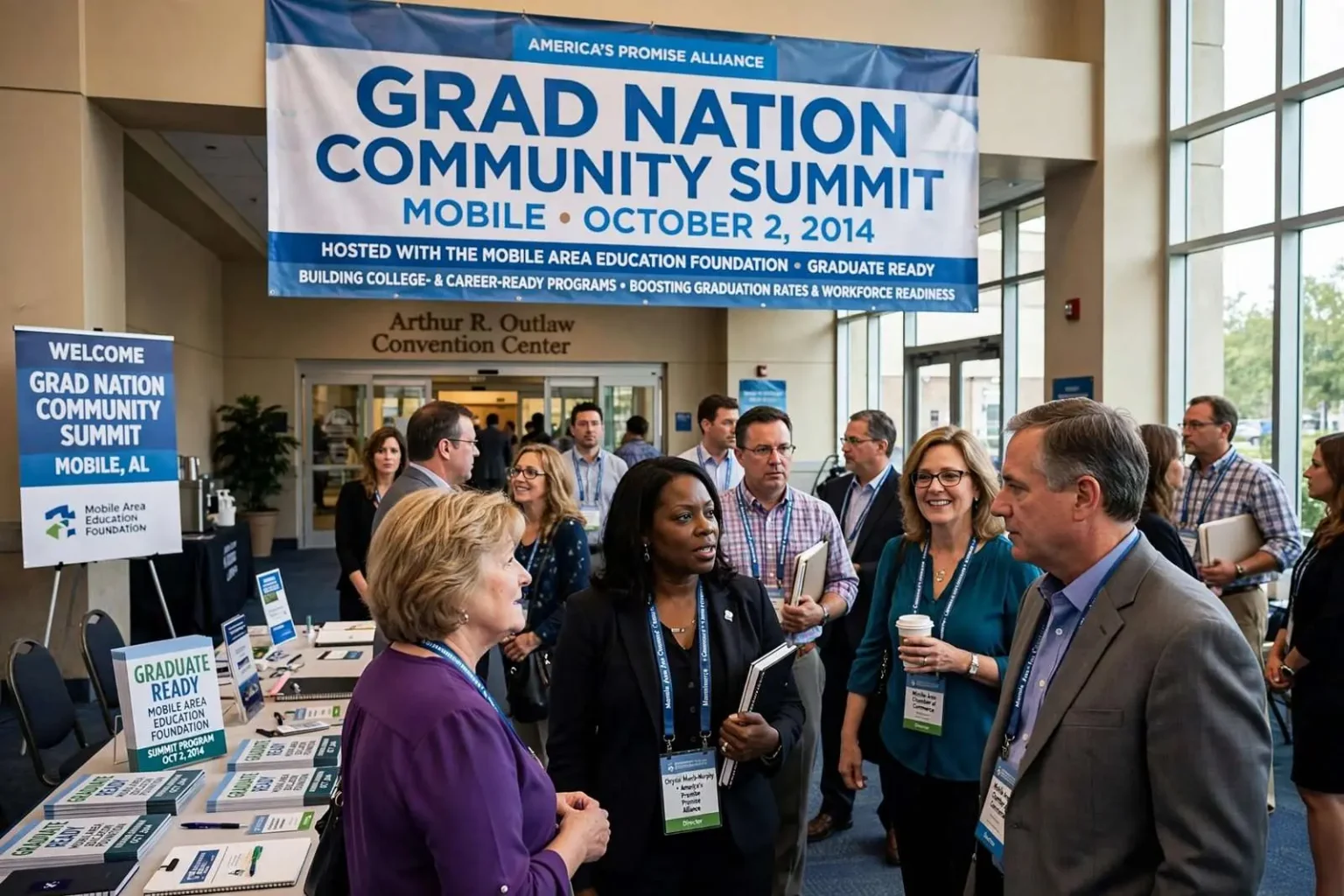
Graduation caps representing Mobile graduation rate effortsLeaders praised Mobile's graduation and workforce efforts at a Grad Nation summit in October 2014.

Education leaders held up Mobile as a national model in October 2014, praising the city’s college- and career-ready programs and its partnerships with business and industry as an example other communities could follow.

The America’s Promise Alliance brought its Grad Nation Community Summit to Mobile on Oct. 2, holding the event in tandem with the Mobile Area Education Foundation’s Graduate Ready meeting. It was one of 100 such summits the alliance hosted across the country.

A curriculum aligned with local employers

The idea of aligning school curriculum with the qualifications sought by local employers “makes perfect sense,” said Chrystal Morris-Murphy, a director with the alliance, who added that the group hoped to encourage other communities to do the same.

Morris-Murphy said Mobile was selected as a host city “because of their history of being forward-thinking and progressive.” She added: “They are doing some really incredible things … just thinking in a collaborative fashion and being willing to share resources.”

More than 400 participants took part in the morning seminars at the Arthur R. Outlaw Convention Center, an event partially funded by a $15,000 grant from the alliance.

State of the schools

The summit opened with state-of-the-schools reports from Carolyn Akers, executive director of the Mobile Area Education Foundation, and Martha Peek, Mobile County schools superintendent. A panel discussion on education and civil rights followed, featuring former Mobile County school board member Hazel Fournier, former Mobile County schools superintendent Harold Dodge, and Mobile Area Chamber of Commerce President Bill Sisson.

Guests could then choose among four discussions on improving Mobile County’s graduation rate, touching on the importance of business and industry internships, early involvement with at-risk children and families, and helping students plan for their futures well before their final year of high school. Peek told the audience that Mobile County’s graduation rate stood at 75 percent but was expected to rise once the 2013-14 numbers came in.

Education and the economy

The luncheon keynote, delivered by Jim Williams, executive director of the Public Affairs Research Council of Alabama, and Neal Wade, chairman of PARCA’s board, examined the ties between a better-educated workforce and economic development.

Williams praised the State Department of Education’s Plan 2020 but cautioned, “it won’t just happen … it’s up to us.” He listed five steps to keep the plan on track: start early; set high expectations; break down barriers to learning; seek improved teaching and leadership; and provide each student with a plan for study and career. By 2020, Williams noted, 65 percent of all U.S. jobs would require some form of post-secondary credentials or training.

See also  Monday Nights on the South Alabama Intramural Fields: Senior Bowl Opens Its NFL FLAG Registration for Mobile Kids

“Talent is today’s currency in economic development,” Wade said, urging communities to be aggressive in meeting the demands of business and industry.

Akers described the summit as a call to action. “It was a day to say, ‘forward march,’” she said, adding that the goal was to identify problems and obstacles and to tackle them. “This is really about the business, industry and community leaders pulling together.” For Mobile, the gathering reflected a coordinated push to lift graduation rates while preparing students for the jobs that would define the region’s economic future.

Mobile is the county seat of Mobile County in southwest Alabama and the state’s only saltwater port. Situated where the Mobile River meets Mobile Bay near the northern Gulf of Mexico, the city has long served as a commercial and cultural gateway between Alabama and the wider Gulf Coast. Founded in 1702 as Fort Louis de la Louisiane and ruled in turn by France, Britain, and Spain before joining the United States in 1813, Mobile carries a layered heritage distinct from the rest of the state.

Today Mobile anchors a metropolitan area spanning Mobile County and neighboring Baldwin County, and it remains a center for shipping, aerospace, healthcare, and higher education in the region. Its downtown and waterfront have seen sustained revitalization, while historic neighborhoods preserve architecture from its colonial and antebellum past. The city’s identity is shaped as much by its working port and industrial base as by its festivals and food culture, making it a frequent focal point for news about growth and change in southern Alabama.

Alabama is a state in the southeastern United States bordered by Tennessee, Georgia, Florida, the Gulf of Mexico, and Mississippi. Often called the Heart of Dixie, it spans Appalachian foothills in the north and flat coastal plains in the south. Its largest cities include Birmingham, Montgomery, Huntsville, and Mobile.

Alabama’s history encompasses Indigenous roots, Spanish and French colonial settlement, a cotton-plantation economy, the Civil War and Reconstruction, and the Civil Rights Movement of the 1950s and 1960s, followed by a shift toward manufacturing, aerospace, and technology. Local news across the state frequently reflects this mix of tradition and change.

See also  80-Plus Acres Charred as Mobile County Brush Fire Smolders Near Homes

Education in South Alabama spans public school systems in Mobile and Baldwin counties, a network of private and parochial schools, and institutions of higher learning including the University of South Alabama, Spring Hill College, and community colleges. Public-school governance rests with locally elected boards.

Boards oversee budgets, curricula, and facilities, often amid debates over funding equity and student achievement. The region’s colleges contribute not only to the workforce pipeline but also to healthcare, research, and cultural life, and education policy set in Montgomery frequently shapes what local districts can do.

Schools are also central to community stability. Enrollment trends, facility conditions, and graduation outcomes are watched closely by families and employers alike, making education a persistent focus of public attention and news coverage across the Gulf Coast.

The economy of the Mobile region is diversified across shipping and logistics, aerospace and shipbuilding, healthcare, tourism, and manufacturing. The Port of Mobile is one of the nation’s busiest seaports and a cornerstone of the local and state economy.

Major employers in aviation and defense contribute to a skilled workforce, while economic-development organizations aim to attract investment and jobs through incentives and infrastructure improvements. Small businesses, from restaurants to professional services, form the backbone of neighborhood commerce.

The health of the regional economy is a frequent subject of public discussion and reporting. Workforce development, recruitment of industry, and the fortunes of local retailers all feed into a broader picture of how the Gulf Coast competes and adapts in a changing national economy.

Local government in the Mobile area operates through a combination of mayor-council or commission structures at the municipal level and a county commission in Mobile County, with elected officials handling budgets, public safety, infrastructure, and zoning. Baldwin County has its own commission and a collection of incorporated municipalities.

Decisions made in council chambers and commission meetings affect roads, school funding, economic development, and quality of life, which is why coverage of local government is a staple of regional journalism. The interplay between city, county, and state authorities often determines how effectively the area can address shared challenges.

Because many services residents rely on are delivered at the local level, the choices of elected officials have direct, everyday consequences. Budget priorities, in particular, reveal a community’s values and shape the trajectory of growth and public welfare for years to come.

The history of South Alabama is shaped by its position at the crossroads of cultures and waters. Indigenous peoples, including the Muscogee (Creek) and Choctaw, lived in the region for centuries before European colonization by French, British, and Spanish powers.

See also  Carmichael Pitches Maysville Revival, New Williamson High in House 103 Bid

The cotton economy and the Civil War left deep imprints, as did the Civil Rights Movement, in which Alabama played a defining role. Understanding present-day debates in the region often requires appreciating this layered past, in which port commerce, racial history, and coastal geography have long intertwined.

That inheritance is visible in the architecture, street names, and institutions of the area. Public memory of the past informs contemporary conversations about growth, equity, and identity, and it frequently surfaces in coverage of local events and policy.

Baldwin County sits directly east of Mobile County across Mobile Bay and is the largest county in Alabama by land area. It encompasses the Eastern Shore communities of Daphne, Fairhope, Spanish Fort, and Foley and stretches south to the beaches of Gulf Shores and Orange Beach along the Gulf of Mexico.

Long among the fastest-growing counties in the state, Baldwin blends suburban development near the bay with tourism-driven coastal economies. Its proximity to Mobile and its position on the Eastern Shore make it a recurring subject of regional news covering growth, infrastructure, schools, and the balance between development and coastal preservation.

Mobile Bay is a shallow estuary in southern Alabama where freshwater from the Mobile, Tensaw, and other rivers mixes with saltwater from the Gulf of Mexico. It is among the largest estuarine systems in the United States and supports commercial and recreational fishing, shipping through the Port of Mobile, and wetlands that buffer the coastline from storms.

The bay’s Eastern Shore, in Baldwin County, includes Daphne, Fairhope, and Spanish Fort, while the Western Shore lies in Mobile County. Its ecology and economy have guided settlement for centuries, and the bay figures in regional debates over development, navigation, and conservation. Events on either shore are routinely covered as part of the interconnected life of the Mobile metro area.