Forward Mobile: The Quiet Circle of 40 That Worked Behind the Scenes
A retired executive told the Rotary Club of Mobile in June 2008 that Forward Mobile, an unpublicized circle of about 40 civic and business leaders, had quietly shaped decades of local decisions.
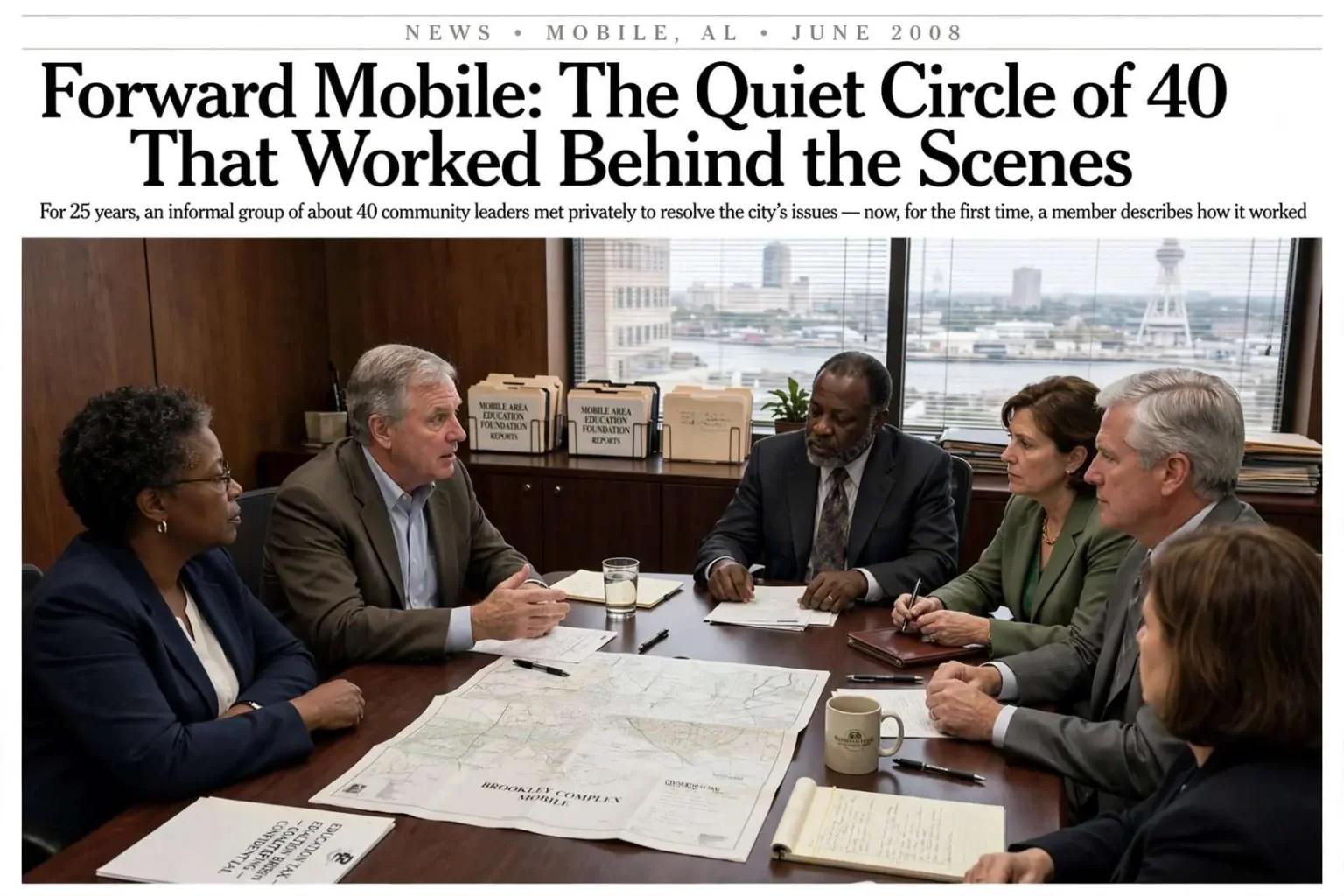
For a group that had spent roughly a quarter of a century avoiding attention, Forward Mobile received an unusual amount of it in early June 2008, when one of its own leaders described its work in public for the first time in memory. The organization had been a fixture of Mobile’s civic machinery for decades without ever appearing in a headline, and its decision to let a member lift the curtain — even partway — said as much about the moment as about the group itself.
An Organization That Does Not Seek Headlines
Speaking to the Rotary Club of Mobile, retired Degussa Corp. executive Charlie Story described Forward Mobile as an informal, loose-knit organization of roughly 40 community leaders that met about once a month, more often if an emergency arose, to resolve issues before they hardened into public conflict. There was no charter, no press office, no public roster — only a standing invitation to the same table. Its ranks, he said, cut across the community: Black and white, men and women, university presidents, bankers, chief executives and business owners.
Story, a Mobile native who was introduced by Bobby Guthans of Midstream Fuel, said the group traded on the standing of its members rather than on publicity. That stature, he argued, gave it access to elected officials at every level — from city council members and county commissioners to legislators, House and Senate leaders in Montgomery, and members of Congress. “A lot of the good that our organization does stems from the opportunities we are able to create to sit down with political leaders,” Story told the club. He asked his audience to imagine the value, for an officeholder, of an intensive conversation with that much accumulated experience gathered around one table — a room where a school issue, a road project and an industrial prospect could all be discussed by people who had seen each of them before.
Roots in an Older Mobile
Story traced the idea back 40 or 50 years, to civic figures such as Austill Pharr and Finlay McRae, who along with other leaders would meet informally whenever a development of importance arose. “They would get together and the issue was taken care of,” he said — a description of the consensus culture that mid-century Mobile’s business leadership used to steer growth through bank decisions, land deals and quiet mediation. Some 20 to 25 years before his talk, he said, a later generation revived the practice and, for want of a better name, called it Forward Mobile. Its stated purpose was simple: to work for the betterment of Mobile and to move the community forward, ideally in concert with other groups and without concern for who received credit.
The anonymity was the point. By never claiming credit, the group avoided the resentment that attends self-appointed civic boards, and by never announcing its positions, it preserved the discretion that made its mediation useful. Story himself did not name a single member during his talk, though he allowed that a few were sitting in the room — a remark that turned the Rotary luncheon into something of a guessing game for the audience.
Speaking in the Afterglow of a Landmark Announcement
The timing gave the talk its charge. Story addressed the Rotarians a day after Mobile’s Brookley complex was named as the site of a proposed aircraft assembly plant tied to EADS North America’s aerial refueling tanker work, a project then valued at roughly $600 million and about 1,100 jobs. It was the largest economic development story in the city in a generation, and the sort of prize, he said, whose public story is only the tip of a much larger iceberg.
“A project like this, a lot of things go on behind the scenes that the public never hears about,” Story said, adding a rhetorical question about whether retired Congressman Jack Edwards, long a force in defense matters, had a hand in it somewhere. Edwards, who had represented Mobile in Congress for three decades and later chaired the Brooks Act defense procurement work that shaped where Air Force business landed, was the archetype of the Behind-the-scenes influence Story was describing — the kind of standing that made things happen without a press release.
The School Tax That Changed the Arithmetic
The example Story returned to was education. He recalled a moment four or five years earlier when, he said, the community and the school system stood at a crossroads, and Forward Mobile helped assemble what he called the broadest coalition the city had ever put together in support of the area’s first new tax for education in some four decades. A previous attempt, he noted, had failed three to one — a margin that had made most officeholders assume the issue was untouchable.
He credited then-Superintendent Harold Dodge with bringing the system’s needs to the group, and praised the Mobile Area Education Foundation and its director, Carolyn Akers, for the progress of the transitional schools, the restructured campuses the foundation championed as proof that new money could produce new results. He also invoked Retirement Systems of Alabama chief David Bronner, who had said repeatedly that had the tax failed, his investments would have gone elsewhere — a warning with teeth, given the RSA tower, hotel and waterfront projects that were then anchoring downtown’s revival.
The episode, in Story’s telling, was the clearest demonstration of Forward Mobile’s method: identify the community’s reckoning, convene the people whose support made the difference, and keep the coalition together until the vote was won. The tax campaign succeeded where its predecessor had collapsed, and the public heard about leadership — not about the table where the strategy was built.
Recruiting Candidates, and Courting Industry
More recently, Story said, the group had become involved in candidate recruitment, on the theory that improving government at any level — city hall, the courthouse, the school board — begins with persuading better people to run. He said Forward Mobile had helped fill some positions with candidates who might not otherwise have entered a race, quietly approaching professionals who had never considered public office and convincing them that the community needed them on the ballot.
His larger argument was about unity. Industry, he said, wants to locate in a community that works together, and Forward Mobile existed to help create that climate — the perception, essential in economic development, that a city’s public officials and private leadership pull in the same direction when a prospect comes calling. Site-selection teams read civic friction as risk, and Mobile’s winning streak in the boom years was, in part, a story about signal sent by a community that resolved its fights privately.
He pointed to his own former employer as evidence that recruitment is only the beginning. Degussa, the German chemical company, expanded repeatedly in Alabama, growing from an initial $200 million investment — the largest in the state during George Wallace’s era — into a far larger stake. An initial plant, once proven, became a string of expansions; the first investor’s experience became the best argument for the next one. Keeping an existing employer happy, Story implied, was as much a civic task as landing a new one.
“Some of you may never have heard of Forward Mobile, and that’s fine, because that’s not our purpose,” Story said. “You should be aware that not everything is seen.”
The remarks offer a rare contemporaneous account of how civic power was organized in Mobile during the boom years of the late 2000s — an era of tanker contracts, steel plants and downtown towers — and of the informal networks that operated alongside the city council, the county commission and the chamber of commerce. Formal institutions made the decisions that appeared in the public record; the informal ones, Story suggested, shaped which decisions ever reached the record.
That structure is as old as the city itself. Mobile’s history includes generations of quasi-private civic bodies — committees of bankers, developers and professionals — that organized waterways, industrial recruitment and downtown renewal before any public agency took up the task. Forward Mobile, in Story’s account, was simply the modern iteration: same method, new names, adapted to an era when the city’s stakes ran to billion-dollar aircraft programs rather than cotton compresses and dock leases.
The model has obvious critics, and Story’s talk acknowledged the tension without resolving it. A community where important conversations happen in unrecorded rooms trades transparency for effectiveness, and the public’s only leverage is the standing of the people invited to the table. But Story’s defense was practical: the record he cited — a school tax that passed after failing three-to-one, an industrial recruitment story of national scale, a pipeline of willing candidates — argued that the private consensus produced results the public process alone had not.
For the Rotarians in the room, the talk was also a recruitment message of its own. Story’s closing advice was to assume that the city’s fortunes depend on arrangements most residents will never see: conversations between an official and a banker, a superintendent and a foundation director, a recruiter and a plant manager. The public should not necessarily know the details, his account implied — but it should know that such rooms exist, and that who sits in them matters.
Two decades later, the account stands as one of the only firsthand descriptions of how the group worked: roughly 40 members, monthly meetings, consensus first, credit last. Whether the organization still operates in the same form, its alumni are visible across Mobile’s public life — in elected office, on nonprofit boards and in the business leadership that continues to court the region’s next big project. The iceberg, as Story put it, remains mostly underwater.