At Mobile Convention Center, Fred Barnes Tells 600 What He Thinks History Will Say About Bush
Journalist and Bush biographer Fred Barnes headlined the Alabama Policy Institute's annual fundraiser in Mobile, predicting the president would leave office to hisses and be judged more kindly later.
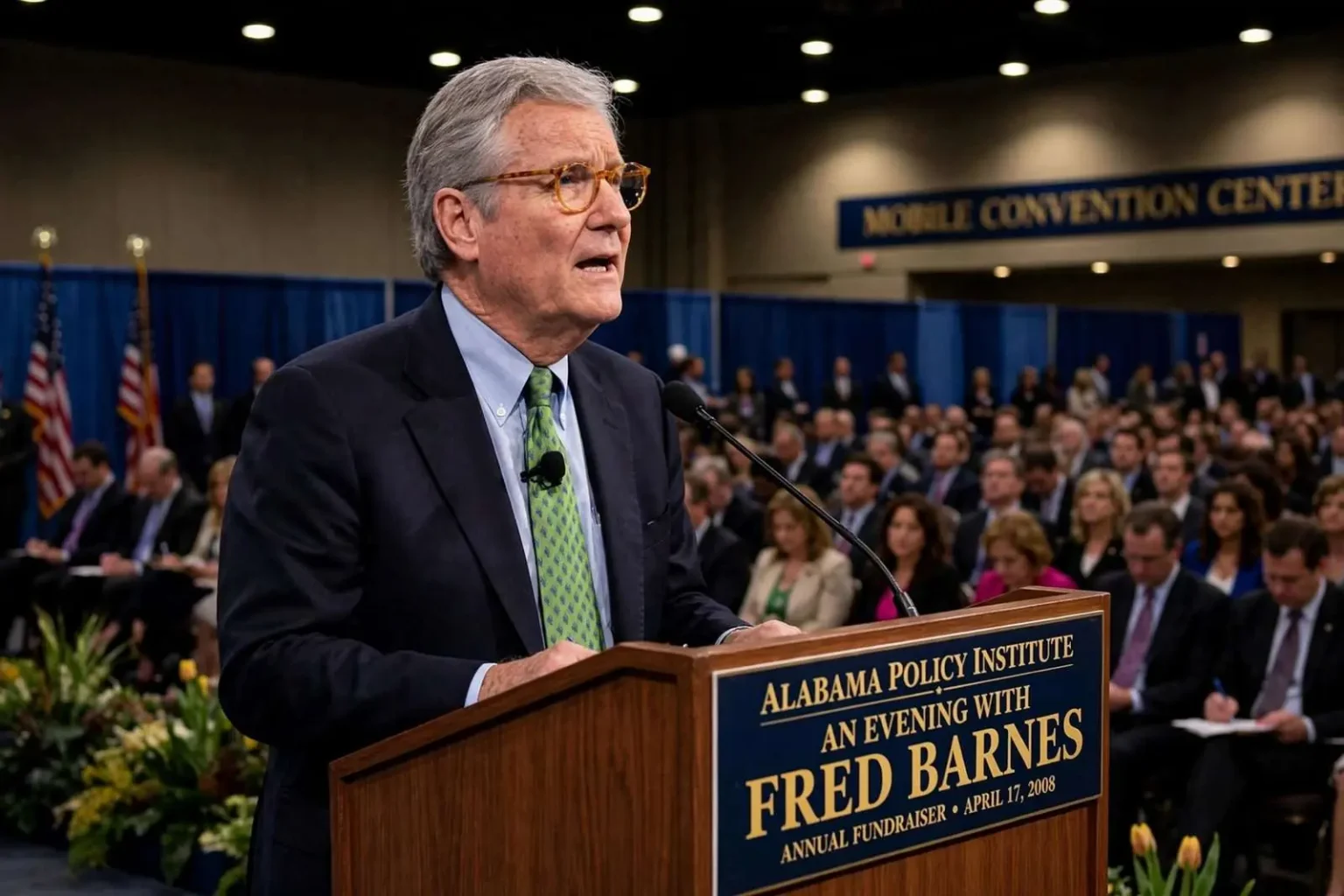
Six hundred people filled the Mobile Convention Center on a Thursday evening in April 2008 to hear a Washington journalist explain a president they had spent eight years arguing about. The occasion was “An Evening With Fred Barnes,” the annual fundraiser for the Alabama Policy Institute, and the speaker was a veteran political reporter and conservative commentator whose recent biography of George W. Bush, Rebel In Chief, had given him unusual access to a famously guarded White House.
Barnes opened, as speakers before friendly crowds often do, with a joke, and the joke was the president’s own.
The secret of a political career
Bush, Barnes reminded the audience, had stumbled badly at the start. He lost a bid for Congress in 1978. Sixteen years later he was elected governor of Texas. He won the presidency in 2000 and held it in 2004.
So what had he learned in between? What was the secret?
“It’s simple,” Bush had told him. “You can fool some of the people all of the time … and I concentrate on them.”
Barnes offered it as evidence of something he insisted was true and widely disbelieved: that Bush was genuinely funny. He extended the compliment to the man who by that April had effectively secured the Republican nomination, Senator John McCain, whose sense of humor Barnes rated as perhaps the best among the candidates still standing.
Barnes illustrated the point with a story from McCain’s revival. The senator’s campaign had been written off the previous summer, and the professionals whose livelihoods depend on proximity to winners had made their excuses and left. By spring, with McCain resurrected, many were angling to return.
Were they welcomed back with open arms, McCain was asked. “Yes, of course, they are,” he replied, “after a little waterboarding.”
Obama, Clinton and a coming upset
Turning to the Democratic contest, still unresolved that spring, Barnes was blunt about the two candidates’ comic gifts. Barack Obama, he said, had flashes of humor. Hillary Clinton’s sense of humor he described as a rumor, sighted occasionally over the years but never quite confirmed.
The observation carried a serious argument inside it. Given that the two Democrats held nearly identical positions on the issues, Barnes suggested, Obama’s warmth might well prove the difference. He compared the senator’s grace under fire and his imperturbability to Ronald Reagan’s, and predicted his easy manner might carry him past Clinton in one of the most remarkable upsets in American political history. Within weeks, that is roughly what happened.
The general election, Barnes told the Mobile audience, would present the country with its starkest choice since 1976, when Jimmy Carter defeated Gerald Ford. On the economy, on foreign policy, on nearly any measure, he saw little gray area between the eventual nominees.
Perception, reality and a president’s legacy
Barnes pushed back on the gloom then settling over the American economy, arguing that the evidence of decline simply was not there. He pointed to Mobile’s own economic activity as one example among the statistics he cited.
The same gap between perception and reality, he argued, might eventually reshape the verdict on the Bush presidency. Bush would leave the arena to hisses, Barnes predicted, but history would likely cheer him. He drew the comparison presidents’ defenders reach for most often: Harry Truman, unappreciated in his time and elevated later.
Bush’s standing, Barnes said, rested on the future of Iraq. If Iraq, holding the world’s second largest oil reserves, emerged as an anchor democracy stabilizing the Middle East, the reassessment would follow.
Two stories about Washington
Barnes closed with anecdotes, both about the distance between what politicians say and what they mean.
The first concerned the late Illinois congressman Henry Hyde, whom Barnes admired for his unyielding opposition to abortion, and Representative Millicent Fenwick, a Republican and an ardent supporter of legal abortion. After one of their lacerating floor debates, Barnes recounted, Fenwick begged Hyde to give some ground so the two could stop pillorying each other.
Hyde refused, and told her a story he said he had never told anyone in Washington: that he had been a foundling, left in a basket on a doorstep by an unmarried mother. Fenwick, dumbstruck, turned and walked away, and the two never argued over the issue again.
“Of course, it wasn’t true,” Hyde later told Barnes. “I made it up on the spot. But it was for a good cause and I’ve never regretted it, not for a single day.”
The second was a toast. At a bachelor party for the talk show host and former Jesuit priest John McLaughlin, then 70 and marrying a woman half his age, Mort Zuckerman of U.S. News & World Report assured the groom that the world would long recall his words after Shakespeare’s had been forgotten, “but not until then.” The same, Barnes concluded, could be said of his own remarks that evening.
The host organization
All proceeds from the event went to the Alabama Policy Institute, the Birmingham-based nonprofit research and educational organization that its executive director, Gary Palmer, described as dedicated to influencing public policy through fact-based, objective analysis. Barnes said such think tanks were proliferating across the country and called API among the best of its kind. Palmer would later be elected to Congress from Alabama’s 6th District.
The institute began in 1989 as the Alabama Family Alliance, which Palmer co-founded, and took the Alabama Policy Institute name in 2000. Palmer led it for more than two decades before his 2014 election to the U.S. House.
Sandy Stimpson, who served as master of ceremonies, said a final accounting of the evening’s financial success was still two or three weeks away. Stimpson would be elected mayor of Mobile five years later.