Family Promise of Coastal Alabama Gives Homeless Families a Path Home
Family Promise of Coastal Alabama shelters homeless families from Mobile and Baldwin counties through a rotating network of local churches.
MOBILE, Alabama — For families in Mobile and Baldwin counties who lose their housing, a local nonprofit called Family Promise of Coastal Alabama is often the first stop on the way back to stability. The organization works closely with area schools, which refer many of the families it serves. When a parent loses a job, a lease ends unexpectedly, or domestic violence forces a family from its home, school social workers and counselors frequently are the first professionals to notice — a child falling asleep in class, bags packed in a backpack, addresses that keep changing on enrollment forms.
A network of churches steps in
Family Promise relies on a rotating group of roughly two dozen participating congregations, known as the Interfaith Hospitality Network, to house families for a week at a time before they move on to the next church in the rotation. Host churches typically take a turn sheltering families several times a year, providing beds and home-cooked meals in the process. Volunteers from each congregation convert Sunday school rooms and fellowship halls into temporary bedrooms, then cook dinner, share meals with the families and stay overnight as hosts.
The rotation model spreads the burden across the network, so no single congregation is asked to house families for more than a handful of weeks each year. It also gives families something institutional shelters often cannot: a table shared with volunteers from a dozen different faith traditions over the course of their stay, and a community that knows their children by name.
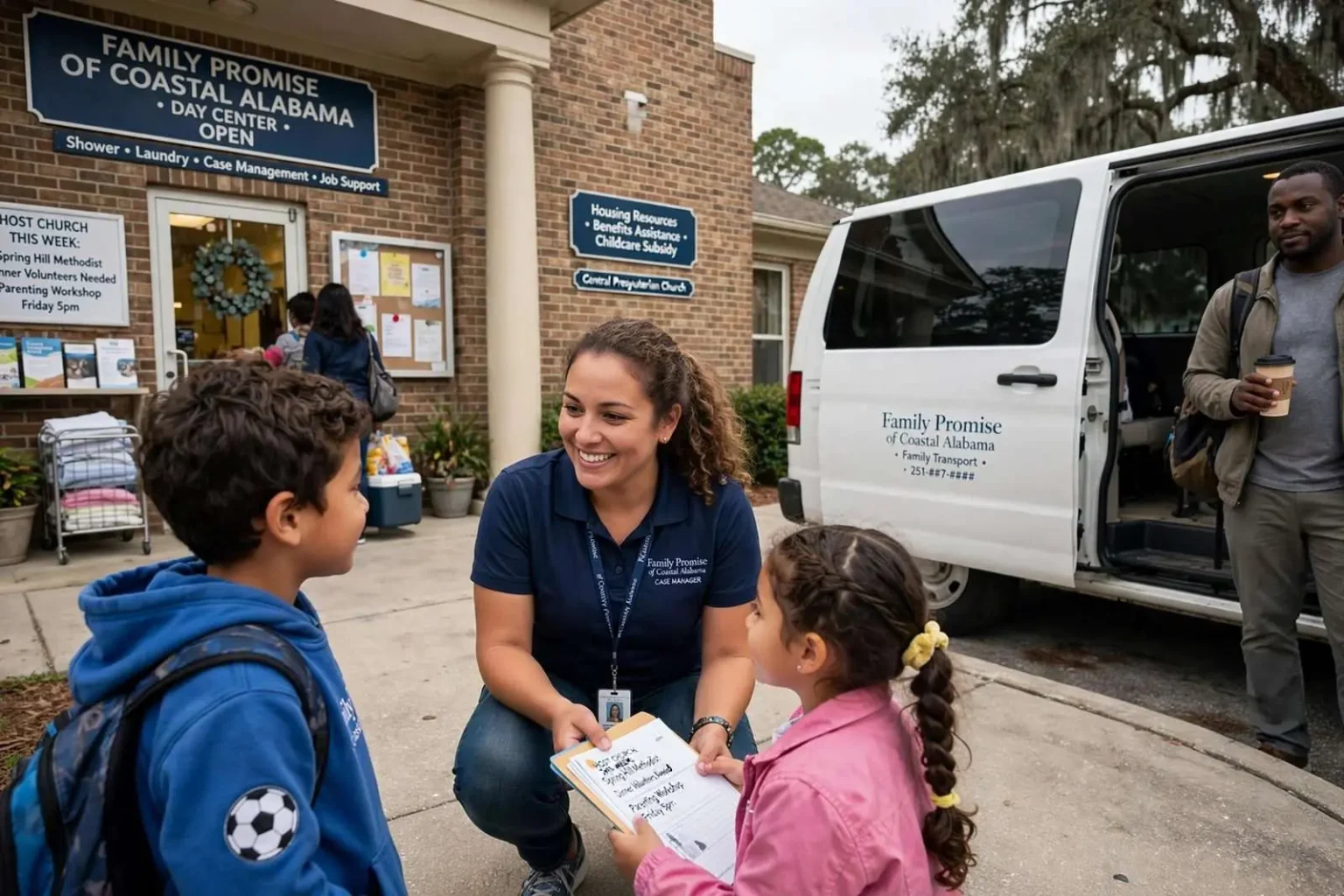
During daytime hours, family members who are not working or attending school gather at a day center based at Central Presbyterian Church. There, they can shower, do laundry, meet with a case manager and search for jobs. The day center is the operational hub of the program — the place where the pieces of a family’s recovery are assembled, one appointment and one application at a time.
Two unmarked vans operated by the agency shuttle parents to work and children to after-school programs, with a case manager coordinating routes and schedule changes with drivers throughout the day. Because a family without housing is usually also a family without a reliable car, the vans are what make the rest of the program workable: a parent can keep a job across town, and a child can stay on the soccer team or the cheer squad without the disruption of the family’s situation showing up in their daily schedule.
Serving the whole family
Local social workers say the program stands out because it keeps entire families together rather than splitting up parents and children, which can happen with some shelter placements. Fathers in particular often face separation from their families in conventional shelter systems, and teenage boys can be barred outright from facilities that serve only women and younger children. Keeping the family unit intact means parents do not have to choose between entering shelter and staying with their children.
Case workers who partner with the agency describe it as a resource for families dealing with domestic violence, job loss and other financial emergencies, as well as teenagers who have left home because of abuse. The program’s case managers work with each family on an individualized plan: securing identification documents, applying for benefits, addressing debts, finding work or better work, and ultimately locating housing the family can afford to maintain on its own.
Families accepted into the program agree to a drug screening and a set of house rules before moving in. The requirements are practical — the network’s host congregations are volunteering their buildings, and the program’s insurance, staffing and space all assume families who can live cooperatively in shared space. Curfews, chores and conduct expectations are spelled out up front, so families know exactly what participation involves.
Organizers say keeping children engaged in normal routines, whether that is soccer practice or an after-school club, is treated as a priority rather than an afterthought during the 14-week stay families are typically allowed. Research on family homelessness has repeatedly found that children absorb the stress of housing instability even when adults try to shield them, and that holding onto ordinary routines — same school, same teammates, same homework hour — is one of the strongest protections for a child’s development during a family’s worst months.
A local nonprofit with local roots
The Mobile program traces back to 2003, when it launched with a $100,000 start-up grant and a coalition of congregations willing to open their doors. It is part of the national Family Promise network, which began in New Jersey in the mid-1980s and has since grown into one of the country’s largest nonprofit networks dedicated specifically to family homelessness, with affiliates in communities across the country. The national organization provides the model, training and back-office support, while each affiliate raises its own funds and adapts the program to its own community.
In coastal Alabama, that adaptation has meant a network built around the geography of two counties: Mobile’s urban core and the faster-growing communities of Baldwin County across the bay. Families served by the program have included households where a single medical bill, a car repair or a reduced work schedule tipped them from paying rent into crisis — families who, a few months earlier, had never imagined needing a shelter program at all.
Why families fall into homelessness here
Housing experts point out that family homelessness rarely announces itself with a long slide. More often it arrives suddenly — an eviction notice after a missed paycheck, a landlord selling a rental house, a breakup that leaves a parent with no affordable option overnight. In a coastal labor market heavy with tourism, service and shift work, hours can swing wildly with the season, and a family living paycheck to paycheck has almost no margin to absorb a bad month.
The Gulf Coast’s housing dynamics add pressure on both sides of Mobile Bay. Rents have climbed faster than wages for many service-sector jobs, and the supply of modest, affordable units has thinned as older apartments and mobile home parks give way to redevelopment. For a single parent earning a typical service wage, an unexpected $600 expense can be the difference between housed and homeless — which is why prevention-minded programs emphasize helping families stabilize income and catch up on arrears before a lease is actually terminated.
How the referral pipeline works
The school connection is the quiet engine of the program. Under federal education law, school districts are required to identify homeless students and remove barriers to their attendance, even when the family has no stable address. Mobile and Baldwin County school employees are therefore often the first to know when a family is doubling up with relatives, sleeping in a car or facing an imminent eviction — and they are positioned to connect the family to services before the situation hardens into chronic homelessness.
Getting a family into the network early matters for practical reasons as well. The 14-week window goes quickly, and every week spent on a waiting list is a week of case management lost. Early referrals mean more time for job searches, benefit applications and housing hunts, and a better chance that a family exits the program into its own lease rather than into another temporary arrangement.
What success looks like
For the congregations involved, the program turns abstract concern about homelessness into something concrete: a casserole, a made bed, a homework session at a folding table. Volunteers consistently report that hosting changes their understanding of who becomes homeless — not the distant figures imagined from downtown street corners, but schoolmates of their own children, families whose car is parked in the church lot on Sunday morning.
For the families, the measure of the program is simpler: a child who kept the same teacher all year, a parent who kept the job, a lease signed in their own name. The case managers, vans, host churches and day center all exist to serve that outcome — and for families in Mobile and Baldwin counties facing the worst stretch of their lives, the organization remains the first door back to stability.
The volunteers behind the rotation
The Interfaith Hospitality Network’s strength lies in its volunteer base. Each host congregation typically designates coordinators who schedule the hosting weeks, recruit volunteers and manage logistics, from laundering linens between stays to stocking the kitchen. When a hosting week begins, members set up beds in classrooms, plan menus and sign up for evening and overnight shifts. Congregations that are not large enough to host on their own sometimes partner with neighboring churches, supplying food or evening volunteers for a week they could not staff alone.
That structure also gives families a measure of privacy that congregate shelters struggle to provide. A family sleeping in a Sunday school room has its own space, its own door and its own routine within the building — small things that reduce the daily friction of living in temporary quarters and help parents preserve a sense of authority and normalcy for their children.
The case management core
Every part of the program is anchored by case management. Families meet with case managers regularly to track progress against their goals, and the managers in turn connect families to the wider web of assistance available in the two counties — job training programs, childcare subsidies, legal aid for eviction or custody matters, and landlords willing to work with families emerging from a housing crisis. The case manager riding herd on van routes during the day is doing the same job in miniature: keeping a complicated schedule from falling apart.
Case managers also prepare families for independence, budgeting with them toward a security deposit and first month’s rent, and coaching them through tenant applications that a past eviction or credit blemish might otherwise sink. Some affiliates of the national network follow families after placement with light-touch support — a check-in call, help resolving a landlord dispute — because the months immediately after rehousing are when families are most at risk of losing housing a second time.
Two decades after its founding, the coastal Alabama program remains a quiet fixture of the region’s safety net: unmarked vans running their loops, church vans folding into bedrooms each Sunday, and case managers at Central Presbyterian working the phones on a family’s behalf. For the families who pass through it, the network’s value is measured not in programs but in the ordinary life it lets them rebuild — job, school, dinner at a table, and a front door of their own at the end of it.