Airbus and United Way Team Up to Fund Mobile Schools
Airbus Mobile and United Way of Southwest Alabama launched a new education partnership, giving $12,000 to four local school programs.
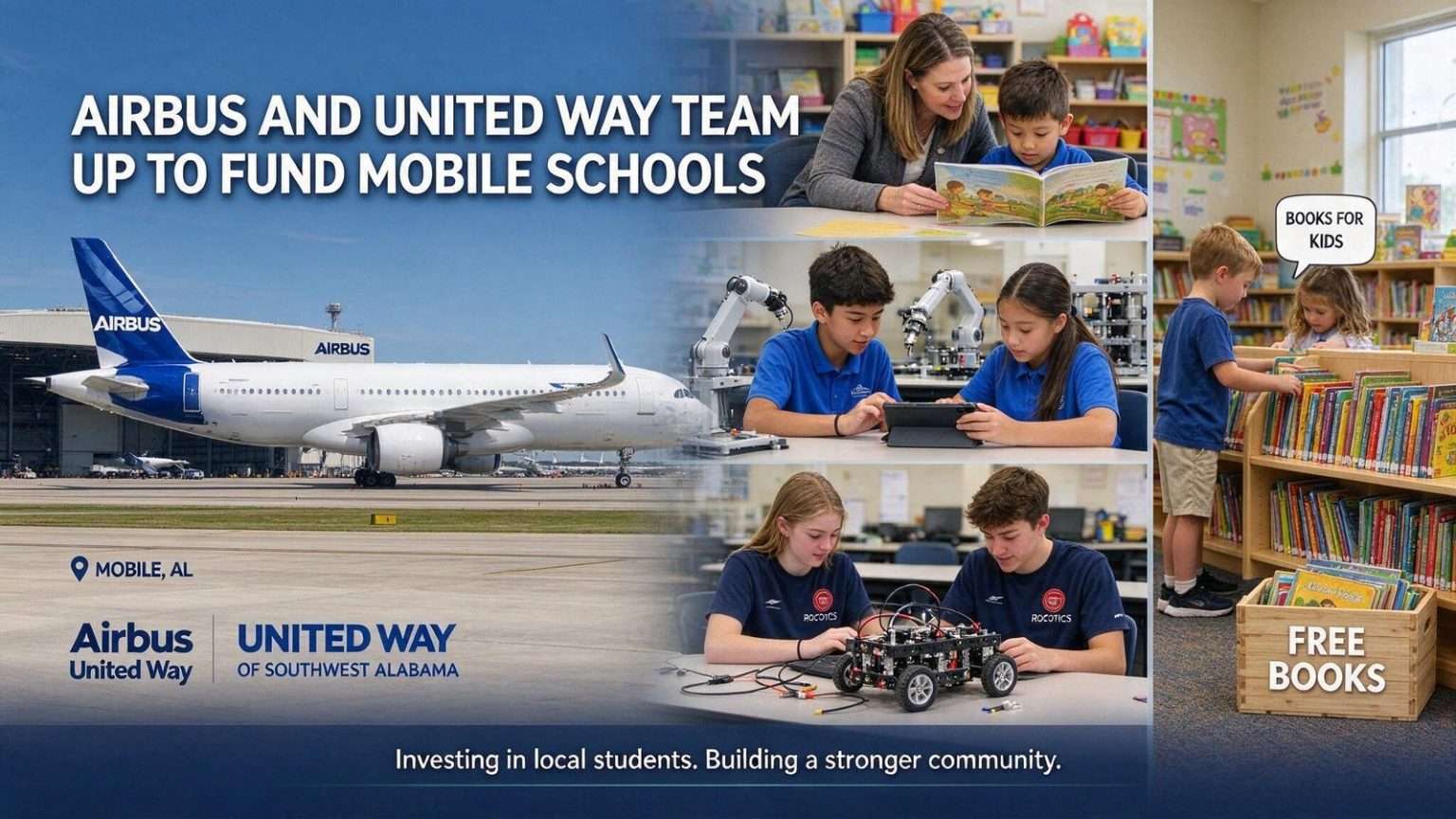
MOBILE, Alabama — Airbus’s Mobile operations and the United Way of Southwest Alabama unveiled a new joint education partnership this week, kicking it off with $12,000 in grants split among four local school programs. The grants are the first round of funding under an arrangement designed to put corporate giving where Airbus employees already live, work and volunteer.
The partnership links one of the region’s largest industrial employers with one of its largest fundraising federations for social services, and it arrives as Mobile works to raise educational outcomes in the neighborhoods surrounding its urban core. Each of the four grants went to a program with a track record in Mobile County public schools, from early reading to high school robotics.
Four local programs share the first round of funding
The initial grants included $4,000 for an accelerated reading program at Gilliard Elementary School, $3,500 for an engineering-focused enrichment program at Pillans Middle School run through the Mobile Area Education Foundation, $2,500 for B.C. Rain High School’s robotics team, and $2,000 to help expand a free children’s book program in the 36605 zip code.
Together the four grants cover nearly the whole arc of a student’s schooling. The Gilliard grant backs reading acceleration in the elementary grades, where fluency is built; the Pillans grant introduces engineering concepts in middle school, the years when students either commit to or drift away from math and science; the B.C. Rain grant supports hands-on robotics at the high school level; and the 36605 book program aims at the earliest learners, getting printed books into homes before children ever reach a classroom.
The Mobile Area Education Foundation, which runs the Pillans engineering program, has worked for years alongside Mobile County Public Schools on initiatives connecting classroom instruction to real careers, and robotics teams like the one at B.C. Rain have become one of the most visible expressions of that effort, taking students from city neighborhoods into regional competitions.
The 36605 zip code, which takes in much of Mobile’s historic Down the Bay and Maysville communities, has been a focal point for early-literacy work in the city, and the $2,000 grant will widen a program that distributes free children’s books to families there — a low-cost intervention widely identified as one of the strongest supports for kindergarten readiness.
Why the companies chose education
The site director for Airbus’s Mobile engineering office, who also chairs the local United Way board this year, said the goal is to get residents thinking about how community needs and business interests overlap in their own neighborhoods before looking elsewhere. The framing reflects a deliberate strategy: rather than treating charitable giving as a check written to distant causes, the partnership aims its first dollars at programs within sight of the company’s own workforce.
Airbus has a substantial stake in the answer to that question. The company’s final assembly line at the Mobile Aeroplex at Brookley has made the city one of a handful of places on earth where commercial jets are built, and the plant’s long-term health depends on a steady pipeline of local graduates who can fill skilled manufacturing and engineering jobs. Education programs that begin in elementary school and run through high school are, in that sense, part of the company’s own workforce plan.
United Way’s role fits the same logic. The organization’s workplace campaigns pool employee contributions across the region and distribute them through community partners, and its local affiliate has spent years on education initiatives that target the earliest and most fixable barriers to student achievement.
Part of a national push
Mobile’s program joins similar Airbus-United Way partnerships already running in Atlanta, Miami, the Washington, D.C., area and Wichita, Kansas, all aimed at supporting community programs that boost student achievement. The company has made the model a template across its American sites, with each community choosing the local programs that receive funding.
Locally, the arrangement means that every dollar Airbus employees pledge through the United Way workplace campaign will be partly matched by the company, with half going toward the new education partnership and a quarter going to the broader annual campaign. The matching structure is designed to amplify employee giving rather than replace it — the more employees pledge, the larger the education fund grows.
Airbus Americas’ president said in a statement that being a strong corporate citizen in the communities where the company operates is a priority, pointing to similar programs the company backs in Wichita and Washington in addition to the new Mobile effort. The statement placed Mobile alongside the company’s other American manufacturing and engineering sites as a community where the company intends to invest beyond the factory floor.
A boost for a broader graduation push
United Way of Southwest Alabama’s president and chief executive said the new funding builds on years of volunteer work Airbus employees already contribute locally, including serving as reading buddies in area schools. He said the partnership will help the organization chase specific local education goals, adding structured funding to the volunteer hours the company’s workforce has been contributing for years.
The reading-buddy programs that Airbus employees have joined pair adult volunteers with young students for regular one-on-one reading sessions, a format that has spread across the Mobile area as schools seek extra adult attention for children who are behind. Employees who spend lunch hours reading with first-graders, the thinking goes, are the same people who will understand why the new grants flow where they do — and who will carry the story of the work back to the plant.
The partnership also lands amid a regionwide emphasis on third-grade reading and high school graduation, benchmarks that Alabama schools have been pushed to meet through state law and district initiatives alike. Funders who back programs on both ends of that span — books for toddlers, reading acceleration in elementary school, engineering enrichment in middle school and robotics in high school — cover the full pipeline that graduation figures ultimately measure.
What the money does at this scale
Grants of $2,000 to $4,000 rarely make headlines, but in school-based programs they are often the difference between a program running and a program ending. Robotics teams use that scale of money for components, competition fees and travel; reading programs use it for materials and take-home books; enrichment programs use it for instructor time and equipment. The partnership’s first round is small in corporate terms and immediate in school terms.
That is the design, according to the partnership’s organizers: modest, recurring rounds of local grants rather than a single large gift. The matching mechanism means the education fund will rise and fall with employee participation, which the companies treat as a feature — it keeps the connection between the workforce and the funded programs visible year after year.
For the four programs named in the first round, the grants arrive as the school year’s planning is underway, letting principals and program directors commit to schedules and materials they might otherwise have trimmed. For Mobile’s broader school community, the partnership’s first round establishes a template that other employers watching the Airbus-United Way model may be invited to follow in coming rounds.
Brookley’s second act as a community anchor
The partnership is also the latest sign of how thoroughly Airbus has woven itself into Mobile’s civic identity since the final assembly line opened at the Aeroplex. The plant, built on the site of the former Brookley Air Force Base, restored an aviation tradition the city lost when the base closed in the 1960s, and the company’s presence has drawn a growing cluster of suppliers and aerospace employers to the same campus. Along the way, Airbus employees have become a visible presence in the community — coaching teams, serving on nonprofit boards and volunteering in classrooms.
Community organizers in Mobile have long argued that the city’s aerospace boom should be measured not only in jobs at the plant but in whether neighborhoods with historically limited opportunity share in the industry’s growth. Programs like the Pillans engineering enrichment and the B.C. Rain robotics team are aimed squarely at that question, putting students from Mobile’s public schools on a path toward the same industry operating down the road.
The education partnership formalizes that connection. By routing its first grants to schools in the city’s urban core and its eastern neighborhoods, the program links the aerospace economy of Brookley to the classrooms that will supply its future workers, and it gives employees a structured way to invest in that pipeline beyond their volunteer hours.
What comes next for the partnership
Organizers expect subsequent rounds of grants to follow the annual workplace campaign cycle, with the education fund growing as Airbus participation increases. The United Way board’s chairmanship — held this year by the Airbus engineering site director — gives the company a direct seat in deciding how those dollars are deployed, and the four programs named in the first round suggest the priorities: early literacy, STEM enrichment and hands-on technical learning.
For now, the four grants stand as the partnership’s opening statement: $12,000, four Mobile schools, and a matched-giving structure built to compound over time. The companies behind it have pointed to the same model working in Atlanta, Miami, Washington and Wichita as evidence that the approach scales, and Mobile’s education community will be watching to see how quickly the fund grows in the campaign seasons ahead.