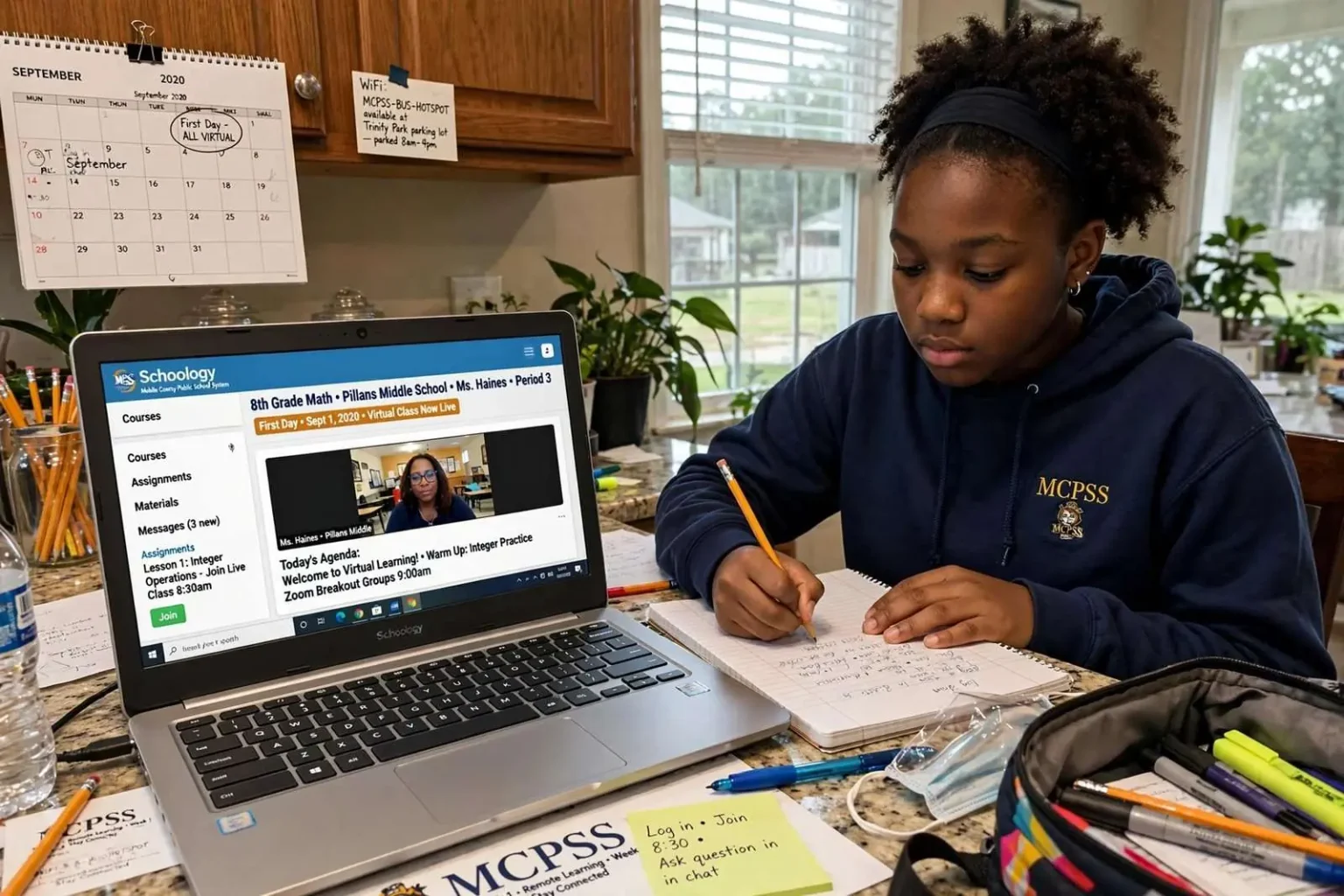
When students in the Mobile County Public School System logged on for the first day of classes on September 1, 2020, they walked into a school year unlike any before. The state’s largest district — with roughly 90 schools serving tens of thousands of students — launched the year entirely online as Alabama continued grappling with the COVID-19 pandemic. Instead of rows of desks and cafeteria lines, the first-day experience played out through screens at kitchen tables and living rooms across Mobile County.
The all-virtual start capped months of uncertainty for families. Across Alabama, school leaders spent the summer of 2020 weighing reopening models as coronavirus case numbers rose and fell, and state officials left individual systems broad latitude to decide how to open. Mobile County, whose enrollment dwarfs every other district in the state, chose a fully remote start for the first nine weeks, a decision that affected not just students and teachers but parents juggling work schedules, childcare, and unfamiliar technology.
For educators, the transition meant teaching without the physical presence of their students. “It’s sad. I’m just gonna imagine that when I’m teaching them virtually that they are actually sitting in my class,” said Pamela Haines, an eighth-grade math teacher at Pillans Middle School. Her sentiment captured the adjustment facing teachers throughout the district, many of whom spent the summer learning new digital tools and reworking lesson plans built over careers of in-person instruction.
Teaching math through a screen presents challenges that go beyond logistics. Math instruction typically relies on hands-on problem solving, whiteboard demonstrations, and immediate feedback while students work through exercises. Teachers like Haines had to recreate those routines in a virtual environment, leaning on screen sharing, digital assignments, and small-group video sessions to keep students engaged and to spot confusion before it compounded into larger gaps in understanding.
Working Through Technology Hurdles
Wireless connectivity and device access presented immediate challenges. Jacinda Hollins, the principal at Pillans Middle School, said her staff was working directly with each family to resolve technical difficulties as they arose. That school-by-school, family-by-family approach became the norm across the district, since a single missing login, forgotten password, or malfunctioning device could leave a child sitting out a full day of instruction.
“I don’t think WiFi will be an issue. As far as the Chromebooks, even though a parent may not have received a Chromebook, you can also access Schoology on your phone, on a tablet, on an iPad, on a laptop, because it’s a web browser,” Hollins explained. Her point underscored the district’s effort to make its learning platform reachable on whatever device a household happened to own — a necessity in communities where not every student had a dedicated laptop or reliable home broadband.
The district also positioned WiFi-equipped buses throughout Mobile County to extend internet access to families without reliable home connections. The buses, parked at designated sites, broadcast wireless signals that students within range could use to reach their coursework. The approach mirrored efforts in school systems across the country that turned fleets of buses into makeshift hotspots after campuses closed, bringing connectivity to neighborhoods and apartment complexes where broadband service was spotty, slow, or unaffordable.
Why Mobile County’s Scale Raised the Stakes
Running a fully virtual opening across roughly 90 schools is a logistical undertaking few districts in Alabama face at the same scale. The Mobile County Public School System serves communities ranging from the urban core of Mobile to suburban west Mobile, communities along the eastern shore of Mobile Bay, and rural stretches toward the Mississippi line and the county’s northern edge. Each of those communities presents different levels of home internet access, device availability, and parental work flexibility, and district leaders had to plan for all of them at once.
The district’s size also meant that even small percentages of students struggling to connect translated into thousands of children. Attendance in a remote setting depends on logins rather than bus rides, so schools tracked participation daily and followed up with families whose children were not showing up in the virtual classroom. Principals and teachers became frontline tech support, walking parents through app installations, headset problems, and browser issues over the phone.
Mobile County’s decision to start remotely aligned it with a number of other large Alabama systems that opened the 2020-21 year online, while smaller and rural districts more often attempted in-person or hybrid starts. The state had earlier canceled spring 2020 standardized testing and closed school buildings statewide when the pandemic first arrived, giving systems months to prepare for the possibility of a disrupted fall.
The Learning Platform Behind the Year
Schoology, the platform at the center of Mobile County’s remote learning plan, is a web-based learning management system used by school districts across the country. Students sign in from any browser to find their courses, assignments, posted videos, and teacher messages in one place, and completed work is submitted and graded through the same system. Because everything lives in the cloud, a lesson started on a school-issued Chromebook can be finished on a family phone or tablet — exactly the flexibility Hollins described to parents who had not yet received a district device.
For parents, the platform doubled as a window into the school day. Guardians could see whether assignments had been opened, submitted, and graded, which helped them supervise learning while balancing their own jobs at home. Teachers posted recorded lessons alongside live sessions so students who missed a morning class — or had to share a single device with siblings — could catch up in the evening.
The pivot to a platform-driven school year reflected a broader shift in American education. Districts that had already invested in devices and digital curricula transitioned with less friction, while others scrambled through the summer of 2020 to buy hardware and train staff. Mobile County’s use of Chromebooks and a single sign-on system gave it a foundation to build on, even though no amount of planning fully eliminated the first-week hiccups familiar to families everywhere: frozen video calls, muted microphones, and children wandering off camera.
The First-Day Experience in Prichard and Beyond
At schools like Pillans Middle, the first morning of the 2020-21 year looked more like a roll call over video than the usual bustle of hallways and homerooms. Teachers took attendance through the platform, walked students through schedules, and set expectations for camera use, participation, and assignment submission. Administrators monitored the rollout in real time, redirecting staff to families still struggling to log in as the morning progressed.
The emotional weight of the day was hard to miss. Educators who had chosen their profession for the daily contact with students now taught to grids of small faces, or to name placeholders where cameras stayed switched off. Principals described empty hallways that would normally be full of noise on a first day, and teachers recorded welcome messages hoping to convey some of the warmth of an in-person greeting.
Families, too, adjusted expectations. Parents of younger students often needed to sit alongside their children through lessons, while older students worked more independently but faced greater temptation to drift. Schools encouraged families to establish routines — designated workspaces, consistent wake times, scheduled breaks — mirroring the structure of a normal school day as closely as home life allowed.
What Remote Learning Asked of Teachers
Beyond mastering the technology, teachers spent the summer and early fall rethinking how nearly everything gets done. Labs, group projects, class discussions, and even simple procedures like collecting papers all required digital substitutes. Professional development sessions, many conducted remotely themselves, focused on engagement strategies for video instruction, building accessible lessons, and supporting students’ social and emotional needs from a distance.
The burden fell unevenly. Teachers with young children of their own managed dual schedules at home, and veterans accustomed to decades of classroom routine had to rebuild their craft from scratch. District leaders acknowledged that the year would demand patience from everyone — teachers, students, and parents alike — as problems surfaced and solutions evolved week to week.
Looking Ahead to an In-Person Return
MCPSS committed to monitoring countywide COVID-19 case levels throughout the initial nine-week virtual period. The district made clear that the remote opening was a starting point rather than a permanent arrangement: when officials determined it was safe for students to return, parents would have the choice between sending their children back to classrooms or continuing online instruction. That dual-track approach gave families latitude to weigh health risks at home against the academic and social benefits of being back in a building.
The nine-week structure gave the district a natural checkpoint. Health metrics — including case counts, hospital capacity, and transmission trends reported by state and county public health officials — would guide whether and how campuses reopened. Districts nationwide adopted similar phased plans in fall 2020, often starting with the youngest grades or with hybrid schedules that reduced the number of students in a building at any one time.
Whenever the return happened, Hollins said the school planned to have teachers rotate between classrooms — rather than students moving hallways — to maintain social distancing and reduce the potential spread of the virus. The arrangement inverts the traditional middle school model, in which students change classes every period. Keeping students in fixed cohorts limits contact between groups, makes contact tracing more manageable if a case arises, and cuts down on the crowded hallway transitions that are difficult to control.
The teacher-rotation model carried its own adjustments. Science labs, art rooms, and other specialty spaces became harder to schedule when students could not travel to them, and teachers spent longer days moving between rooms instead of planning at a desk. Still, many districts across Alabama and the nation adopted the same approach during the pandemic as one of the more practical ways to keep schools operating under distancing guidelines.
What the Virtual Start Meant for Local Communities
For Mobile County employers, the remote opening meant parents continuing to work from home or rearranging shifts to supervise children. Community organizations, churches, and after-school programs in some neighborhoods stepped in to provide supervised learning spaces for families who could not stay home. The first weeks of the year were as much a community logistics exercise as a school operation.
The WiFi bus program became a small symbol of that shared effort. A parked school bus radiating internet into a neighborhood parking lot was an imperfect substitute for broadband, but it gave students without home service a way to submit assignments and attend virtual classes. Similar programs appeared in rural districts across Alabama, where long distances and limited provider options made home connectivity even harder to secure.
A School Year Defined by Flexibility
By the time the first day ended, the district’s message to families was consistent: be patient, communicate with teachers, and expect adjustments. Lesson plans, schedules, and health decisions would all remain fluid as long as the pandemic continued. The 2020-21 school year in Mobile County would be judged not by how smoothly the first day went, but by how quickly the system learned and adapted.
For Haines, Hollins, and thousands of educators across the county, the goal remained the one that drives every school year — helping students learn — even if the classroom had shrunk to the size of a video window. The district’s roughly 90 schools would continue to operate remotely through the initial nine weeks while officials watched the public health data, prepared buildings for a distanced return, and kept lines open to the families navigating it all from home.