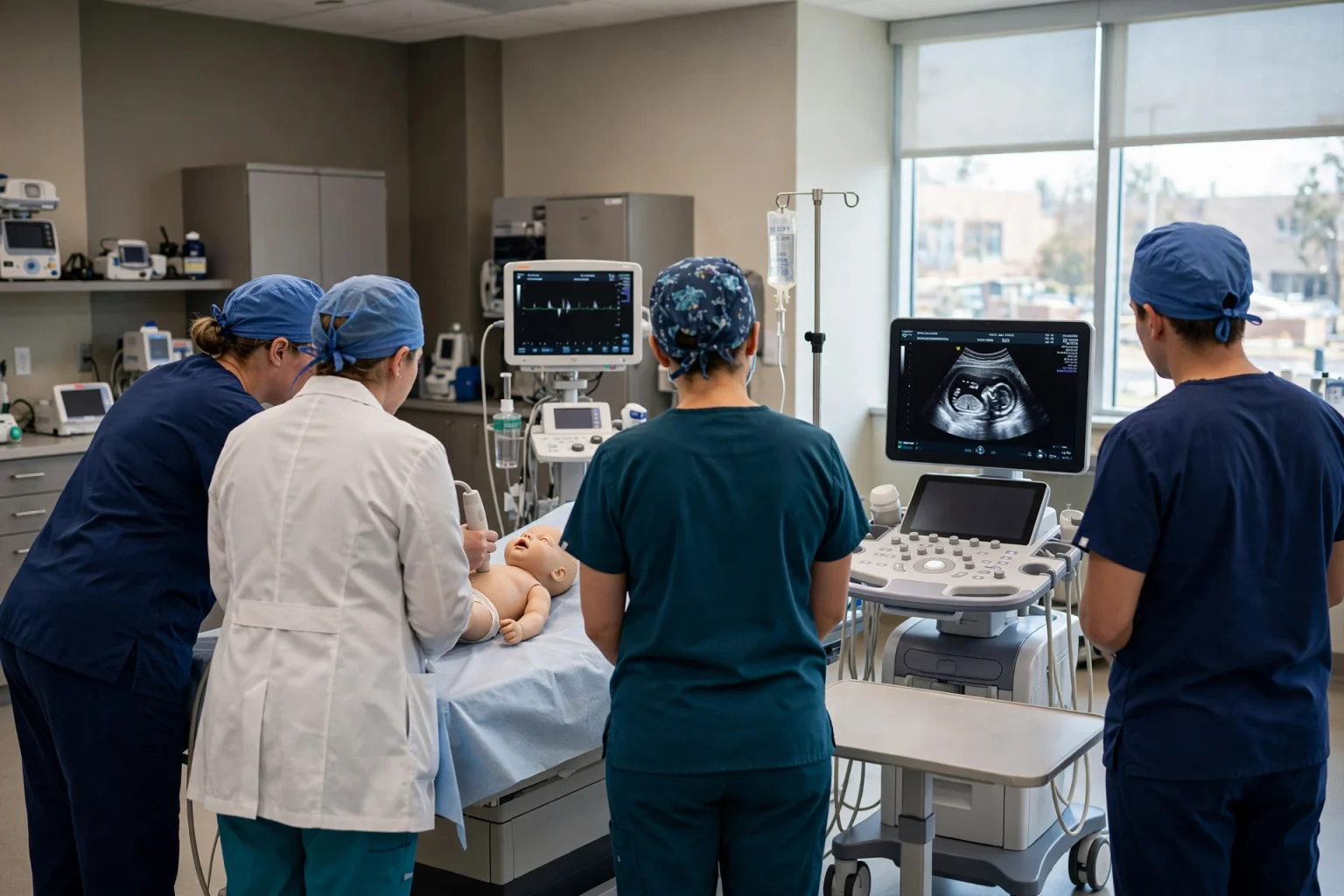
MOBILE, Ala. — Point-of-care ultrasound training has become a regular part of the pediatric residency curriculum at USA Health, where the Department of Pediatrics recently held its second annual hands-on pediatric POCUS workshop at the USA Health Simulation Center. The program aims to improve procedural safety and build clinicians’ skill and confidence in using bedside ultrasound to care for children.
The workshop brought together faculty trainers and learners from across USA Health, the academic health system of the University of South Alabama, and offered participants 6.5 continuing medical education credits.
What point-of-care ultrasound is
Point-of-care ultrasound, commonly called POCUS, refers to ultrasound imaging performed and interpreted by the treating clinician at the patient’s bedside, rather than in a separate radiology department. Using a portable device, a physician can quickly look at the heart, lungs, abdomen, blood vessels or other structures to help answer a specific clinical question in real time. Because ultrasound does not use ionizing radiation, it is particularly attractive for use in children.
Growing use in children’s hospitals
The local effort is led by USA Health neonatologist Dr. Gangajal Kasniya, MBBS, FAAP, who is also an assistant professor of pediatrics at the university’s Frederick P. Whiddon College of Medicine.
POCUS training programs are becoming more common at academic children’s hospitals, according to USA Health, because research shows they can improve factors such as how long it takes to reach a diagnosis and, in some situations, patient outcomes. The American Academy of Pediatrics now recommends structured training, credentialing and quality assurance programs to support safe use of the technology.
Data from the AAP also show that point-of-care ultrasound can speed clinical decision-making, guide follow-up imaging and reduce unnecessary testing, USA Health said.
Potentially lifesaving in the NICU
In neonatal intensive care units, a timely bedside ultrasound may be lifesaving in emergencies such as cardiac tamponade or pneumothorax, according to the information shared by USA Health.
As general background, cardiac tamponade occurs when fluid builds up in the sac surrounding the heart and puts pressure on it, preventing it from pumping effectively. A pneumothorax is a collapsed lung caused by air leaking into the space between the lung and the chest wall. Both conditions can become critical quickly, which is why rapid identification at the bedside can matter so much for fragile newborns.
From one workshop to a yearlong curriculum
The department held its first POCUS workshop in May 2025. Since then, it has finished the first year of a longitudinal POCUS curriculum for pediatric residents and has started the second year.
The curriculum includes six hands-on sessions each year, with three held during each half of the academic year. A longitudinal approach spreads training over time, allowing residents to build and reinforce skills through repeated practice rather than relying on a single course.
Foundations and high-yield procedures
According to Kasniya, the course addressed both foundational knowledge and high-yield procedural applications designed specifically for pediatric practice.
Instructors were drawn from a range of specialties, including radiology, cardiology, emergency medicine, pediatric anesthesia and neonatology, along with faculty from the Whiddon College of Medicine. Participants came away with a better grasp of the skills needed, and greater confidence, to bring POCUS into their everyday clinical work, USA Health said.
The role of simulation training
The workshop took place at the USA Health Simulation Center, where clinicians can practice skills in a controlled setting before applying them with patients. Simulation-based education is widely used in medical training because it allows learners to repeat procedures, receive feedback from experienced instructors and build competence without risk to patients.
What it means for families
For families in the Mobile area and the wider Gulf Coast region whose children are cared for by USA Health pediatric teams, the growing use of POCUS means more physicians trained to use bedside ultrasound to help guide care. Parents with questions about how imaging is used in their child’s treatment should speak with their child’s care team.