Mobile to Honor 118 Fallen Officers at Annual Memorial Service
Mobile law enforcement agencies held their annual Law Enforcement Memorial Service to honor the 118 officers who died in the line of duty in 2014.
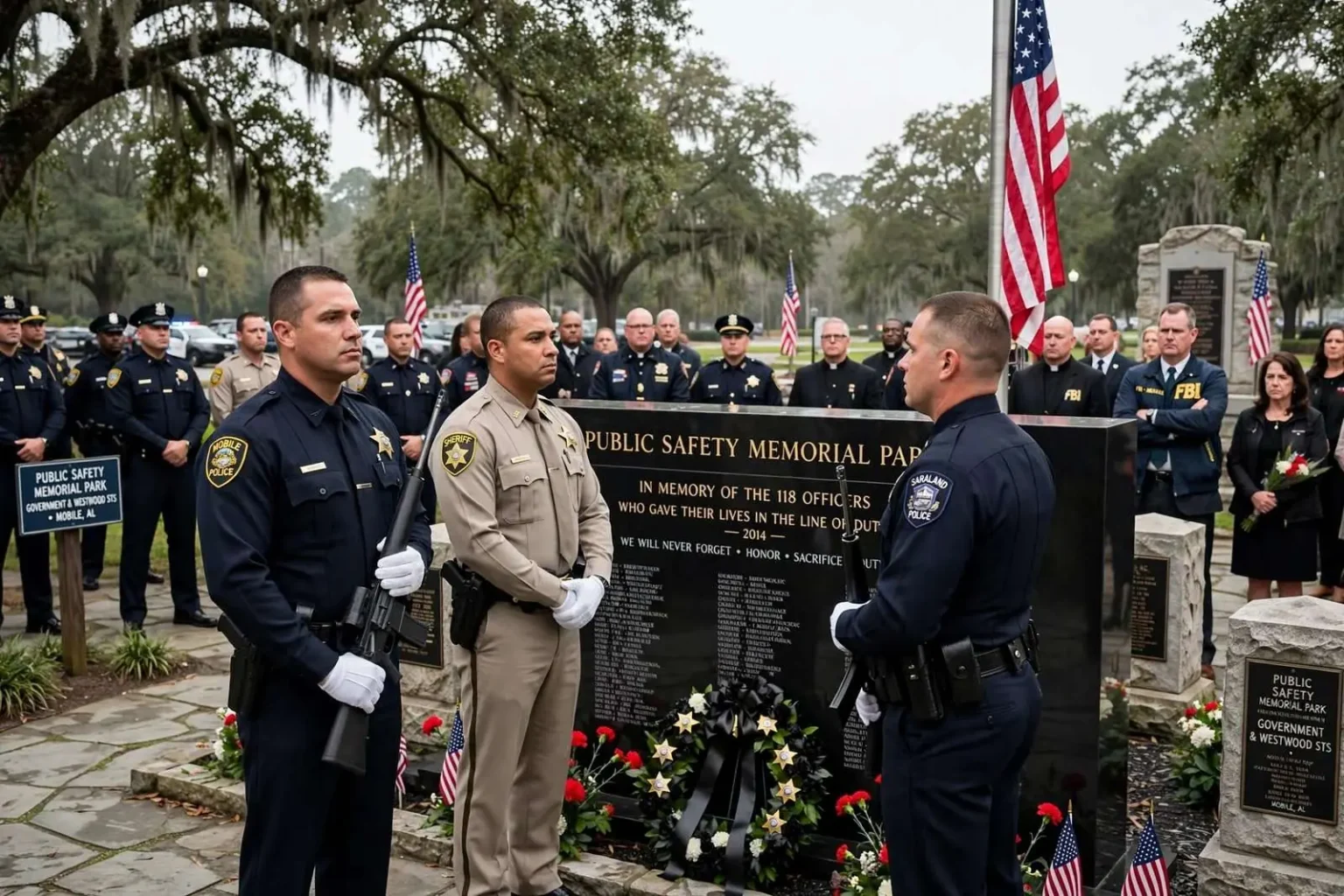
Mobile-area law enforcement agencies gathered Thursday morning to honor officers across the country who lost their lives in the line of duty, continuing an annual tradition that has become a fixture of the city’s public safety calendar. The Law Enforcement Memorial Service took place at Public Safety Memorial Park, near the intersection of Government and Westwood streets, and was open to the public, giving civilian residents the chance to stand alongside the officers, deputies, and federal agents who protect the region.
Assistant Mobile Police Chief Joseph Kennedy noted that 118 officers died in the line of duty nationwide in 2014, a sobering figure that organizers say underscores the risks officers face daily. Kennedy, speaking ahead of the ceremony, said seven Mobile police officers have died in the line of duty over the department’s history, a number that gives the local observance a personal weight for the men and women of the department who knew some of those officers as partners, mentors, and friends.
“It’s just a time for us to reflect and look back at our fellow officers,” Kennedy said of the annual service. The remark captured the tone organizers aim for each year: not a political event, not a recruitment pitch, but a quiet hour in which the law enforcement community and the public it serves pause together to remember.
A Park Built for Remembrance
Public Safety Memorial Park sits along the Government Street corridor in Mobile, and it was designed from the start as a place where the city’s tribute to fallen first responders is permanent rather than annual. Memorials of this kind serve a double purpose. They give departments a formal site for ceremonies like Thursday’s service, and they give families of the fallen a place to visit at any time of year, when the cameras and crowds are long gone.
Services at the park draw a cross-section of the region’s public safety community. Mobile police officers in dress uniform, deputies from the sheriff’s office, firefighters, dispatchers, and federal agents from the agencies that maintain a presence in Mobile all gather under the same trees. For younger officers, the ceremony is often their first sustained encounter with the history of the profession they have chosen, read out loud in the names and stories of those who came before them.
The timing of the service places it in the stretch of May when the nation formally honors its fallen officers. National Police Week in Washington, D.C., and Peace Officers Memorial Day have, over decades, grown into a national tradition of remembrance, and communities across the country hold their own local observances in the same period. Mobile’s service is part of that broader wave, timed so that local families can take part without traveling to the national memorial.
The Toll in Alabama and Nationwide
According to the Officer Down Memorial Page, the long-running independent registry of line-of-duty deaths, four Alabama law enforcement officers died in the line of duty in 2014. Two succumbed to heart attacks connected to their duties, while two others were killed in car accidents. The tracking organization also noted that a police dog died from gunfire that year, a reminder that the toll of law enforcement work extends beyond human officers to the K-9 partners who walk beside them.
The composition of that year’s Alabama losses reflects a pattern that safety experts have documented nationally. While gunfire remains the risk the public most associates with police work, heart attacks, traffic collisions, and other duty-related causes claim a substantial share of officers’ lives each year. The memorial service deliberately honors all of those losses, not only those that involve a confrontation, because the registry and the departments themselves treat every line-of-duty death the same way.
Nationwide, the 118 officers lost in 2014 represented dozens of agencies across nearly every state, from large metropolitan departments to small rural forces where a single death can devastate an entire town. Each name read at ceremonies like Mobile’s stands for a department that lost a colleague and a family that lost a member, and organizers note that the national figure tends to rise and fall from year to year but never reaches zero.
A Multi-Agency Show of Unity
Robert Lasky, special agent in charge of the FBI’s Mobile Division, addressed attendees at the ceremony, giving the federal presence at the event a speaking role. The FBI’s Mobile Division covers the southern Alabama region and works daily alongside local agencies on violent crime, public corruption, and counterterrorism matters, so its participation in the memorial underscores the extent to which modern law enforcement in the region operates as a joint effort.
Honor guards from the Mobile Police Department, the Saraland Police Department and the Mobile County Sheriff’s Office were expected to participate, lending a multi-agency show of unity to the proceedings. Honor guard duty is among the most visible and demanding assignments in any department, requiring precise drill work and, at memorial services, the emotional discipline to present colors, render honors, and fold flags while families watch.
The inclusion of Saraland’s honor guard reflects the way policing in Mobile County has become a shared enterprise across municipal lines. Saraland, the fast-growing city in the county’s northern reaches, operates its own full-service police department, and its officers work the same highways and respond to the same mutual-aid calls as their Mobile counterparts. When an officer falls anywhere in the county, departments across the region feel it.
The service, sponsored jointly by the Mobile Police Department and the Mobile County Sheriff’s Office Chaplain’s Office, has been held annually for years as a way for the law enforcement community and the public to pause and remember those who died protecting their communities. Chaplain-led involvement shapes the character of the event, bringing prayer, scripture, and pastoral care into a ceremony that is as much about the living, the grieving families, and the surviving officers as it is about the fallen.
What the Memorial Means for Families
For the families of fallen officers, annual services serve a purpose that no investigation, trial, or settlement can. They confirm, year after year, that the community has not forgotten. Survivors frequently describe the reading of names and the playing of taps as painful but necessary rituals, moments when their loss is acknowledged publicly rather than absorbed privately.
Departments also use the occasion to care for their own. The death of a colleague reverberates through a squad room for years, and chaplains, peer-support officers, and counselors increasingly treat memorial weeks as a natural time to check in with officers most affected by past losses. Mobile’s chaplaincy program, coordinated with the sheriff’s office, has made that pastoral follow-up part of the annual cycle of remembrance.
The tradition of formally honoring fallen officers stretches back more than a century in American policing, but the modern memorial movement took shape in the 1980s, when the national memorial in Washington was dedicated and departments began standardizing their own local observances. Since then, the annual service has become as fixed a part of police culture as the badge itself, a recurring appointment that departments keep regardless of whether the preceding year brought a local loss.
Mobile’s department, one of the largest municipal forces in Alabama, carries its own internal history of sacrifice, and the seven officers it has lost in the line of duty over its history are remembered not as statistics but as individuals whose names current officers know. Veterans of the department can often recall where they were when each died, and ceremonies like Thursday’s give that memory a structured, communal outlet rather than leaving it to private recollection.
County Sheriff’s Office deputies, who patrol the unincorporated stretches of Mobile County and operate the county jail, bring their own losses to the ceremony. The sheriff’s office covers by far the largest geography of any agency in the region, and its personnel face the same risks on rural roads and interstate corridors that city officers face on urban streets, a reality the joint sponsorship of the service is meant to reflect.
The participation of a K-9 remembrance, acknowledged through the registry’s accounting of a police dog killed by gunfire in 2014, resonates with handlers and the public alike. Police dogs serve as partners in the fullest sense, clearing buildings, locating suspects and missing people, and standing between their handlers and danger. Across the country, K-9 deaths are now recorded alongside human officers’ in most official registries, and their names appear on memorial walls with their own badges.
Community attendance at the service has varied over the years, but organizers consistently extend the invitation beyond the policing family. Civilian presence at a law enforcement memorial carries meaning in both directions, offering support to grieving departments and giving residents a fuller picture of the risks their public safety agencies shoulder. In a year when 118 officers died nationwide, that shared moment of acknowledgment is, in the organizers’ words, the least the community can offer in return.
Organizers say the memorial serves not only as a tribute to officers lost in Alabama but as a broader acknowledgment of the dangers faced by law enforcement personnel nationwide, from the biggest cities to the smallest towns. The ceremony closes another year of remembrance in Mobile with the same promise that animates similar services across the country: that the names of the fallen will be spoken, their service recorded, and their sacrifice carried forward by the officers who continue to wear the badge in their honor.