A New Memoir Revisits the Leverett Case and the Long Shadow of Abuse
Phyllis Hain's memoir, Diamond in the Dark, returns to one of Mobile's most sensational cases of the early 1980s and traces how a childhood of violence shaped the choices of a lifetime.
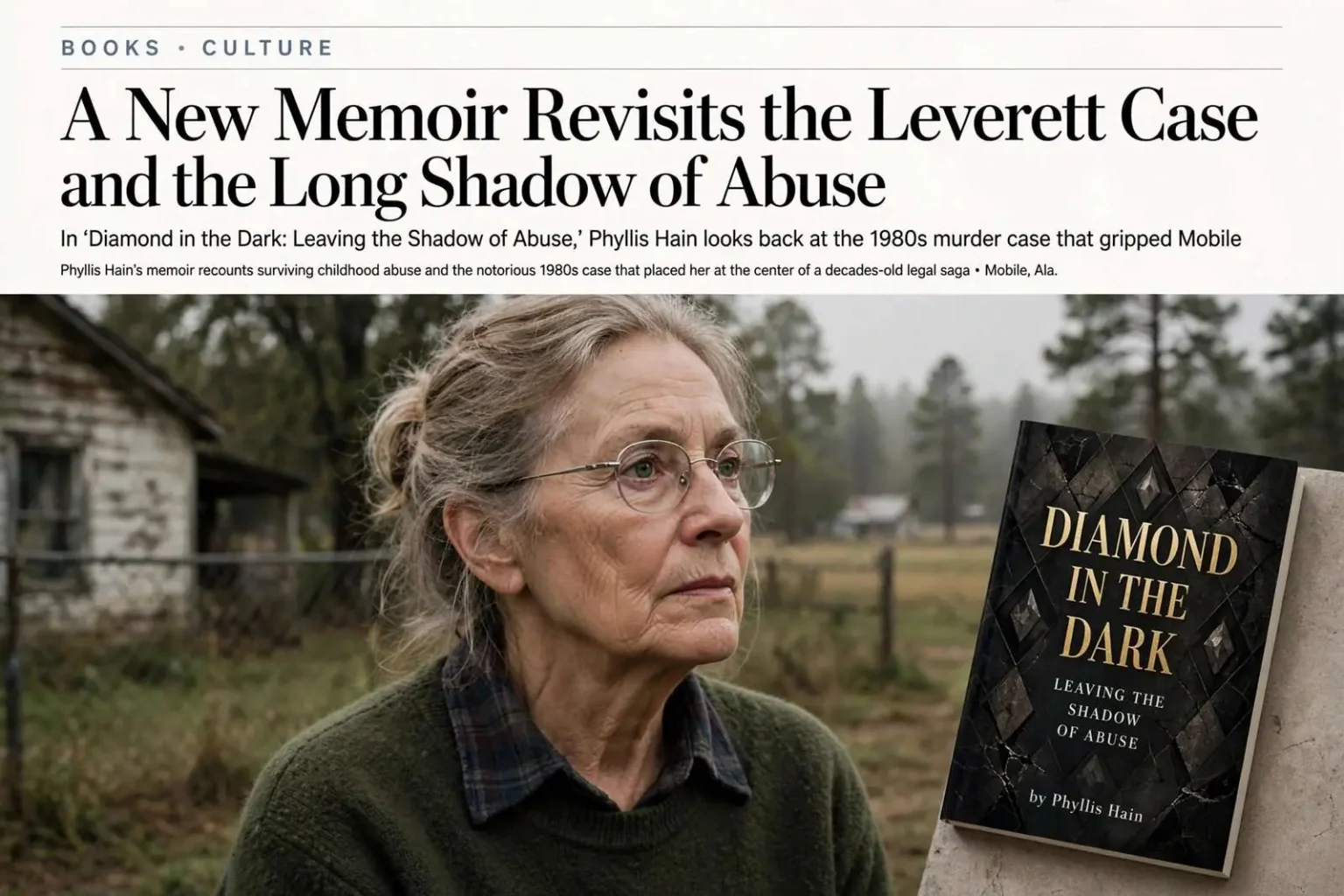
In the early 1980s, a story emerged from Mobile that reached the national press, playing out in headlines like a murder-mystery novel. It became known as the Leverett case, and the woman at its center has now told her own account in a memoir titled “Diamond in the Dark: Leaving the Shadow of Abuse,” by Phyllis Hain. For readers who remember the case as it unfolded, the book revisits ground that once dominated the city’s conversations; for those who never heard of it, it reads as an anatomy of how a private marriage became a public spectacle, and of the years of damage that set the whole story in motion.
A Case That Gripped the City
Paul Leverett’s wife was found shot, her throat cut, in the couple’s home — at first glance the victim of a burglary gone wrong. Six months later, Leverett married Phyllis, and the rumors began, with the law close behind. The speed of the remarriage, coming on the heels of a death that had never been cleanly explained, gave the case its grip on the public imagination. Mobile in that era was a city where such a story traveled by coffee pot and newsroom alike, and the national press found in it all the elements of a thriller: wealth, suspicion, a grieving household turned bridal, and a homicide investigation with no tidy answer.
Prosecutors first sought to convict Phyllis of perjury for her grand-jury testimony, but a judge threw the case out. The grand jury then indicted Leverett in a murder-for-hire scheme, and he was tried, convicted and sent to prison on the testimony of convicted felons. The legal saga that followed traced the full machinery of the courts — a grand jury, an indictment, a trial and a conviction resting on witnesses whose own credibility was, by definition, compromised. For the author, the experience of being investigated, interrogated and charged while still reeling from the events themselves is one of the memoir’s central ordeals.
Years later, Leverett was killed in prison, along with the warden’s wife and another inmate trusty, by a fellow prisoner. The account handed down was that Leverett died heroically defending the warden and his wife. As for the killing of his first wife, Leverett maintained his innocence to the end; in retrospect, the author writes, she is not so certain. That single, quietly devastating admission — a wife who lived through the case looking back with doubt the police could never prove — is among the most arresting passages in the book, and it is handled with the same unsentimental candor that marks the rest of the memoir.
The Deeper Story
Beyond the sensational headlines, the book is about the long-lasting effects of childhood abuse and how those wounds shape the choices that make a person who they become. The narrative begins in the 1950s, with a young, green-eyed Phyllis growing up in what should have been wholesome farm country outside Pensacola but was instead marked by family violence. The setting is familiar to anyone who grew up in the rural Panhandle: small farms, scattered communities, and households whose troubles stayed behind closed doors because there was nowhere else for them to go and no one empowered to intervene.
Her father, a World War II veteran, was later diagnosed with brain damage and post-traumatic stress. For most of his postwar life, the memoir recounts, his condition was largely ignored by the Veterans Administration and the medical community, leaving the family to fend for itself. That detail places the family’s story squarely within a generation of returning servicemen whose psychological wounds went unnamed for decades. Post-traumatic stress was not formally recognized as a diagnosis until 1980, long after the war had ended, and in the meantime families like the author’s absorbed the consequences alone — the flashbacks, the rages, the drinking — with no clinical language for what was happening at their kitchen table.
His binge drinking and violent rages, and the family’s acquiescence to them, formed the template against which Phyllis would measure relationships with men for much of her adult life. The memoir is most piercing in tracing that inheritance: how a child raised amid volatility learns to read moods, to placate, to normalize the abnormal, and how those survival skills follow her into adult relationships that replicate the danger they were formed by. The Leverett case, seen through this lens, is not merely a crime story but the endpoint of a chain of violence that began decades earlier and hundreds of miles from Mobile.
The author’s account also captures how a community processes a case like this one. Mobile of the early 1980s followed the Leverett story the way it followed weather — closely, personally, and with strong opinions — and Phyllis lived at the center of that attention while awaiting her own legal fate. The memoir describes what it costs to be a public suspect in your own city: the stares, the whispers, the reporters, the ordinary errands that become gauntlets. It is a dimension of famous criminal cases that newspaper coverage never records, and her rendering of it gives the book much of its emotional weight.
A Story of Survival
Ultimately, the book reads as the story of a woman determined to get it right, and who eventually did, after a long education in the school of hard knocks. The arc is not a tidy one. The author’s account includes the missteps and false starts that recovery from abuse almost always contains, and the memoir earns its resolution precisely because it refuses to shortcut the years of wrong turns that came first. Readers who come for the true-crime skeleton of the Leverett case will find the flesh-and-blood account of a person rebuilding a life underneath it.
It is a reminder that the law and society too often fail to protect an abused spouse until after the fact — and only then if the victim survives. That observation, written decades after the events described, has lost none of its force. The systems that respond to domestic violence — police, prosecutors, courts — overwhelmingly arrive after an injury has already occurred, and the memoir makes plain how little recourse existed for women of the author’s generation, particularly in small towns and rural communities where a family’s business stayed its own.
The memoir points readers toward resources such as Penelope House, the Mobile-area shelter where battered women and children can find refuge. The reference is deliberate and practical. Penelope House has served the Mobile area for decades as a lifeline for families fleeing violence, offering shelter and support at the moment of greatest danger — the period surrounding and immediately after a decision to leave. By naming it, the author converts her own history into something usable for the next reader who may be living inside a version of her past.
In its diary-style candor, the book recalls earlier tell-all memoirs that changed public conversation, and Hain closes by listing concrete ways readers can help. The genre has a long lineage — first-person accounts that dragged private violence into public view at a time when it was polite fiction to call it a family matter — and the author is conscious of standing in that tradition. The closing pages shift from narrative to instruction: volunteer, donate, believe, intervene, and support the institutions that shelter those who have run out of safe options.
From the Shadows Toward the Light
It is, in the end, a good story and a good read — one that may well get the conversation going. That is how the author frames her own hopes for the book, and the framing suits its dual nature: a reconstruction of one of Mobile’s most notorious criminal cases, and a meditation on the childhood damage that set its participants on their courses. The two threads braid together through the narrative, each making sense of the other, until the sensational events of the early 1980s read less like a mystery novel and more like a case study in how untreated trauma propagates through families and lives.
The memoir, published by Bancroft, is available in print for those wishing to follow Phyllis Hain’s journey from the shadow of abuse toward the light. Its pages do what the headlines never could: they introduce the whole person behind the case name. For Mobile readers, the book is also a local document — a first-person account of a case that once filled the city’s front pages, told from the inside by the person who lived it. And for readers elsewhere on the Gulf Coast, in the farm country outside Pensacola where the story begins, it is a recognition that the quiet violence behind closed doors, so long ignored, has always deserved exactly this kind of telling.