What Residents Love and Lament About Mobile: A Community Weighs In
Dozens of Mobile-area residents shared what they treasure and what frustrates them about the Port City, from riverfront beauty and Southern charm to schools, litter and downtown's future.
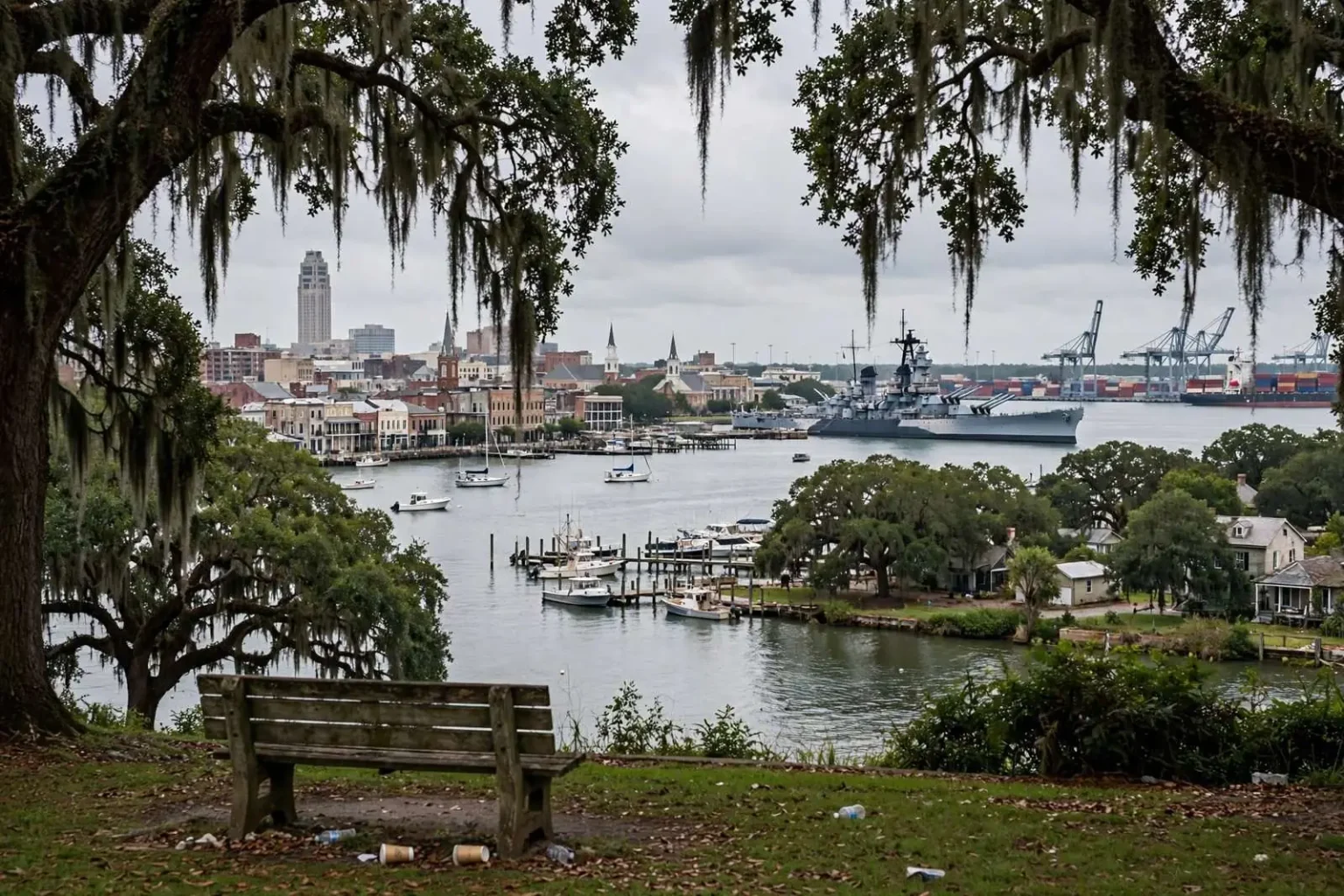
Ask enough people what they think of Mobile and a portrait begins to emerge, one drawn in equal parts affection and exasperation. That is what happened when a few dozen area residents were asked three simple questions: What do you like most about the city? What do you dislike most? And what is the one thing about Mobile you feel most strongly about, even if others might shrug it off?
The answers, gathered from lawyers, educators, salespeople, retired judges and hospital administrators, revealed a community proud of its setting and its heritage yet impatient with itself. The exercise captured something that official surveys and economic reports often miss: the day-to-day texture of living in a 300-year-old port city that has watched Southern rivals rewrite their downtowns while Mobile’s own revival has come in fits and starts.
What People Love
Again and again, residents pointed to Mobile’s relationship with the water. The Bay, the rivers and the nearby Gulf came up as sources of pride and easy recreation. Boating, fishing and the beach runs to Dauphin Island and the Florida line are woven into how Mobilians measure a good weekend, and the city’s identity as a Gulf port — shaped by the shipyards, the State Docks and the container traffic of the harbor — gives it an economic and cultural character that inland Southern cities lack.
So did the city’s scale. “Big enough to provide choices but not so big that it is overwhelming,” one lawyer put it, noting cultural offerings that stretch from opera to monster truck pulls and dining that runs from down-home to gourmet fusion. Mobile supports a symphony orchestra, a ballet, an opera company and a museum scene anchored by the Mobile Museum of Art, the History Museum of Mobile and the USS Alabama Battleship Memorial Park across the Bay, a cultural roster that surprises visitors who expect a city of Mobile’s size to offer less.
Neighborhoods drew warm reviews. Ashland Place, Oakleigh, Spring Hill, the newer subdivisions of west Mobile and the quiet of Dauphin Island were all named as places people were glad to call home. Others celebrated the region’s natural beauty, its skyline and what several described as the enduring Southern charm and friendliness of its people. The historic districts south of downtown, with their antebellum and Victorian homes shaded by centuries-old oaks, give the older quarters of the city a walkable, lived-in character that residents clearly treasure.
“People make a city, not land, rivers and buildings,” one respondent offered. “Mobile is special because Mobile’s people are special.”
What People Lament
If there was a single, recurring frustration, it was public education. Respondent after respondent singled out the school system and the county school board as an obstacle to growth. “Unless we provide a better education system for our next generation, Mobile will forever wallow around in the theater of mediocrity,” one man warned, tying schools directly to the city’s ability to attract higher-paying jobs.
The concern reflected years of upheaval in Mobile County’s schools, one of the largest districts in the state, where magnet programs had won national praise even as the system struggled with funding, leadership turnover and the knock-on effects of white and middle-class flight to private academies and suburban districts. For employers trying to recruit professional talent to the Gulf Coast, the reputation of the public schools has long been among the first objections they must overcome.
Downtown’s condition was another sore point. One resident lamented the “abandonment of downtown as a functional place of commerce,” while others worried about the neglect of historic structures and what they saw as unplanned, sprawling development. The complaint belonged to its era: Dauphin Street and the blocks around Bienville Square had not yet seen the restaurant and condo revival that would later transform the historic core, and shoppers had migrated to the malls and big-box corridors of west Mobile, leaving older commercial streets underused.
Litter and the unkempt appearance of some properties came up repeatedly. “There’s not enough pride to keep our city beautiful,” said Linda Steele, who nonetheless wanted her neighbors to know the city has “an amazing Symphony Orchestra.” The observation speaks to a theme residents returned to throughout: the sense that Mobile’s problems are as much about self-image as resources, a city that undersells assets its rivals would market relentlessly.
Concerns about crime and public safety surfaced too. Several respondents said they believed the police force was undermanned and underpaid, and a few argued that crime in parts of the city was under-reported. One resident raised worries about immigration enforcement, while another criticized what he considered lax traffic enforcement. Public safety staffing has been a recurring budget debate in Mobile, with pay levels for police officers and firefighters routinely cited as a reason for attrition to suburban departments and higher-paying private jobs.
The Things People Feel Most Strongly About
Asked to name the single issue closest to their hearts, respondents returned to familiar themes with real urgency. Jeff St. Clair, a hospital administrator, said he felt strongly both about staffing the police force and about the city’s need for western annexation, a priority he feared few shared. The annexation question — whether Mobile should extend its city limits westward along Airport Boulevard and Highway 98 to take in the populous, commercial unincorporated areas of Mobile County — has divided local politics for decades, with annexation proponents arguing the city’s tax base has been hollowed out while suburbs enjoy city services without paying city taxes.
Retired judge John F. Butler made the case for embracing tourism, arguing that Mobile’s history and beauty made it “truly poised to grow.” Mobile’s tourism case rests on assets few Southern cities can match: three centuries of history, one of the nation’s oldest Mardi Gras traditions, antebellum and Victorian architecture on a scale that draws preservationists from across the country, and a waterfront setting on Mobile Bay.
Others urged the city to hold on to its young talent. “I feel very strongly about keeping young talent, tomorrow’s leaders, in Mobile,” an educator said, adding that too much in the city had long been “controlled by people who would have retired decades before anywhere else.” The brain-drain worry is a constant in Gulf Coast cities: young professionals educated at the University of South Alabama, Spring Hill College and the University of Mobile too often begin their careers in Atlanta, Houston or Nashville, drawn by larger job markets and the perception that Mobile’s civic leadership offers fewer openings for a new generation.
Comparisons to Savannah, Charleston and New Orleans came up more than once, usually as a challenge: those cities had turned heritage into economic engines, and Mobile, respondents insisted, had the same raw material. Savannah’s restoration of its historic squares and Charleston’s tourism economy have become the standard references for Gulf Coast preservation advocates, proof that historic port cities can convert architecture and atmosphere into jobs, hotel nights and tax revenue without surrendering their character. New Orleans, two hours west on Interstate 10, demonstrates both the promise and the perils of a tourism-centered identity.
Ken Nixon offered a note of optimism, praising the local judiciary as “the best group of judges in the state” and describing a downtown he believed was reviving. That optimism, amid so much frustration, is itself characteristic of Mobile — a city whose residents are quick to catalog its shortcomings precisely because they believe so firmly in its potential.
Taken together, the responses sketched a city at a hinge point, confident in its bones and its beauty, restless about its schools and its leadership, and convinced that its best chapters were still unwritten. What emerges from the full range of answers is not a condemnation of Mobile but a demand from the people who know it best: that the city invest in its schools and its streets, market what Savannah and Charleston already market successfully, and hand a share of responsibility to the young people it has spent decades watching leave. The affection is not in question. What residents were really debating was whether Mobile, at long last, believes in itself as much as its people believe in it.
A Portrait Drawn From Ordinary Voices
The value of a canvass like this one lies in what it reveals about consensus. People who agreed on almost nothing politically — a retired judge and a hospital administrator, an educator and a salesperson — converged on the same short list of civic concerns: schools, downtown, appearance and public safety. And they converged just as clearly on what they love: the water, the neighborhoods, the food and the unforced friendliness that strangers from elsewhere notice within days of moving in.
The survey also illustrates how Mobile residents define themselves against their neighbors rather than against national trends. The references were local and regional — Dauphin Island, the Bay, Savannah, New Orleans — and the aspirations were regional too: not to become another Atlanta, but to claim the Gulf Coast’s historic-port-city crown that Mobile believes is rightfully its own. That instinct shapes everything from the city’s tourism campaigns to its debates over downtown development, and it explains why the Savannah comparison stings and motivates in equal measure.
What residents described, in effect, was the agenda Mobile has been working through ever since: investing in schools to hold families, restoring the historic core to draw people back downtown, marketing Mardi Gras and the historic districts as economic assets rather than mere traditions, and extending police staffing and city services to match the population that growth has delivered. Each respondent answered three simple questions about one Southern city. Together, they produced something closer to a civic blueprint — drafted by the people who would have to live with it, and who love the place enough to demand better of it.