Orange Beach Council Declines Appraisal, Ending Pursuit of $14 Million RV Park Purchase
A motion to authorize a $15,000 appraisal of the 23.7-acre Beech RV Park failed at a special-called Orange Beach City Council meeting, effectively ending the city's pursuit of the $14 million property.
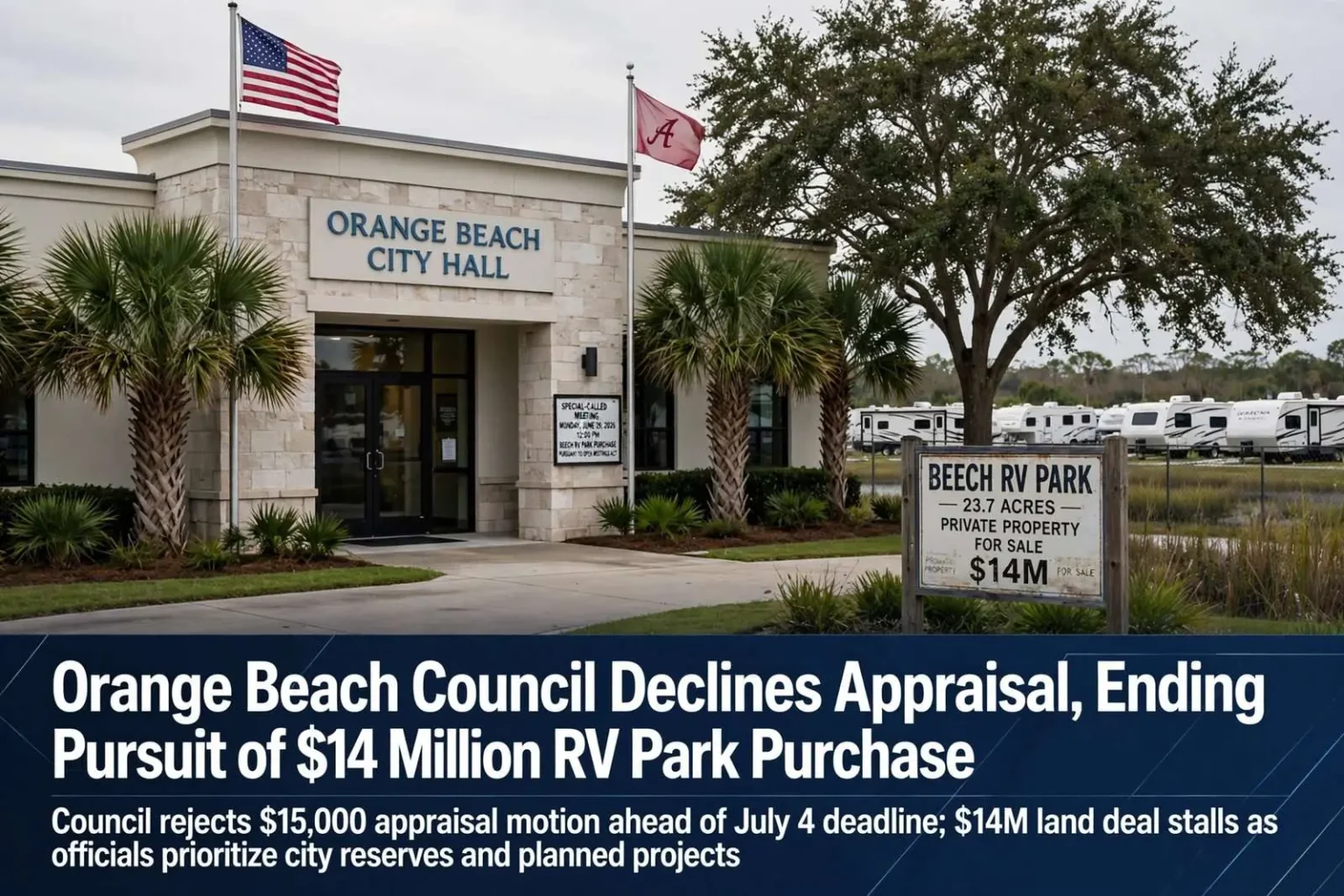
The Orange Beach City Council walked up to a $14 million land deal and then declined to take the first step toward it. At a special-called meeting held Monday, June 29, at noon at Orange Beach City Hall, a motion to authorize an independent appraisal of the Beech RV Park property failed. Without an appraisal, and with a hard deadline approaching, there was no realistic path forward for the purchase.
The Property and the Deadline
The land in question is the Beech RV Park, a 23.7-acre parcel zoned primarily as a mobile home park. A private party held the land under contract and offered to convey that purchase option to the city before the contract expired. The city faced a July 4, 2026, deadline tied to that third-party option, which is what forced the special-called meeting rather than allowing the matter to move through a regular agenda cycle.
Alabama's Open Meetings Act generally requires at least seven days' public notice for a regular meeting but allows a special-called meeting on as little as 24 hours' notice, which is how councils handle time-sensitive business between regular sessions.
The asking price was $14 million. Baldwin County assessed the land value alone at $4.729 million in 2026, though that figure does not account for revenue generated by the RV park as an operating business. The gap between the assessment and the ask was one of several points that drew council skepticism.
The Financial Case Against It
City Administrator Ford Handley presented the numbers and did not soften his conclusion. His recommendation was not to proceed.
Orange Beach currently holds roughly $120 million in reserves. A $14 million purchase would consume about one-eighth of that cushion before a single dollar was spent on improvements. And improvements would be required.
- Drainage: Estimated at $1 million to $5 million depending on the scope of work.
- Staffing and equipment: Four new staff positions, plus trucks and equipment, at roughly $464,000 in first-year costs alone.
Handley warned that committing those resources could require delaying projects already in the city’s pipeline, including a new pool, fitness center upgrades and a proposed civic center. In effect, the council was being asked to weigh an RV park against amenities residents have already been told to expect.
The Appraisal Problem
Roughly an hour before the meeting began, the process took an awkward turn. Heron Valuation Group withdrew its original $8,500 appraisal quote. Frank Reed of Heron told Handley the firm could not meet the city’s compressed timeline. That left exactly one appraisal option on the table, at $15,000.
A motion was made to adopt a modified resolution authorizing an appraisal of up to $15,000. The motion failed. With no authorized appraisal, the council could not establish an independent value for the property in time to act before the July 4 deadline, and members indicated the purchase had no path forward under that timeline.
Questions Raised From the Dais
Council members pressed on several fronts during the discussion. One line of questioning concerned whether the city could bypass the intermediary entirely and negotiate directly with the Beech family. Handley said the letter from the intermediary indicated direct negotiation with the seller was possible, which raised the obvious question of why the city would pay a premium to acquire someone else’s option.
A council member also noted that the property’s size had been described inconsistently throughout the process, listed at 16.2 acres, 23 acres and 28 acres at different points before 23.7 acres was ultimately confirmed. For a parcel carrying an eight-figure price tag, that inconsistency did little to build confidence in the underlying due diligence.
Several members voiced open doubt about whether the property was worth $14 million at all. One observed that other businesses had evaluated the parcel and passed on it, suggesting the market had already rendered a verdict.
The Pirate Theater Withdrawal
Handley also confirmed that the developer behind the proposed Pirate Theater has withdrawn its application for the property. That removes one of the competing visions for the site and changes the calculus for whatever comes next.
Executive Session and What Follows
After the failed motion, the council moved into executive session to discuss pending litigation. The session was expected to run about an hour, with no plan to reconvene in open session afterward.
For residents, the practical outcome is that a substantial parcel in a city with very little undeveloped land remaining will stay in private hands for now. Orange Beach is hemmed in by water on multiple sides, and every acre that changes hands carries outsized consequence for what the city can build in the future. The council’s decision preserves its reserves and its project schedule, but it also forecloses, at least for this cycle, the opportunity to control the fate of nearly 24 acres.