The Boy Who Rowed Out to Farragut’s Fleet: A Mobile Family’s Memoir Begins
A memoir by Sister Marie Emilie, a Mobile-born nun, opens with an Irish immigrant on the docks, a wounded Confederate prisoner, and a boy summoned home by Admiral Farragut himself.
MOBILE — In March 2005, readers were introduced to the first installment of “The Rock Whence I Was Hewn,” a family memoir written by Sister Marie Emilie, S.N.D. — born Elizabeth Zoe Walsh (1892-1979) — recounting the life and times of the Walsh family and of the city they had called home for generations. She began, as memoirists of a certain age often do, by explaining why she had finally sat down to write.
“This is one of those things I have been wanting to do for a long time,” she wrote, “not so much for my own sake, but because so many of you have asked me to do it.”
As the oldest surviving member of the Joseph Michael Walsh side of the family, she felt the obligation of the last witness. The title came from a phrase she had once read in a book by the poet and novelist Alfred Noyes, who described his homeland as “the rock whence I was hewn.” She addressed her readers — her family — directly: “You have much to learn about the rock whence you were hewn.”
The framing says a great deal about the kind of memoir this is. Sister Marie Emilie wrote as a religious — the initials after her name mark her membership in the Sisters of Notre Dame — but the voice throughout is that of a family historian, writing to cousins and descendants scattered by the decades, recording what she had heard and seen because no one else now living had heard it from the people who were there. Family memoirs of this kind circulate in typescript among relatives for a generation or two and then, too often, vanish. Serialized in print, the Walsh account became a small act of preservation for one of Mobile’s old Catholic families — the sort of chronicle in which the city’s story is told not through its public events but through one household’s scrapes, losses, and small acts of survival.
Two Brothers, One Continent
The family, she explained, was French and Irish. The Irish side arrived in the early 1840s, almost certainly driven out by the potato famine that emptied whole counties of ambitious young people.
Two brothers, Richard and Tom Walsh, sailed from Ireland, landed in New York and struck out for the interior. Somewhere around Nashville they parted. Tom went west and eventually settled in Montana, where, judging by the names of his descendants, the Walshes became a numerous clan. Richard came south, to be nearer the sea.
Their parting around Nashville belongs to a pattern familiar to anyone who has traced Irish immigrant families through the American interior. The famine years of the 1840s pushed a million or more people out of Ireland in the space of a few years, and the ports of arrival — New York above all — were way stations rather than destinations for many of them. Brothers and cousins split at crossroads towns, following whatever work or kinship pulled them: one branch west to the mining and ranching frontier, another south to the ports and river towns of the Gulf. The Walsh brothers’ divergence left two family trees an ocean of continent apart, and the memoirist grew up knowing the Montana branch only through its names.
“The sea has always been in the Walsh blood,” the memoirist observed — an inheritance she believed explained why so many of her relations were drawn to the beaches, the Gulf, and anything that was really water. Richard made his way to Mobile, found work along the docks, and set his sights on a business of his own. Mobile in the 1850s was exactly the kind of city that rewarded that ambition: a cotton port whose wharves, warehoused bales, and steamboat trade made it one of the busiest shipping points in the South, and a city whose docks required exactly the kind of steady, physically able men the famine had scattered across the world.
Sometime between 1850 and 1852 he married Mary Ann Jackson, an Irish girl about whom the family record preserved almost nothing. The children came in order: Joseph M. Walsh — the memoirist’s father, born, according to Mobile records, on March 14, 1854 — and Mary Ann, called Aunt Sis; then Uncle Jack, Aunt Lil, Aunt Addie, and last of all Uncle Lee.
The nickname Aunt Sis for the eldest daughter is the kind of small, durable family usage the memoir preserved wherever it could — the tags by which a household’s members are known across generations, outliving the formal names that appear in church registers and census rows. The 1850s census takers and diocesan records of Mobile catch such families only in glimpses; it is memoirists who give them their faces.
Shiloh, and a Prison Ship in Boston Harbor
The family grew and prospered until the outbreak of the Civil War. Richard Walsh joined the Southern army. A friend, Emil Herpin, went with him, and the two fought together until Herpin was killed at Walsh’s side at the Battle of Shiloh in April 1862. Walsh was wounded in the same action and taken prisoner. That ended his active service.
Shiloh, fought on the Tennessee River at Pittsburgh Landing in early April 1862, was at that point the bloodiest battle of the war — two days of fighting that stunned both armies with their casualties. Alabama regiments were heavily represented in the Confederate army there, and men like Walsh and Herpin, dockside tradesmen from a Gulf port, stood in the sorts of formations that absorbed the worst of the first day’s fighting. For the Walsh household in Mobile, the news from Tennessee would have arrived as such news always did in the war’s first year — uncertain, days late, and carried by newspapers printing casualty lists that no one could match to their own people until someone came home or did not.
He was shipped north and confined on a prison ship in Boston Harbor, where he remained for years past the point of any military necessity — because, his granddaughter recorded, he refused to take the oath of allegiance to the United States.
Boston Harbor’s islands had been repurposed during the war as prisoner-of-war stations, and Confederate officers captured in the western and southern theaters sometimes found themselves confined there, hundreds of miles from any family able to reach them. For a Mobile man whose household contained small children, the distance was as complete a separation as a prison wall. And the choice he made — declining an oath that would have freed him, probably years earlier — was the kind of small, stubborn loyalty the memoirist clearly regarded as defining of her grandfather’s generation. It cost him years and gained him nothing practical; it was simply who he had decided to be.
How the family survived in his absence, she did not know. “I know that the war continued and they suffered everything that war usually brings with it,” she wrote, “although the fighting itself in the form of actual combat did not reach Mobile.”
That admission is characteristic of honest family history — the memoirist declines to invent what the record does not hold. What is known is the context: with the city’s men at the front and its breadwinners imprisoned far away, the households of Mobile ran on the labor and ingenuity of women and older children, contending with shortages, inflation, and the improvisations of a wartime economy. Mobile escaped combat for most of the war, which spared its families the burning that visited other Southern cities, but spared them nothing else.
A Note from the Admiral
Mobile was, however, a crucial port, and blockade runners used it freely. In response the Union sent Admiral David Farragut and a fleet to seal the harbor.
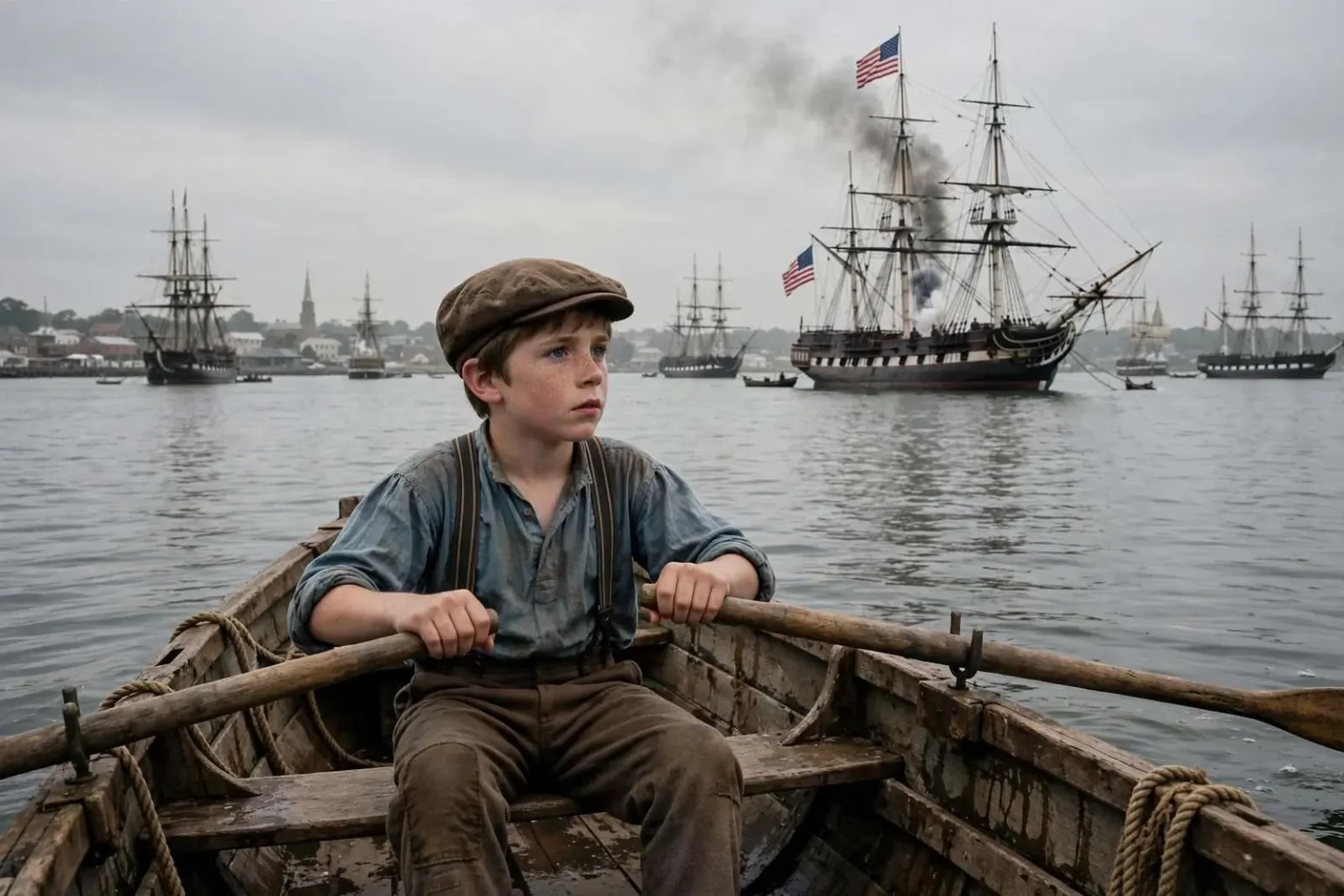
Joseph Walsh was a boy of about 11 when Farragut’s ships anchored in the bay. He was captivated. He took to standing on the docks watching the vessels ride at anchor, and eventually worked up the nerve to steal a rowboat lying alongside the wharf and pull himself out for a closer look.
The scene belongs to a very particular stretch of Mobile’s history — the years when the presence of the United States Navy sat within sight of the city’s own wharves, close enough that a curious child could study it at leisure and, eventually, get himself into the kind of trouble only a waterfront boy can. Farragut was by then the most famous naval officer in America, the captor of New Orleans, and the fleet he brought to the Gulf in preparation for the campaign that would close Mobile Bay was the largest concentration of naval power the city’s people had ever seen at anchor.
His mother, occupied with her household, had no idea where he was — until there was a knock at the door. She opened it to find a Union sailor, an apparition about as welcome in a Confederate household as any that could be imagined, holding her son by the arm and carrying a note.
The note was from Admiral Farragut. It asked, politely, that she keep her boy clear of the Union ships, as his sailors could not guarantee his safety if he kept rowing out to look at them.
“Unfortunately,” the memoirist added with evident regret, “my grandmother did not have enough respect for the ‘Yankees’ to keep the note, so it is one of the things we do not have. However, I know the story to be true.”
The lost letter is the memoir’s aching detail — a document signed by one of the great figures of American naval history, written to a Mobile woman about her eleven-year-old, and thrown away out of wartime spite. Sister Marie Emilie’s insistence that the story is true, told to her within the family’s living memory, is the historian’s substitute for the artifact.
Why It Endures
The vignette captures something particular about Mobile in wartime — a besieged city where the blockade was close enough that a curious child could row out to it, and where the commanding admiral of the enemy fleet took the trouble to send a boy home to his mother rather than let him drown.
It is also the memoir working exactly as its author intended. A family chronicle earns its keep not in general statements about the past but in the specific, checked-against-nothing details that only a household remembers: a friend’s name, a battle, a refusal, a note from an admiral, a grandmother’s discarded paper. The Walsh story reaches back through famine, immigration, war, and occupation to a rowboat on Mobile Bay, and delivers it all in the first person of the last witness. The next installment turned to the French side of the family.