A Courthouse Ceremony for Judge Sarah Hicks Stewart, and a Season of Kickoff Rallies
Mobile County's newest circuit judge was set for a public investiture at the courthouse, and a string of campaign kickoffs signaled that the 2006 election season had arrived at Government Street.
MOBILE — Mobile County’s newest circuit judge had already taken the oath in private and gone to work, but the legal community was preparing to mark the occasion properly.
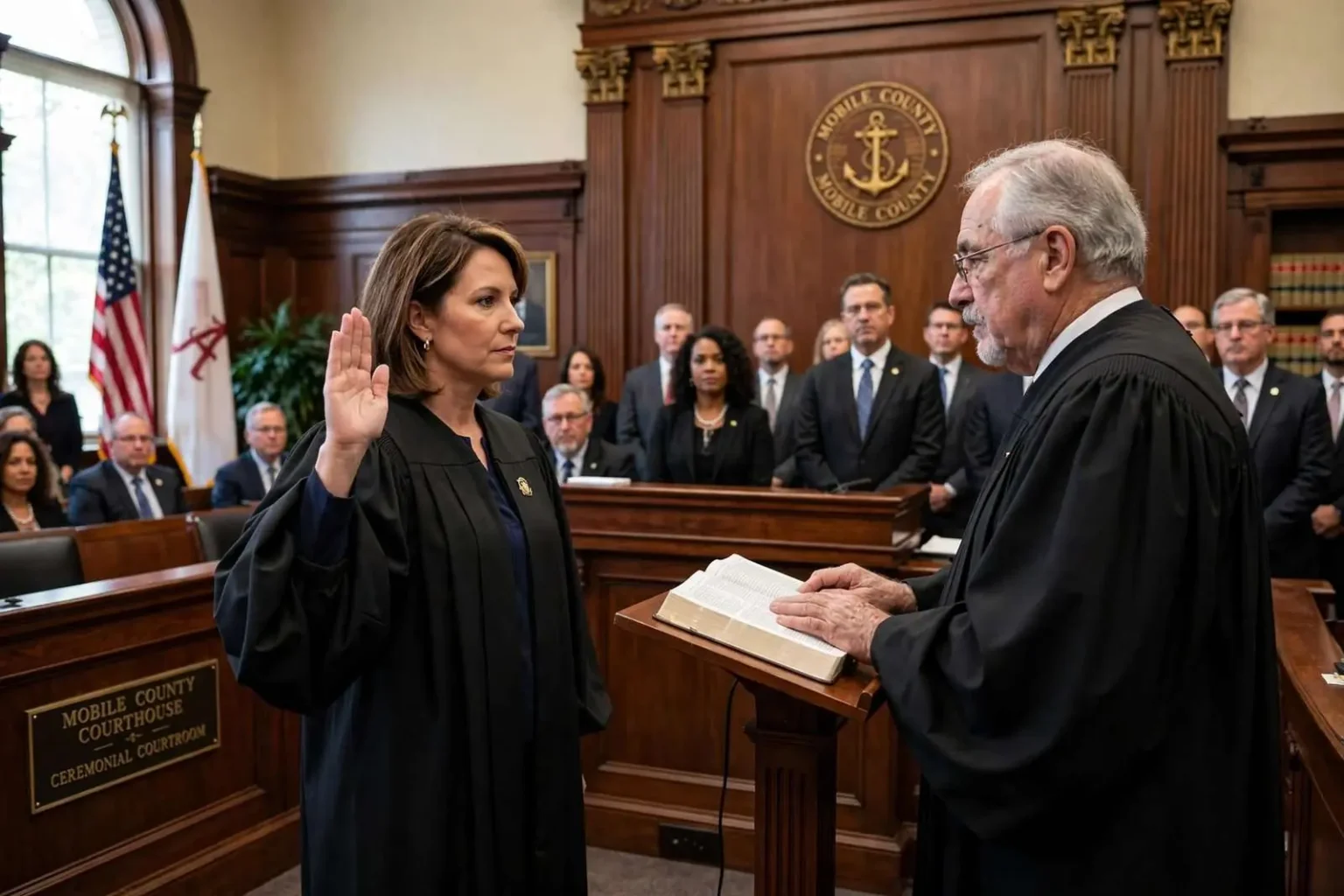
A public swearing-in ceremony for Circuit Judge Sarah Hicks Stewart was scheduled for 11 a.m. Friday, Jan. 27, in the ceremonial courtroom of the Mobile County Courthouse. Retired District Judge Dominick Matranga was to preside. The choice was not a distant one: Stewart’s brother, who had also been her law partner, was married to Matranga’s daughter. In a courthouse where families, firms and campaigns have long overlapped, the arrangement drew notice without drawing objection.
The detail said something accurate about Mobile’s legal community, where judges, prosecutors and practicing attorneys frequently share surnames, firm histories and social ties going back generations. A presiding judge connected by marriage to the new appointee’s family was, by local standards, an unremarkable fit — the sort of arrangement that raises eyebrows elsewhere and barely registers at home.
Sworn In First, Celebrated Later
The formal oath had already been administered so that Stewart could begin hearing cases without delay. The January ceremony was the civic version — the one that lets colleagues, courthouse staff and the public witness a judge’s installation on the bench.
The sequencing was practical. Courts cannot leave a vacancy open while invitations go out, so the working oath came first and the ceremony followed, giving the bar and the public their formal moment while the docket kept moving.
Circuit judges in Alabama handle the state’s most serious criminal cases and its largest civil disputes, and an appointment to that bench is among the more consequential decisions a governor makes at the county level. Stewart had been named to the seat by Gov. Bob Riley, filling the vacancy created by the death of presiding Circuit Judge Bob Kendall.
In Alabama, an appointed judge does not serve indefinitely on the strength of the appointment. The seat still had to be won at the ballot box, and Stewart moved quickly to prepare for that possibility.
The stakes for litigants were concrete. A circuit seat in Mobile County means presiding over capital murder trials, major product liability and business litigation, and the civil dockets that have made the county a recurring venue for large claims. Whoever holds the position shapes scheduling, settlements and trial outcomes for years, which is why appointments to the bench are watched as closely as any elected office in the courthouse.
Money Arrives Before an Opponent Does
According to courthouse sources, Stewart raised roughly $15,000 within a day or two of opening her campaign account — a show of early strength intended less to defeat a rival than to discourage one from appearing. A funded war chest assembled before anyone announces is the oldest deterrent in Alabama judicial politics: it tells prospective opponents that the race will be expensive before it begins.
She faced the prospect of opposition in either the Republican primary that summer or in the general election in the fall, and neither had yet materialized. Her Republican campaign was to be launched formally at a get-together from 5 to 7 p.m. Thursday, Feb. 9, at Wintzell’s Oyster House on Dauphin Street downtown — a room that has hosted a great many Mobile political beginnings.
The choice of venue was its own message. Wintzell’s, a downtown institution, has long been where Mobile candidates gather supporters around oysters and sweet tea to announce intentions, and booking it for a campaign kickoff placed Stewart’s race squarely in the city’s political season.
The Bakery Cafe Books a Busy Week
Stewart was not the only candidate setting out chairs. Jo Jo Schwarzauer, then serving as court administrator, planned to kick off her Republican campaign for circuit clerk with a rally at the Bakery Cafe from 5 to 7 p.m. Tuesday, Feb. 7.
Schwarzauer had worked at the county courthouse in a variety of assignments for nearly 30 years, a résumé that in clerk’s races often counts for more than any endorsement. The office rewards institutional knowledge — familiarity with filings, fees, juries and the daily machinery that keeps a courthouse functioning — and few candidates could claim a longer apprenticeship than the sitting administrator.
Area business and civic leader David Cooper agreed to chair her campaign.
The circuit clerk’s job carried a starting annual salary of about $58,000 and a six-year term. The clerk is the custodian of the court’s records and the manager of its paperwork — an office that rarely makes headlines but that every lawyer in the county depends upon. Case files, subpoenas, juror summonses and the money that moves through the courts all pass across the clerk’s counters, making the position one of the least visible and most operationally important in county government.
The Bakery Cafe was also the site of District Judge Judson Wells’ kickoff at 5:30 p.m. Thursday, Feb. 9. The Republican incumbent had no announced opposition.
Wells had been appointed to the district bench in 1997, ran unopposed in 1998 to fill the unexpired term of retired District Judge Dominick Matranga, and ran unopposed again for a full term in 2000. Two cycles without a challenger had made his seat one of the quietest in the courthouse, and the early kickoff suggested he intended to keep it that way for a third.
What the Robes Pay
District judges at the time drew about $111,000 a year, but Wells’s length of service allowed him to retain a county supplement that lifted his total compensation to roughly $146,000 annually.
The district bench handles misdemeanors, preliminary hearings, small civil claims and much of the daily traffic of the justice system, and its six-year terms have historically been quiet affairs in Mobile County. The volume is high — thousands of cases a year — but the politics are usually low, and most district judges serve out their terms without ever facing a serious race.
That pattern looked likely to hold. Of the sitting district judges, none was expected to draw opposition, according to sources in both the Democratic and Republican parties — a rare point of agreement between the two organizations as the 2006 cycle got under way.
The quiet district bench contrasted sharply with the contested top of the courthouse. While the district judges prepared to coast, the circuit clerk’s race and Stewart’s new circuit seat were drawing early money, chairs and schedules — evidence that in Mobile County, competition concentrates where the offices are most powerful, and falls away where they are most routine.
Why It Mattered
Judicial elections in Alabama are partisan, which means that judges must raise money, hire consultants and stand before voters in the same primaries as candidates for governor and sheriff. The state’s courts are elected by party label, so a seat on the bench is contested with the same machinery — fundraising calls, direct mail, signage — that surrounds any other office.
Critics have long argued that the arrangement forces judges to solicit contributions from lawyers who will later appear before them. Defense attorneys, plaintiffs’ lawyers and corporate counsel all end up on donor lists, and the money has historically flowed heavily from trial lawyers and business interests whose cases dominate state dockets. Alabama’s judicial races have at times drawn national attention precisely because of those sums.
Defenders answer that election keeps the bench accountable. Voters, in that view, are better judges of a candidate’s temperament and record than any appointing governor, and the discipline of a campaign is worth the awkwardness of the donor ledger. The argument has run through Alabama politics for a generation, and neither side has carried it decisively — the elections remain, and so does the fundraising.
Either way, the practical effect in Mobile that winter was plain enough: a new judge who had been on the job only weeks was already raising money, and the courthouse crowd was booking rooms.
A Courthouse in Campaign Season
The concentration of kickoffs in a single week — Schwarzauer on Feb. 7, Stewart and Wells on Feb. 9 — turned two downtown restaurants into the early polling places of the 2006 cycle. In Mobile, where judicial and county offices are contested in partisan primaries, the winter social calendar effectively becomes the first stage of the election, months before any ballot is printed.
For Stewart, the sequence was rapid even by local standards: appointed by the governor, sworn in and working, publicly celebrated, funded, and formally launching a re-election campaign — all within weeks of taking the seat that Judge Bob Kendall’s death had left open. What remained was the part no appointee controls: the primary that summer and the general election in the fall, in which the seat would either be hers by acclamation or decided at the ballot box like any other office in the courthouse.