Mobile Police Host Fish Fry to Reconnect With Campground Neighborhood
Mobile police and city leaders are hosting a community fish fry in the Campground area after a major drug enforcement operation there.
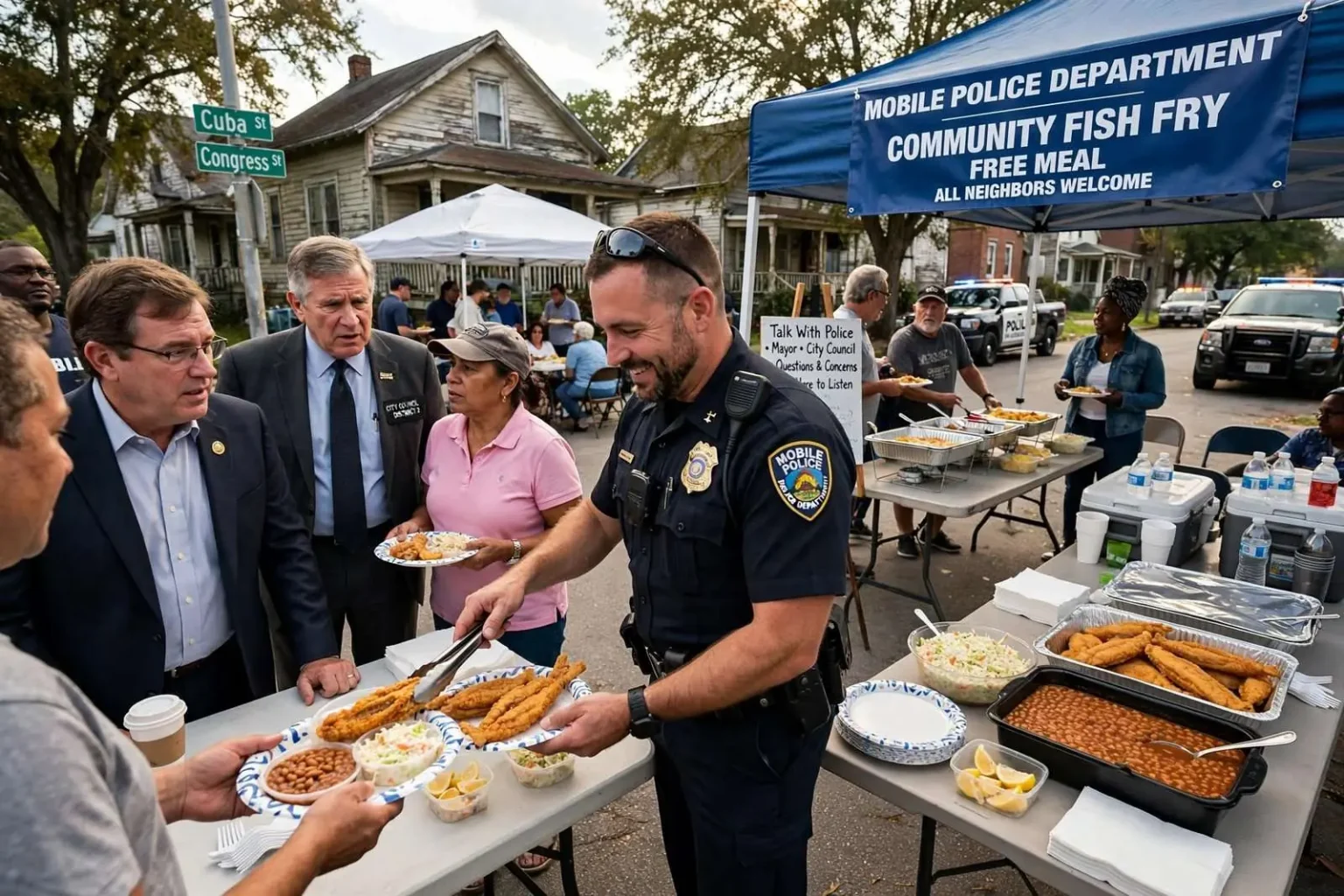
A month after a large-scale drug enforcement sweep shook the Campground and Bottoms neighborhoods, Mobile police are returning to the same streets with a different goal: building trust over a plate of fried fish. City officials plan to spend an afternoon at the corner of Cuba and Congress streets, where officers will serve fish, baked beans and coleslaw free of charge to residents. The setting could hardly be more deliberate — an ordinary street corner in the heart of the area where the arrests happened, tents and folding tables where patrol cars stood a month earlier, and officers behind the serving line instead of at the doors of suspected drug houses.
Police leadership, the mayor and the district’s city councilman are expected to attend and speak directly with neighbors. That lineup matters to residents who have watched previous enforcement actions come and go without much follow-up: when the city’s top officials show up in person to eat fried fish and take questions, it signals that the arrests were meant to be a beginning rather than an ending. The event is scheduled to run through the afternoon, giving residents who work during the day a chance to stop by on their way home.
The gathering follows an operation in which investigators, after months of undercover work gathering evidence on drug activity in the area, carried out coordinated arrests at several homes. The sweep was the product of sustained investigation rather than a response to a single incident — months of complaints, undercover purchases and surveillance that built cases strong enough to move on in a single day, at multiple locations, before anyone could be tipped off.
Dozens of people were taken into custody as authorities moved through the neighborhood, an effort that drew mixed reactions from residents who watched the operation unfold from nearby sidewalks. Some neighbors expressed relief at seeing police take action, describing years of frustration with drug activity and its effects on their community, while noting they were glad city leadership was following up in person rather than simply moving on after the arrests.
That mixture of relief and wariness is familiar to anyone who has lived through a major enforcement action in their own block. Arrests remove people from the neighborhood, but they also bring a surge of police activity, disrupted routines and questions about what comes next. Residents whose homes back up to the targeted houses have lived with the activity for years; a single morning of arrests, however welcome, does not undo the accumulated strain. The fish fry is designed to answer the question that follows every sweep — now what? — face to face rather than through a press release.
Why a Fish Fry Instead of a Town Hall
Organizers set up tents and seating at the intersection for the event, with police leadership planning to spend the afternoon fielding questions and concerns directly from the people who live there. The choice of format is intentional. A town hall meeting in a church basement or a community center carries a formality that keeps some residents away, particularly those who are wary of police or have had negative encounters with the justice system. A plate of fish and a folding chair on the corner where the arrests happened lowers the barrier: come as you are, eat, and talk if you want to.
The Campground and Bottoms are among Mobile’s most historic neighborhoods, communities that grew up just beyond downtown in the decades after the Civil War and built their identity around family churches, schools and block-by-block social ties. Like many older urban neighborhoods across Alabama, they have weathered decades of economic disinvestment, and the drug activity that prompted the sweep is as much a symptom of that decline as a cause of it. Residents who have stayed through the hard years tend to describe the same reality: the neighborhood is worth saving, and the people causing trouble are a minority the majority is tired of carrying.
Officials describe the fish fry as part of a broader effort to break cycles of violence and drug use in the Campground area through sustained engagement rather than one-time enforcement. The theory behind that approach is straightforward. Arrests address the supply side of street-level drug activity, but they do nothing about the conditions that allow it to regrow — vacant houses, absent landlords, young people with nowhere to go, and residents too discouraged to keep reporting what they see. Engagement events are meant to rebuild the reporting relationship that enforcement depends on for its next round of cases.
City leaders say building direct lines of communication between residents and officials is central to improving safety long after the sweep’s headlines fade. A resident who has shaken the hand of a district captain at a fish fry is more likely to call that captain when a new dealer appears on the corner. A councilman who has eaten beans at a neighbor’s folding table knows which streetlight has been out for a year and which vacant house has become a problem. Those small connections are the raw material of community policing, and they cannot be built from headquarters downtown.
The approach reflects a broader strategy Mobile has leaned on in neighborhoods affected by concentrated law enforcement action — pairing arrests with follow-up community outreach in the weeks after. Police departments across the country have learned the same lesson the hard way: enforcement without engagement breeds resentment that makes the next investigation harder, because witnesses stay silent and informants dry up. The follow-up event, whether it is a fish fry, a walk-through with officers or a listening session with the mayor, is the mechanism by which a department tells a neighborhood it plans to stay invested rather than disappear until the next sweep.
The timing — one month out — is part of the design as well. A week after the arrests, emotions are still raw and the population of residents willing to stand on a corner with police is smaller. Three months later, the moment has passed and the message of commitment is harder to sell. A month is close enough to feel like follow-through and far enough for the most acute disruption of the operation to have settled.
What Residents Can Bring to the Table
Residents interested in raising concerns about ongoing issues in the neighborhood were encouraged to attend and speak with officials directly during the event. Organizers have made clear that the afternoon is not just a photo opportunity: the officers and elected officials on hand are there to hear specific complaints — a corner that needs patrols, a house that needs attention, a light that needs fixing — and to note who is asking. For neighbors who have been calling in issues for years without response, the fish fry offers something rarer than a plate of food: the chance to put a name and a face to their concerns in front of the people with the authority to act on them.
The measure of whether the fish fry succeeds will not be the turnout on the afternoon itself but what follows it. Sustained engagement, by definition, is judged over months and years, not at a single event. Residents will be watching to see whether patrol presence in the Campground and Bottoms stays consistent after the cameras leave, whether the complaints collected at the tents produce visible action, and whether the city follows the arrests with the kind of investment — housing rehabilitation, youth programs, code enforcement on vacant properties — that addresses the conditions drug activity feeds on.
For their part, organizers point to the sequence itself as evidence of intent. The city could have treated the sweep as the end of the story: indictments handed up, press conference held, case closed. Instead, within thirty days, the mayor, the councilman and the department’s leadership committed an afternoon to the same blocks, serving food they paid for and listening to the same residents who watched the arrests happen. In neighborhoods where government attention usually arrives only with bad news, that follow-through is its own message.
The dynamics on the ground will determine the rest. Drug activity at the scale that prompted a months-long investigation does not vanish because its participants were arrested; demand remains, and the vacuum left by a coordinated sweep can attract new actors if the neighborhood does not hold together. That is why police officials consistently pair these operations with appeals to residents — report what you see, call the tip line, come to the events — because the most durable form of neighborhood security is a community that stays engaged between enforcement actions, not after them.
The fish fry also gives the department a chance to hear what the numbers do not show. Crime statistics will record the dozens of arrests and the complaints that preceded them, but they will not record which house on Cuba Street has frightened children crossing the street, or which aunt has been keeping watch over a block of teenagers since school let out. Those details come out over folding tables with food in hand, and they are precisely the details that make the next investigation — and the next round of community response — more effective.
Mobile has used this pairing of enforcement and outreach before, and the neighborhoods where it has taken hold share a common trait: residents who showed up. The corner of Cuba and Congress will be easy to find on the afternoon of the event — look for the tents, the smoke from the fryers and the line of folding chairs — and the invitation is open to everyone who lives with the consequences of both the drug activity and the arrests. Officials plan to be there through the afternoon, plates in hand, ready to listen first and explain second.
For a neighborhood that has spent a month processing a police operation that moved through its streets, the simplest gesture may be the most meaningful one: officers who served warrants in August serving fish in September, on the same corner, with nothing to hand out but food and their attention. Whether the trust built there lasts depends on everyone involved — but the city has made the first move, and it came with baked beans and coleslaw.