Operation Drive Thru: Mobile Police Move on Campground Neighborhood Crack Market
Mobile Police, U.S. Marshals and Secret Service agents raided the Campground area Friday, targeting what officials call the city's last open-air crack market.
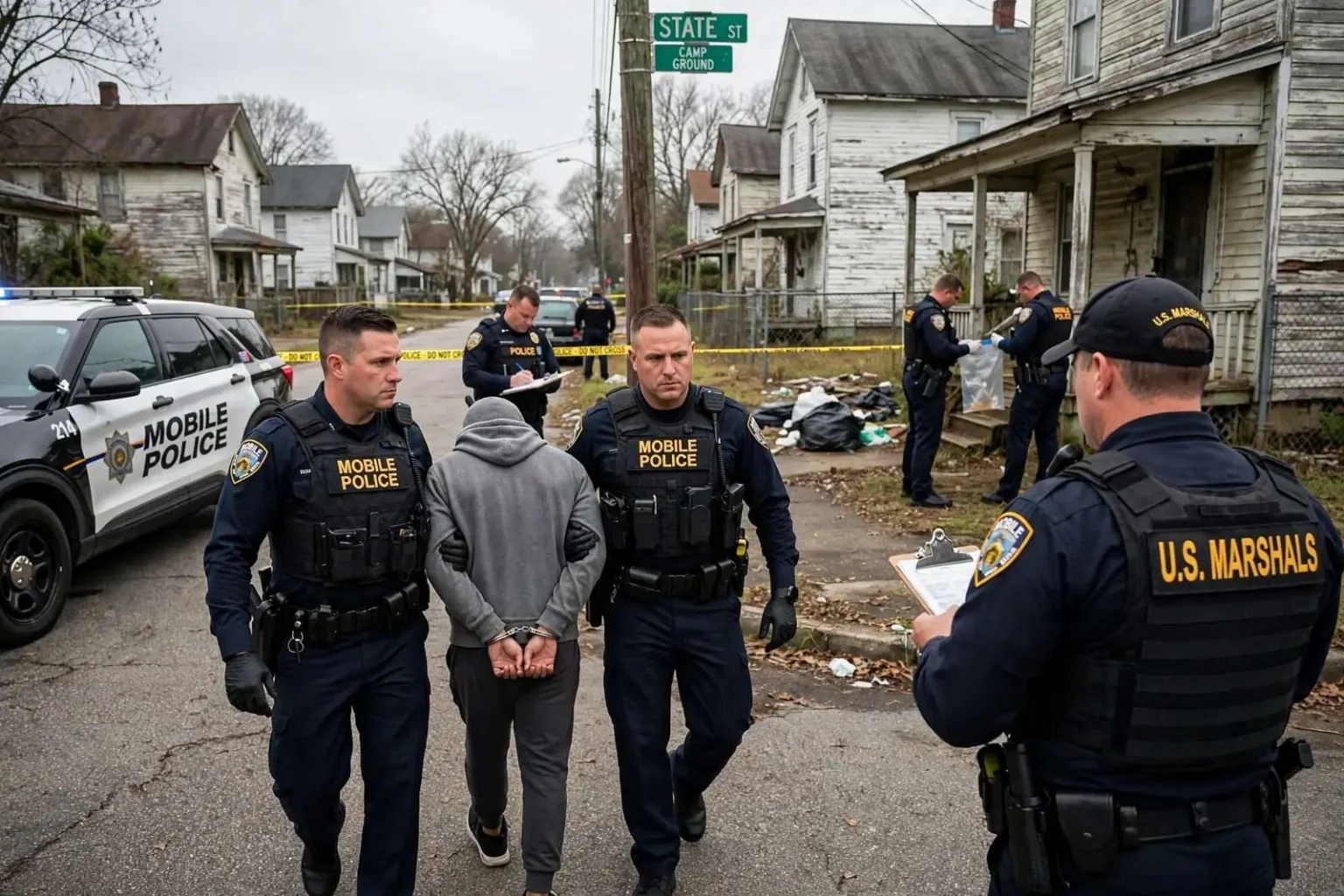
Federal and local officers descended on Mobile’s Campground neighborhood Friday morning, the culmination of a months-long undercover push that Mobile Police Chief James Barber says targeted the city’s last open-air crack cocaine market.
About a dozen people were detained and handcuffed along State Street as investigators sorted through outstanding warrants and searched for drug paraphernalia. The morning sweep was the visible end of an operation that had been building for months, with undercover officers working the same blocks that uniformed patrols had long avoided confronting directly.
The Mobile Police Department coordinated the operation, dubbed Operation Drive Thru, with the U.S. Marshals Service and the U.S. Secret Service. The pairing of local detectives with federal partners gave investigators tools a city department alone cannot summon: federal warrant authority, deputy marshals for apprehensions, and the investigative reach that comes with task-force work.
A Second Push Into the Campground
It marked the second major law enforcement push into the Campground area in less than a year, following June’s Operation Bottoms Up, which resulted in more than 60 arrests but, according to Barber, did little to slow the area’s drug trade long-term.
The Campground is a small, historic neighborhood wedged near downtown Mobile, its name a holdover from the 19th century when the land served travelers as a stopping point. Over decades the area changed from a working residential district into one of the city’s most visible open drug markets, its location near downtown making the trade hard to hide and easy to supply.
Barber’s candid assessment of the first operation’s limits shaped the second. A raid that arrests dozens of buyers and sellers, he concluded, treats symptoms while the underlying market — the demand, the supply routes and the properties that host it — remains intact. Operation Drive Thru was designed differently: months of documentation, hundreds of transactions recorded, and a legal strategy aimed at the places where the trade lives, not just the people who pass through it.
Barber said he personally walked the neighborhood and was struck by the visible signs of the ongoing drug and prostitution activity there. For a police chief, walking a market street rather than riding through it in a cruiser serves a purpose beyond symbolism: it shows officers what residents live with daily, and it shows residents that the department’s leadership has seen it too.
Door to Door, Then a Crackdown
After he and Mayor Sandy Stimpson went door-to-door meeting residents in December, the department launched the new operation with help from a special prosecutor assigned by Mobile County District Attorney Ashley Rich.
The door-to-door canvass was an unusual opening move for a drug enforcement effort. Rather than sweeping in unannounced, the city’s top officials asked residents what they were living with and what they wanted done. The special prosecutor arrangement addressed one of the chronic frustrations of street-level drug enforcement — cases that stall between arrest and prosecution — by putting a dedicated prosecutor inside the operation from the beginning.
Investigators say they documented hundreds of drug transactions and carried out more than 100 undercover buys over roughly five months of surveillance, ultimately securing more than 70 drug-related warrants against 20 suspects.
The scale of the documentation mattered. Individual street-level buys typically result in minor charges that ripple through the court system with little cumulative effect. Building dozens of cases against a core group of 20 suspects, each supported by recorded transactions and months of surveillance, gave prosecutors the leverage to seek meaningful outcomes — and gave officers a body of evidence that would survive defense challenges long after the Friday morning sweep ended.
Search Warrants and a Nuisance Case
Search warrants covered eight homes in the neighborhood, including a State Street property that police say was used as a base for both drug sales and prostitution. The owner of that home, an elderly Campground resident, was not expected to face criminal charges, but police said she had allowed the property to be used for illegal activity.
The case of the State Street house captured the complexity the operation was built to address. In neighborhoods where open markets take hold, the worst properties are often occupied by elderly owners who have lost control of them — homes taken over by relatives, dealers or squatters while the owner, intimidated or impaired, stops resisting. Officers arranged for the woman to be taken to a local hospital Friday as investigators moved to have the home declared a drug-related nuisance in court, a legal step that can lead to seizure of the property.
Alabama’s nuisance abatement law gives cities a civil path against properties that repeatedly host drug activity, one that does not require charging the owner with a crime but can end in forfeiture or court-supervised corrections. City officials separately secured an emergency order to clear debris from an adjacent lot that had sat charred and littered since a fire years earlier, which neighbors said had long been a blight on the block.
A Neighborhood That Stopped Calling
Residents who spoke with reporters described a neighborhood where fear had discouraged people from calling in even serious incidents. Several said they had heard gunfire nearby in recent months but did not contact police, worried about retaliation.
Barber pointed to that silence as evidence of how deeply the drug trade had taken hold, saying that when neighbors are too afraid to report crime, dealers effectively control the streets.
The dynamic he described is well known to police departments in cities across the country: once a market establishes itself, the people best positioned to report it — the residents next door — become the least likely to pick up the phone. A single block where no one calls 911 can host years of open dealing. Breaking that pattern requires more than arrests; it requires giving residents a reason to believe that reporting crime is safe and that reporting it changes something.
The five months of undercover work were designed with that reality in mind. By building cases with officers’ own documentation rather than waiting for neighbor complaints, the department avoided putting residents in the position of witnesses against dealers who would remain on the street during the investigation. Only after the warrants were secured did the operation surface publicly, with the mass of arrests arriving at once.
What Comes After the Raid
Police and city officials said they were working with community leaders on a broader strategy to rebuild trust and improve safety in the Campground area going forward, with additional details on arrests and property seized from the operation expected to be released in the following days.
The follow-through is where previous efforts fell short. After Operation Bottoms Up, the market regenerated within months, supplied by the same demand and hosted by the same properties. This time, the city points to pieces intended to make regeneration harder: the nuisance case against the State Street house, the cleanup of the burned lot, the special prosecutor’s ongoing handling of the 70-plus warrants, and a community presence that began with the mayor and chief knocking on doors in December.
Urban policy research and the city’s own experience point to the same conclusion: enforcement clears a market only as long as something replaces it. Vacant buildings invite the trade back, unlit lots shelter it, and young men with no other income refill it. The broader strategy city officials describe — beyond the warrants — will be judged by whether the Campground’s blocks look different in a year, not by the number of handcuffs applied on a Friday morning.
Barber acknowledged the challenge extends beyond a single raid, noting that some families in the neighborhood have cycled through the drug trade for multiple generations.
That acknowledgment frames the limits of what Operation Drive Thru can accomplish. A market sustained across generations reflects unemployment, addiction, housing instability and family breakdown — forces no police operation can arrest. What Friday’s sweep could do, in the department’s view, is break the immediate hold: remove the 20 suspects whose warrants were secured, strip the trade of its base property, and give the residents who stayed silent for years their first sustained experience of a block without an open drug market.
How Residents Can Help Sustain It
Officials urge Campground residents to report suspicious activity promptly and to work with the community leaders involved in the follow-up strategy. Anonymous tip channels remain available for those still worried about retaliation, and the department has said that maintaining the neighborhood’s recovery will depend on residents feeling safe enough to call police the next time they see the trade trying to return.
For a neighborhood within sight of downtown’s skyline, the stakes extend past its own boundaries. An open-air market blocks from the city center shapes how visitors, investors and residents across Mobile see the city’s core. Friday’s operation was the largest step yet in a campaign the city describes as a partnership — and the coming months will show whether the partnership holds.