Mobile Area Education Foundation Lands $120,000 Grant to Boost College Access
Mobile Area Education Foundation will use a new $120,000 Lumina grant to expand college and credential access across Mobile County over the next two years.
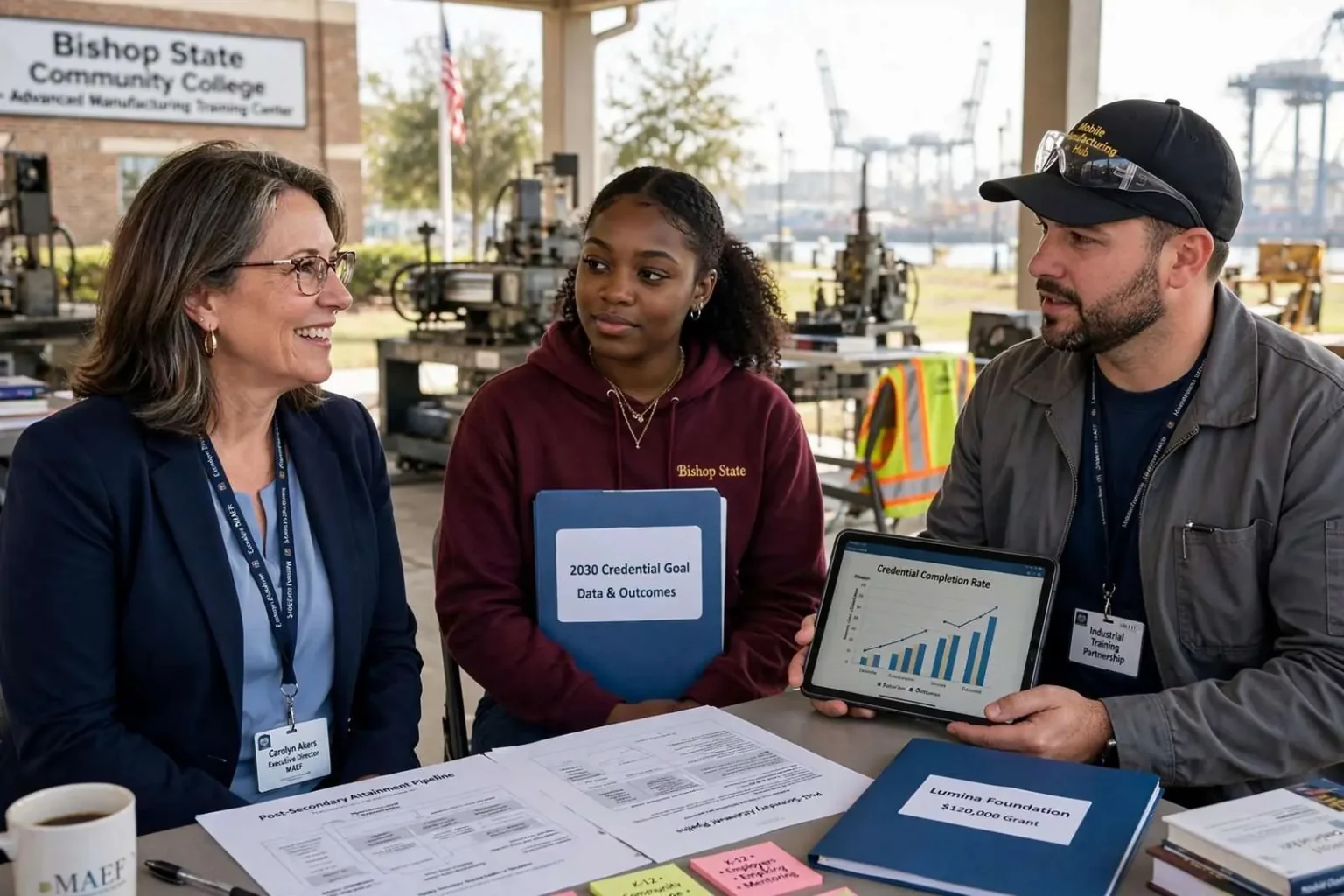
The Mobile Area Education Foundation has been awarded a $120,000 grant from the Lumina Foundation, funding that will be distributed over the next two years to strengthen the nonprofit’s push to get more Mobile County residents into college classrooms and career-training programs.
The foundation, widely known by its acronym MAEF, has spent years working alongside Mobile County’s public schools, two- and four-year colleges, and local employers to close gaps in post-secondary attainment.
Executive Director Carolyn Akers called the new partnership with Lumina a significant boost for that ongoing work in the Mobile community.
The grant arrives at a moment when the conversation about education beyond high school has shifted nationally. Increasingly, employers and economists frame the question not as college versus work, but as credentials versus none — the recognition that virtually every growing industry now demands some form of education or training after high school.
MAEF’s position in Mobile’s education landscape is that of a convener. Rather than running classrooms itself, the foundation works to align the institutions that do — the county’s public schools, Bishop State Community College and the region’s universities, along with the employers who hire their graduates — toward shared goals that no single organization could reach alone.
What the Grant Will Fund
The grant money is earmarked for several specific priorities: sharpening the strategies MAEF uses to help students actually finish degrees and credentials once they enroll, building more durable systems for tracking outcomes, deepening collaboration across the community, and improving how programs are planned and measured for impact.
Each priority addresses a known weak point in the college-access pipeline. Getting students onto a campus is only half the challenge; a large share of students who enroll in college or training programs never finish, leaving with debt and lost time but no credential. Completion strategies — advising, mentoring, financial aid navigation and early-warning systems — aim to keep those students moving to the finish line.
Tracking outcomes is the unglamorous work that makes everything else accountable. Programs that cannot say how many participants enrolled, completed or found employment struggle to improve, and funders increasingly demand that data before renewing support. Durable tracking systems turn scattered anecdotes into a record the community can act on.
Collaboration, meanwhile, is the currency in which community-level education work is done. A student’s path runs through a school system, a college, a training provider and an employer, often within a few years. When those institutions plan separately, students fall through the seams; when they coordinate, the seams close. Much of MAEF’s value lies in keeping that coordination alive.
Measurement rounds out the list. By improving how programs are planned and evaluated for impact, the grant pushes MAEF and its partners toward decisions grounded in evidence rather than habit — a discipline that determines which initiatives expand and which are reworked or retired.
Lumina’s National Mission
Lumina Foundation, a national organization focused on expanding access to education beyond high school, has set a broad goal of increasing the share of Americans who hold a post-secondary degree or credential.
Lumina President Jamie Merisotis said graduates from programs like MAEF’s become the backbone of the economic, social, and cultural future of the communities that produce them.
The Indianapolis-based foundation has become one of the most influential players in American higher education policy, funding initiatives across the country and pressing states and metro areas to set concrete attainment targets. Its strategy relies heavily on local partnerships — organizations like MAEF that know their communities and can move institutions that a national funder never could.
Merisotis’s framing reflects the argument at the heart of Lumina’s work: that post-secondary attainment is no longer a personal advantage but a community necessity. Metro areas with credentialed workforces attract employers; those without them watch industries locate elsewhere. In that view, a grant to a Mobile nonprofit is an investment in the city’s economic future as much as its classrooms.
A 2030 Goal for Mobile
Locally, MAEF has framed its work around a similarly ambitious target: doubling the number of Mobile-area residents earning a post-secondary credential by the year 2030.
Reaching that goal, foundation leaders say, will require close coordination between K-12 schools, community colleges, four-year universities, and area businesses, all pointed toward a shared pipeline that starts as early as pre-kindergarten.
The 2030 target gives Mobile’s education community something it otherwise lacks: a single number to organize around. Doubling credential production is a measurable outcome, tracked through the same data systems the Lumina grant will strengthen, and progress toward it can be reported publicly year by year. Goals of that kind change behavior precisely because they can be missed.
The pipeline concept underlying the goal stretches the work of college access back to the earliest grades. A student’s likelihood of earning a credential is shaped by reading proficiency in the elementary years, by algebra readiness in middle school, by rigorous coursework and advising in high school, and by financial and academic support at the college threshold. No single intervention at the end of the pipeline can compensate for weakness along the way.
Employers sit at the pipeline’s other end, and their role has grown in MAEF’s model. Businesses that articulate their skill needs clearly — and that offer internships, apprenticeships and hiring pipelines — give students concrete reasons to finish training, connecting classroom effort to a visible future.
Manufacturing and the STEM Economy
Akers pointed to Mobile’s status as one of only ten communities nationally designated as an advanced manufacturing hub as a reason the partnership carries extra weight.
In a STEM-driven local economy, she said, a strong alliance between higher education, K-12 schools, and industry is essential to producing workers with the right skills.
Mobile’s manufacturing designation reflects the transformation of the region’s industrial base over the past two decades. The city’s harbor and industrial corridor have attracted major advanced manufacturing investment, bringing with them thousands of jobs that require technical training — precision machining, industrial maintenance, welding, process technology and engineering support — rather than the unskilled labor of earlier eras.
That shift changes what “college and career ready” means in Mobile County. The advanced manufacturing economy rewards exactly the credentials the 2030 goal counts: certificates from two-year technical programs, industry certifications and engineering degrees alike. A student who completes an industrial maintenance program stands on the same attainment ladder as one who finishes a university engineering track.
The designation also positions Mobile to compete for additional federal and state support tied to workforce development. Communities recognized as manufacturing hubs gain access to programs that fund training equipment, instructor development and partnerships between industry and education — resources that amplify what local dollars like MAEF’s Lumina grant can accomplish.
For K-12 educators, the message from the manufacturing sector is practical. Students who might once have seen vocational training as a fallback now find that technical pathways lead to well-paying careers in one of the region’s growing industries — provided they earn the credentials along the way.
Accountability and Public Reporting
The Lumina funding will help MAEF convene local stakeholders around building out that pre-K-to-post-secondary pipeline, with an emphasis on shared responsibility among partners and public reporting of progress toward the 2030 goal.
MAEF has said it intends to lean on data-driven planning and transparent, annual progress updates as the initiative moves forward, giving the Mobile community a way to track whether the investment is translating into more graduates and credentialed workers in the years ahead.
The public reporting commitment is more than a courtesy to funders. Community-wide education goals live or die on visibility: when progress numbers are published annually, institutions feel the pull of expectations, and when they stall, the community can ask why. Transparency converts a foundation’s internal strategy into a public compact.
Shared responsibility language carries its own weight. Attainment goals fail when every institution assumes another will do the work; they advance when schools, colleges and employers each own a piece of the outcome. MAEF’s convening role exists precisely to assign and sustain that ownership across organizations that answer to different boards, budgets and constituencies.
The two-year grant horizon also imposes discipline. Funding distributed over 24 months must show movement within that window — stronger tracking systems built, partnerships formalized, completion strategies tested — before the work can attract the next round of support. MAEF’s track record in securing national funding suggests the community’s education infrastructure has grown capable of competing for it.
For Mobile County residents, the grant’s significance is best measured against the goal it serves. If the region is to double credential production by 2030, the work must begin with investments exactly like this one: the unglamorous machinery of data, coordination and planning that turns a community’s ambition into enrolled students, finished programs and, ultimately, credentialed workers filling the jobs a growing Gulf Coast economy is creating.