Mobile County DHR Director Tells Rotarians Poverty and Illiteracy Travel Together
Rose Johnson, director of the Mobile County Department of Human Resources, addressed the Sunrise Rotary Club on poverty and what she called its co-conspirator, illiteracy.
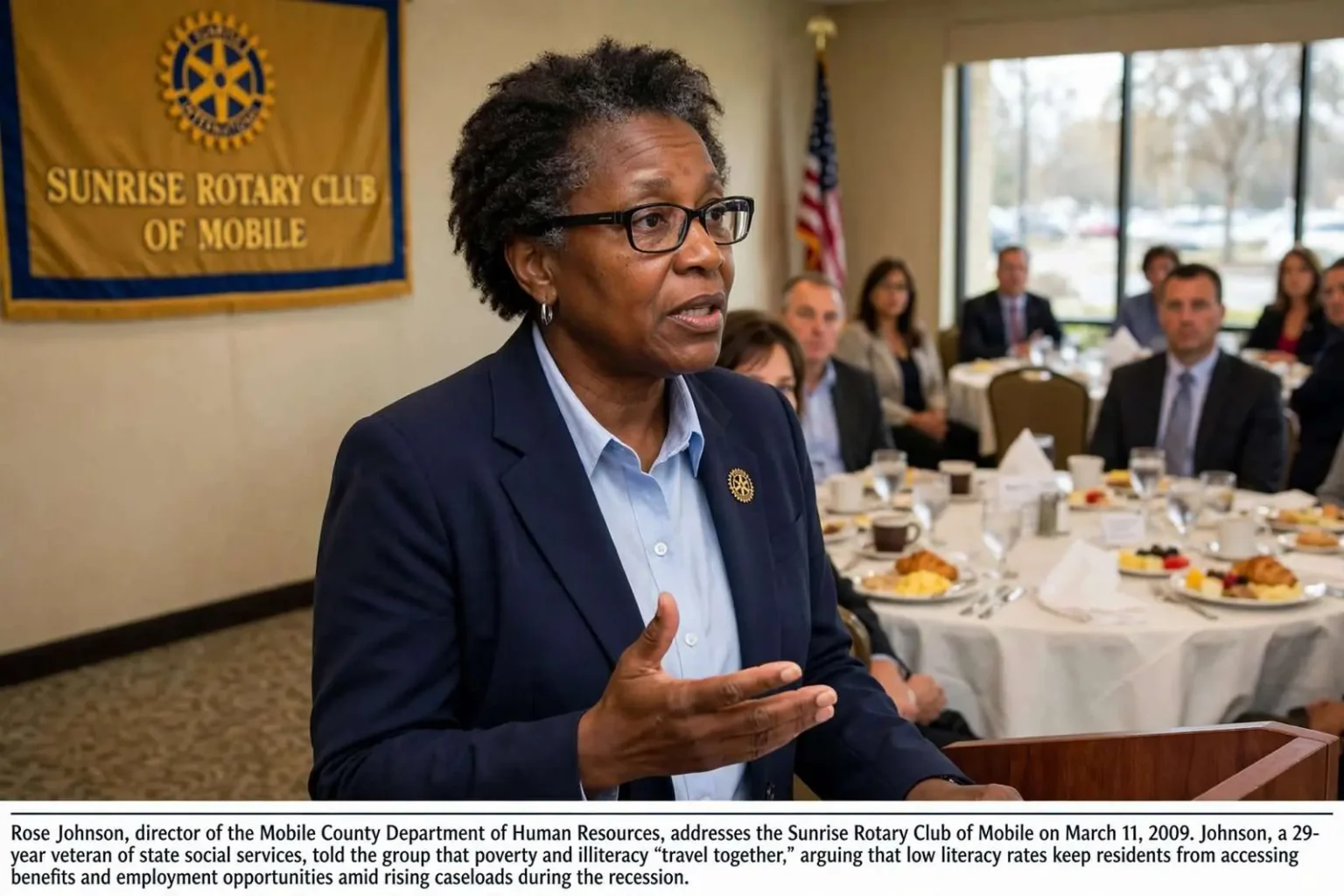
Rose Johnson brought a plain thesis to the Sunrise Rotary Club of Mobile on March 11, 2009: poverty rarely travels alone, and the companion it keeps most faithfully is illiteracy.
Johnson, director of the Mobile County Department of Human Resources, spoke on poverty and what she called its co-conspirator. She had led the department for nearly seven years, having previously served as its deputy director, and she came to the subject with a 29-year career behind her.
The scale of the department
The numbers Johnson worked with each day gave weight to her argument. The Mobile County DHR employed a staff of 380 and provided services to the roughly 400,000 residents of Alabama’s second-largest county.
Its programs covered a wide span of human need:
Child Support. Food Assistance. TANF and JOBS, the state’s welfare-to-work programs. Adult Protective Services. Child Welfare Services.
Each of those programs, in its own way, ends up dependent on reading. Applications must be completed. Notices must be understood. Court orders, benefit rules, work requirements and case plans all arrive on paper, and the consequences of misreading them fall entirely on the person least equipped to read.
That is the practical link Johnson’s remarks drew between the two conditions. Illiteracy does not merely accompany poverty; it makes escaping poverty measurably harder, because nearly every exit is marked with words.
A parent who cannot read the paperwork misses deadlines for benefits that would feed the family. A job applicant who cannot read the posting, the application or the training manual is screened out before skills are even considered. A senior who cannot read a benefits notice forfeits a check. In each case the underlying problem is not laziness but literacy, and in each case the penalty is paid in poverty.
A career in the system
Johnson’s path to the director’s office ran through much of the state’s social services apparatus. She had worked in federal grant administration and served as an administrator in four other county offices before returning to Mobile.
She earned her master’s degree in social work at the University of Alabama in Tuscaloosa, after completing her undergraduate work at Fairleigh Dickinson University in Teaneck, New Jersey.
The rotation through multiple county offices gave her the kind of perspective that a single-assignment career does not. Rural county DHR offices, small-town caseloads and urban operations present different versions of the same programs, and an administrator who has run offices in different corners of the state learns which problems are universal and which are local. Johnson brought that map with her when she took the Mobile County post and then, years later, its top job.
Her seven years as director had also spanned the transformation of the welfare system nationally, from the old entitlement structure to the work-focused TANF and JOBS programs the county administered in 2009. Those programs put requirements on recipients — work activities, training, job search — and every requirement is a document, which is why Johnson’s two subjects, poverty and illiteracy, kept meeting inside her own caseloads.
The timing of the talk
The timing of her talk mattered. In March 2009, the recession was pressing hard on exactly the population her department served, and the pressure was visible in the programs she described.
Food assistance caseloads were climbing across Alabama and the nation as jobs disappeared, and Mobile County was no exception. Each newly unemployed worker who came through the department’s doors joined the rolls that Johnson’s 380 employees administered, and many of them arrived carrying the same literacy limitations that had kept them in low-wage work in the first place.
What the recession meant for DHR
The downturn that began in 2008 hit Alabama’s low-income households with particular force, and Mobile County’s economy — with its shipbuilding, port, chemical and service employment — shed jobs across sectors at once. DHR offices around the state absorbed the shock. Applications for food assistance rose, families that had never sought public help appeared in waiting rooms, and case workers managed growing caseloads with staff levels that did not grow alongside them.
For an administrator like Johnson, the recession reshaped the department’s daily business. Clients who had been briefly self-sufficient were returning; children whose parents had lost work moved into the child welfare system’s field of view; and the JOBS program’s mission of moving people into employment collided with an economy that was losing jobs faster than it created them. Speaking to the Sunrise Rotary in that season, she was describing her department’s circumstances, not reciting a theory.
The literacy connection in practice
The link between illiteracy and poverty shows up in the specific mechanics of every DHR program. Child Support cases turn on paperwork that establishes paternity, calculates obligations and tracks payments. Food Assistance requires household documentation, income verification and recertification on a schedule that arrives in the mail. Adult Protective Services depends on elderly and vulnerable clients understanding documents that others may be asking them to sign.
Case workers see the consequences directly. Missed appointments that were never understood. Benefits terminated because a renewal notice went unread. Recipients sanctioned under work requirements they could not decode. Each of those outcomes is recorded as a program statistic, but underneath nearly all of them is a reading problem that the system’s paper requirements made decisive.
That is why social services agencies across the country have worked to simplify forms, add oral interviews, and partner with literacy councils — because a benefits system designed entirely on paper quietly excludes the people who need it most. Johnson’s argument to the Rotarians was that Mobile County’s poverty numbers would never fully move until the county’s literacy numbers moved with them.
Why the Rotary audience mattered
Civic clubs like the Sunrise Rotary Club of Mobile occupy a particular place in a community’s response to problems like the ones Johnson described. Their members are employers, bankers, educators and professionals — the people who hire, who sit on nonprofit boards and who fund literacy programs. A director of human resources speaking to that audience is recruiting partners, not just informing them.
The message she carried was one those listeners could act on directly: workplaces that train workers, organizations that tutor adults, and institutions that design their paperwork for people who struggle to read all attack poverty at the point where illiteracy does its damage. Rotary clubs across Alabama had long supported literacy initiatives for exactly that reason, and Johnson’s remarks gave the local club a working connection between its charity and the county’s largest social services operation.
The long shadow of the problem
Poverty and illiteracy reinforce each other across generations, which is what makes the pairing so durable. A parent who cannot read tends to have fewer books in the home, less ability to help with homework, and less standing in dealings with schools — and children who start behind in reading tend, statistically, to end up in the low-wage labor market where their own paperwork struggles begin again.
Breaking that cycle is the work of many institutions at once: schools, adult literacy programs, churches, employers and the public agencies Johnson led. Her department saw the failed end of the cycle every day, in the applications half-filled and the notices gone unread. Her argument in March 2009 was that a community serious about poverty had to be equally serious about reading, because the two problems were, in practice, one problem wearing two faces.
What the department’s programs actually do
For readers unfamiliar with the agency’s reach, the department’s portfolio is wider than its name suggests. Child Support locates noncustodial parents, establishes legal obligations and collects and distributes payments that keep single-parent households afloat. Food Assistance administers the federal nutrition benefits that anchor food budgets in low-income homes. TANF and JOBS provide temporary cash assistance tied to work and training activities, with the explicit goal of moving families off the rolls and into paychecks.
Adult Protective Services investigates reports of abuse, neglect and exploitation of vulnerable adults, a caseload that grows in hard economic times. Child Welfare Services handles the investigations, foster placements and family preservation efforts that sit at the most difficult end of the agency’s work. Each program carries its own federal rules, state policies and documentation requirements, and each depends on the same 380-person staff to deliver services correctly and on time to a client population spread across a county larger in population than most Alabama cities combined.
That operational reality was the backdrop for everything Johnson told the Rotarians. The connection between literacy and poverty was not an abstraction to the people answering the department’s phones; it was the reason half of them spent their days reading documents aloud to clients who could not.
Nearly seven years into her tenure at Mobile County DHR, with a 29-year career behind her and a recession pressing on her caseloads, Johnson had earned the standing to make that argument plainly — and on March 11, 2009, over breakfast in downtown Mobile, she made it.