Wilmer Couple and Their Five Adopted Children Escape House Fire Unharmed
A Wilmer couple and their five adopted children escaped safely after an early-morning fire destroyed the home they had just finished building.
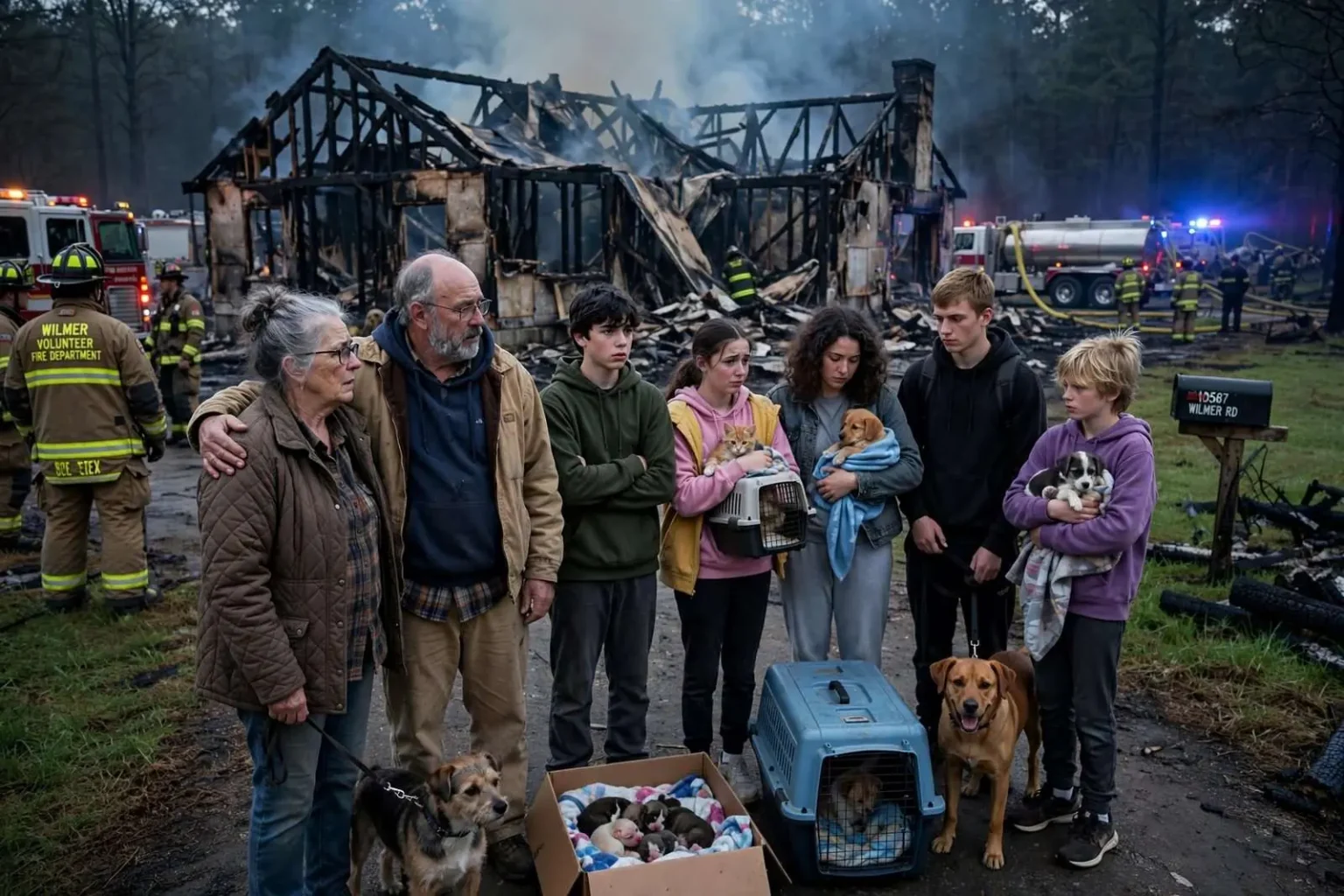
A Wilmer couple and their five adopted children made it out safely after an early-morning fire tore through their home and destroyed it just weeks after they finished building it. The fire struck in the dead of night on Wilmer Road, in a rural stretch of western Mobile County where volunteer fire departments answer calls that can be many minutes from the nearest hydrant.
Nancy McDowell, 67, said she woke around 2 a.m. to what she initially thought was her son making coffee, part of the family’s usual morning routine. When her husband, Drew McDowell, 68, called out and got no answer, the couple realized the sound they were hearing was actually the home’s fire alarm. Smoke was already billowing from a room above their bedroom.
What happened next unfolded in minutes. The couple fled with their five adopted children, several dogs, two cats and a litter of puppies, escaping with little more than the clothes they were wearing. For a family that had just finished building the house — a project that represented months of planning and work — the speed of the loss was staggering. One night the home was new; the next it was gone.
Firefighters from the Wilmer, Tanner Williams, Semmes and Georgetown volunteer fire departments spent hours battling the blaze. The response drew departments from across the region, a common practice in rural Mobile County where no single volunteer company has the manpower to fight a fully involved structure fire alone. Tanker trucks shuttled water to the scene, and crews worked through the early morning hours to bring the flames under control and keep the fire from spreading to nearby property.
Authorities did not release a cause for the fire. Investigators typically examine the scene after the flames are out, but with the home a total loss and the family safely outside, officials did not announce a determination about where or how the blaze began.
‘Devastating, But Not the End of the World’
“It’s devastating but it’s not the end of the world,” Nancy McDowell said afterward, adding that she was grateful no one was hurt. Her summary captured the family’s outlook in the days that followed: a house can be measured in money, but everyone who slept in it — the couple, the five adopted children, the dogs, the cats and the puppies — got out alive.
The family’s escape underscores the role working smoke alarms play in rural fire survival. With the nearest career-staffed fire station far away, the minutes between a fire’s start and a family’s awakening are the difference between an evacuation and a tragedy. The alarm that the McDowells first mistook for kitchen noise did exactly what it was designed to do.
One of the couple’s adult sons, Jacob McDowell, a firefighter in Adel, Georgia, who was adopted by the McDowells as an infant, drove through the night after learning about the fire from missed calls. He arrived to find the home he grew up in reduced to a burned shell, and he was allowed to enter the damaged structure to retrieve a collection of heirloom guns passed down through his father’s family, which the family said were the only significant items recovered from the house.
For a family of firefighters, the ironies were bitter. Jacob’s profession is fighting the kind of fire that took his family’s home, and his training gave him a clear-eyed view of what the family faced and what could — and could not — be salvaged. The heirloom firearms he carried out were generations of family history compressed into a single armful, the only tangible keepsakes to survive.
One firefighter was injured in the response. Wilmer Volunteer Fire Department Chief Mike Cooper was struck by part of a collapsing wall during the fight against the blaze. Nancy McDowell said he appeared to suffer only minor injuries. Structure fires in rural areas carry exactly those risks: weakened floors and walls can fail without warning, and volunteer crews working at night face the added strain of fatigue and limited visibility. Cooper’s injury was a reminder that the firefighters who answer rural calls are neighbors risking themselves for neighbors.
A Family Built by Adoption
The McDowell household is a testament to adoption — five children brought into the family over the years, now ranging from teenagers to adulthood, including a son who became a professional firefighter himself. Building a new home large enough for that family was the work of years; losing it weeks after completion would break many households. The McDowells’ response, family members said, was to lean on the thing that made them a family in the first place.
Family members described the loss as sudden and disorienting, noting that the home had only recently been finished. “It was like, shock… a reminder you shouldn’t take things for granted,” said 17-year-old Alex McDowell, one of the couple’s children.
Neighbors and relatives rallied around the family in the fire’s aftermath, offering places to stay, clothing and help with immediate needs. In rural communities like Wilmer, that kind of response is automatic — church networks, extended family and neighbors who have known each other for decades mobilize quickly when a household loses everything. The family’s immediate needs were met in the first days by that network while longer-term arrangements took shape.
Volunteer Firefighting in Western Mobile County
The response to the Wilmer Road fire illustrates how rural fire protection works in Mobile County’s western communities. Wilmer, Tanner Williams, Semmes and Georgetown are volunteer fire departments — organizations staffed largely by trained residents who leave their homes at all hours to answer calls. In areas outside municipal water systems, departments depend on tanker operations, hauling water to scenes and drafting from portable tanks, which slows the fight and multiplies the manpower needed.
Mutual aid agreements are what make these responses work. When a structure fire breaks out in Wilmer, dispatchers call in surrounding departments automatically, because a fully involved house fire requires more firefighters, apparatus and water than any single volunteer company can supply. The hours-long battle at the McDowell home drew on all of that — and it came at the usual cost of volunteer firefighting, including the injury to Chief Cooper.
Volunteer departments across the region operate on lean budgets funded by fire fees and fundraising, and they consistently ask residents for two things: support at fundraisers, and basic fire prevention at home — working smoke alarms, clear exits and careful use of heating equipment. The McDowell fire, whatever its cause, showed why the prevention message matters so much in areas where help is minutes away.
Starting Over
In the days after the fire, the family’s focus turned to the practical work of starting over. Insurance discussions, salvaged belongings and temporary housing topped the list, along with the immediate needs of five children and a menagerie of displaced pets. The puppies born in the new house — a sign of the life the family had been building there — survived the fire along with the rest of the animals.
The loss of a newly built home carries a particular sting. Every choice in the house, from the layout to the finishes, reflected the family’s decisions and labor, and weeks of enjoyment was all the completed project got. Still, Nancy McDowell’s assessment in the aftermath — devastating, but not the end of the world — set the tone for how the family processed it.
What the fire did not take was the thing the McDowells spent decades building first: a family assembled through adoption, held together across generations, and backed by a rural community that showed up when it mattered. A house took weeks to build and a night to destroy. The family that lived in it took years to build, and one night proved it fireproof.
The McDowells’ escape and the community response that followed now become part of the story told about the Wilmer community — a rural crossroads settlement in the far western corner of Mobile County, near the Mississippi line, where families tend to stay for generations and where the volunteer fire department is one of the community’s central institutions.
Fire officials encourage every household in these communities to check smoke alarm batteries twice a year and to practice fire drills with children, particularly in homes with many occupants. A family the size of the McDowells — five children plus adults, plus pets — has to move a dozen living beings out of a burning house in the dark. Knowing who goes where, and which doors to use, saves the minutes that matter.
For now, the family is rebuilding with help from the network that formed around them within hours of the fire. The heirloom guns Jacob McDowell carried out of the ruined house will go with the family wherever they land — the one piece of the old home that made it through, carried out by the son whose profession is the fight his family lost, and who drove through the night to be there when it counted.
The Wilmer Volunteer Fire Department, meanwhile, returns to its routine with one of its chiefs recovering from a wall collapse on a call that took everything from a family down the road. That is the arrangement rural communities live with: neighbors protecting neighbors, at real risk, with the understanding that the next call could be their own front door. On Wilmer Road, everyone now knows exactly what that means.