Mobile Council Approves Stadium Lights Over Objections, Tables Judge Selection Plan
The Mobile City Council approved a contested Hank Aaron Stadium lighting contract and tabled a plan for a citizens' judge selection committee.
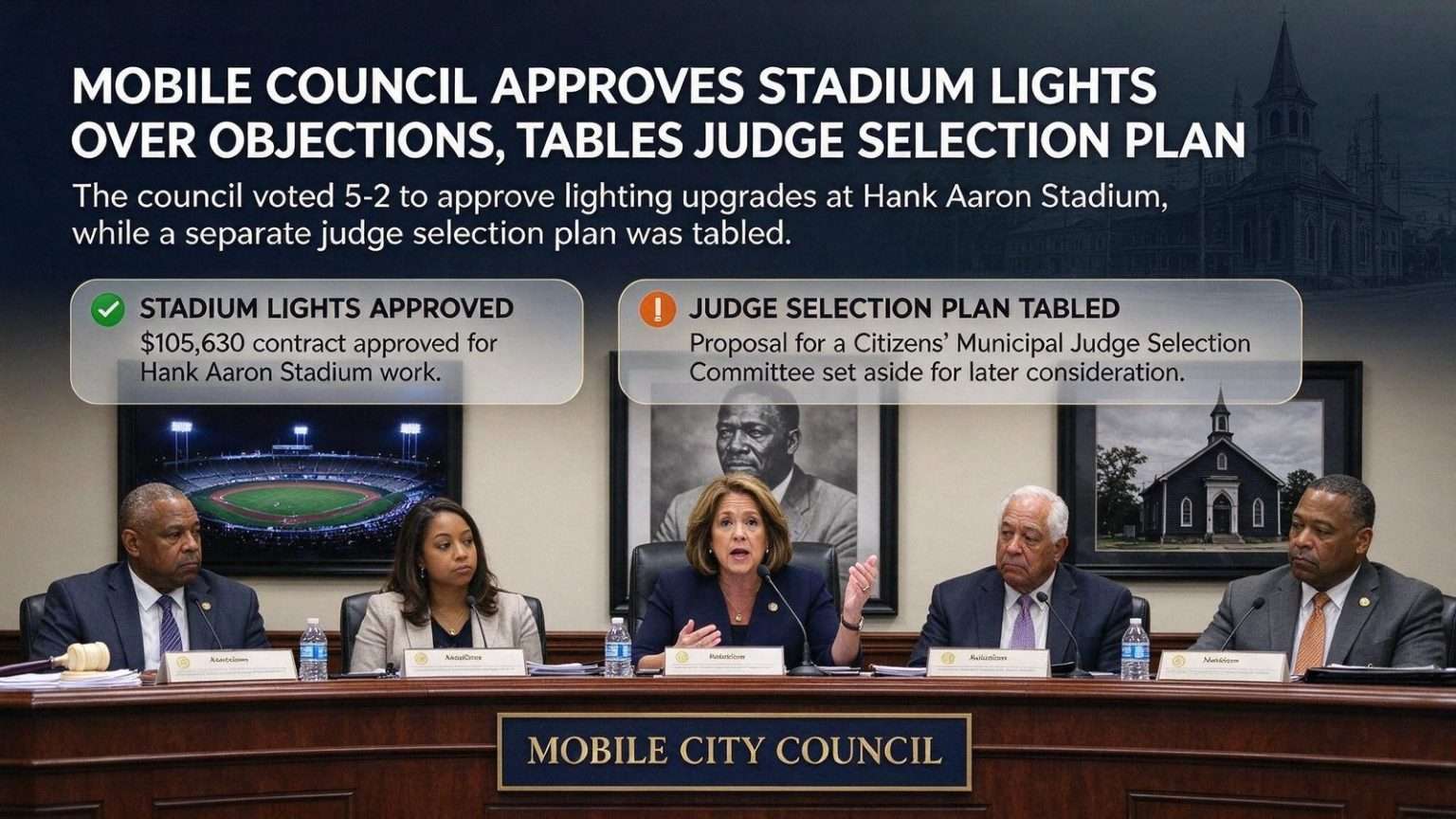
The Mobile City Council voted to move forward with lighting upgrades at Hank Aaron Stadium this month despite renewed objections from a council member who argued the city was extending favorable treatment to a tenant behind on rent. Council members approved a $105,630 contract with Moody’s Electric Inc. for the stadium lighting work, with District 6 Councilwoman Bess Rich casting one of two dissenting votes.
Rich reiterated concerns she had raised the previous week, saying the private investor responsible for stadium upgrades had stopped making lease payments more than two years earlier and owed the city over $150,000, which she said was presumably tied to the city’s failure to complete a separate list of requested improvements. The dispute placed the council in the position of funding improvements to a facility whose lease relationship with the city had itself fallen into arrears.
“My job as a City Council member serves as a check and balance with my one vote,” Rich said. “I can’t vote to release additional taxpayer funds to be used by a private investor without a new contract before me addressing the future commitments of the city and BayBears.”
Council President Gina Gregory joined Rich in voting against the contract, but the measure passed 5-2 as the city worked to prepare Hank Aaron Stadium for the Mobile BayBears’ April season opener. The schedule drove the timing: minor league seasons open whether a city’s paperwork is settled or not, and stadium lighting that fails inspection before opening day leaves the team and the city scrambling in the season’s first homestand.
The Stadium and the City’s Stake
Hank Aaron Stadium, opened in the late 1990s in west Mobile, was built as the home of the BayBears and named for Mobile’s most famous athlete, the Hall of Famer whose Major League home run record was set after he grew up in the city. The ballpark has hosted Double-A baseball for two decades, and it anchors a stretch of the city that includes the university area’s commercial corridors along Airport Boulevard and Cody Road.
The city’s arrangement with the team and its investor partners has been the source of recurring friction in council chambers. Under the lease structure, the private side committed to upgrades and rent while the city retained the facility as a public asset, and each side has periodically pointed at the other’s unmet obligations. Rich, who has made reviewing such agreements a signature of her long tenure on the council, argued that the lighting contract put new public money into the arrangement without settling the old debts first.
The majority’s counterargument was practical. The stadium’s lights serve a facility the city owns, used by the team, its fans and events beyond baseball, and deferring electrical work risks costlier failures and a season that cannot be played safely after dusk. Members voting yes framed the contract as maintenance of a city asset, separate from the contractual dispute Rich wanted resolved first, though her objection pressed the question of whether the two can truly be separated when the tenant negotiating on the other side is also the beneficiary of the work.
The BayBears’ opening day gives every outstanding question a deadline. Minor league front offices plan promotions, season ticket packages and staffing around a fixed April date, and the lighting contract cleared the council so the electrical work could be scheduled, inspected and finished before the first pitch. Cities that host professional teams learn quickly that the league’s calendar does not wait for municipal debates, which is why the majority treated the contract as urgent even as the lease dispute remains unresolved.
For Rich, whose council tenure has repeatedly returned to lease and contract oversight, the vote was one more instance of a pattern she has pressed for years: public money should not flow to a partner whose existing obligations are in default until those obligations are renegotiated in writing. Her objection, first raised the previous week and repeated at the vote, preserved her position for whatever negotiation comes next between the city and the team’s investor group.
Judge Selection Plan Tabled
In other business, the council tabled a proposed ordinance that would have created a Citizens’ Municipal Judge Selection Committee, with District 5 Councilman Joel Daves casting the lone vote against setting the measure aside. The proposed committee would have inserted a citizen panel into the process of recommending municipal judge candidates, a structural change to how the city picks officials who preside over its municipal court.
Municipal judges in Mobile handle the city’s docket of traffic cases, misdemeanor offenses and ordinance violations, and the method of their selection has been debated in cities across Alabama as a question of reform: should judges be chosen solely by elected officials, or should a citizens’ panel vet candidates first? The tabling puts that question off for another day, and Daves’ vote signaled his preference to keep the proposal moving rather than shelve it indefinitely.
Members also unanimously approved a new city code governing the sale of puppies within Mobile city limits. The measure aligns Mobile with a national wave of municipal regulations aimed at pet sales, in which cities have restricted retail puppy sales in order to cut off channels from large-scale breeding operations, sometimes called puppy mills, whose conditions have drawn sustained criticism from animal welfare groups. Cities adopting such codes typically aim the restrictions at retail storefronts while leaving unaffected the sales by shelters, rescue organizations and individual owners.
The unanimous vote reflected how such ordinances tend to travel through municipal politics. Unlike stadium leases or judge selection, pet sale regulations divide few interests inside city hall, and the public response to puppy mill investigations has made the measures popular. For Mobile’s animal services operations, the code adds an enforcement framework aimed at the retail end of a trade the city’s animal control officers have dealt with case by case.
Historic Preservation Grants Move Forward
The council additionally approved two historic preservation grant applications to the Alabama Historical Commission: a $5,000 request to document the Lafayette Heights Historic District with photographs and architectural descriptions, and a $10,000 request to conduct re-surveys of the Church Street East and Africatown historic districts while preparing National Register nominations for the Automobile Alley, Lewis Quarters and South Oakleigh districts.
The Lafayette Heights documentation project would create a formal architectural record for a mid-century neighborhood west of downtown, the kind of survey that preservationists use to establish a district’s boundaries and character before seeking historic status. Documentation grants of this size typically fund professional photography and written descriptions of contributing structures, the raw material of any later National Register effort.
The larger request carries more historical weight. Church Street East, one of Mobile’s oldest residential districts near downtown, and Africatown, the community founded by survivors of the Clotilda, the last known ship to bring enslaved Africans to the United States, both hold established places in the state’s history. Re-surveys update decades-old records, confirming which structures retain historic integrity and which have been altered beyond recognition, and they keep the districts’ documentation current enough to defend their status.
The National Register nominations for Automobile Alley, Lewis Quarters and South Oakleigh would extend formal recognition to three more corners of the city. Automobile Alley, along Government Street near Broad, preserves the commercial architecture of Mobile’s early car dealership era. Lewis Quarters and South Oakleigh represent neighborhood histories, one a small community with deep roots, the other an extension of the Oakleigh garden district’s documented streetscape, that have never been captured in a Register nomination of their own.
Listing on the National Register does not restrict what private owners do with their property, but it opens access to federal and state preservation incentives, and it formally acknowledges a district’s significance in the state’s documented history. For Africatown especially, which has drawn national attention as descendants of the Clotilda survivors have pushed for recognition and investment in the community, official documentation supports grant applications and heritage tourism planning that the neighborhood’s advocates have pursued for years.
The Alabama Historical Commission administers the matching grant program through which the city is seeking the funds, and the council’s approval of both applications sends them into the state’s competitive review. If awarded, the grants would fund work carried out by consultants and the city’s historic development staff, with the surveys and nominations returning to the council for acceptance as they are completed.
Taken together, the meeting’s agenda spanned the range of a city council’s work: a contested six-figure contract at the ballpark, a structural question about who chooses the city’s judges, a unanimous animal welfare ordinance, and preservation paperwork reaching from mid-century neighborhoods to a community whose founding story is taught in the state’s schools. The 5-2 vote on the stadium lights will draw the attention, but the quieter items, from the judge selection table to the Africatown re-survey, may prove the ones with the longest reach.