Mobile Council Postpones Stadium Lighting Vote, Approves Noise Ordinance Changes
The Mobile City Council held over a Hank Aaron Stadium lighting contract and approved noise ordinance changes and public safety funding in a busy session.
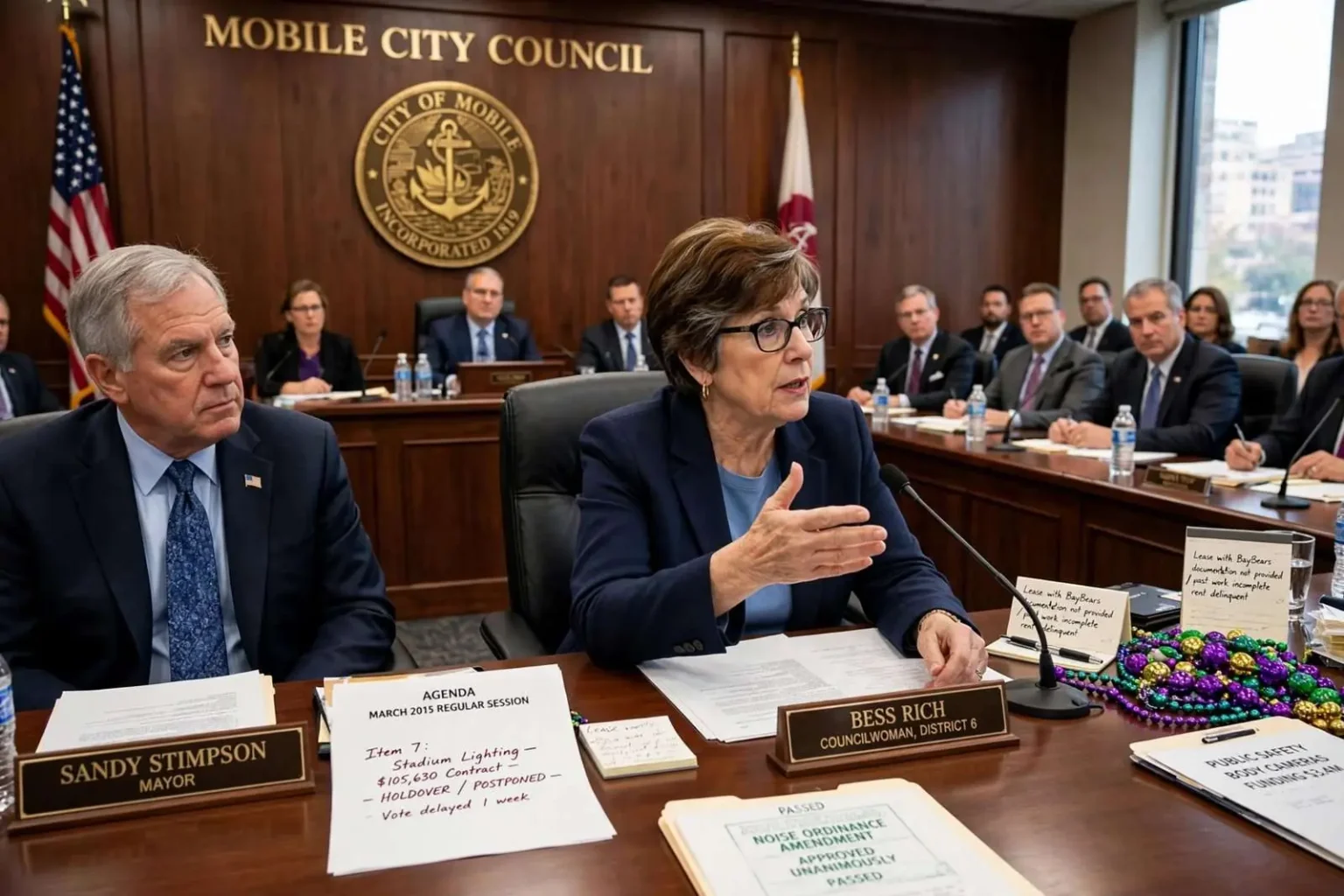
The Mobile City Council covered a wide range of city business this month, from a delayed vote on stadium lighting upgrades to funding for police body cameras, during a session that came in the wake of the 2015 Mardi Gras season. The agenda offered a cross-section of the decisions a city of Mobile’s size faces every week — contracts, zoning, public safety spending and a dash of civic history — with the thread of this year’s Carnival celebration still fresh in the background.
Council members postponed a vote on a proposed $105,630 contract with Moody’s Electric Inc. for lighting upgrades at Hank Aaron Stadium after District 6 Councilwoman Bess Rich requested a one-week holdover. The delay drew immediate attention because the stadium lease has been a running sore between the city and its baseball tenant, and Rich made clear her concerns went well beyond the electrical work itself.
Rich argued that Mobile BayBears management still had not produced a new lease agreement with the city or proof that past stadium work had been completed, all while the team remained behind on rent. Her objection distilled the frustration that has built up on the council over years of lease negotiations: the city was being asked to spend on a facility whose tenant had not delivered basic documentation or payment.
“We’re doing something special for the tenant that is not paid to date,” Rich said. Her one-line summary captured the mood among members who see the stadium relationship as one-sided, and it set the terms for a debate that will resume when the contract returns to the agenda.
A deadline behind the delay
Mayor Sandy Stimpson’s chief of staff told the council that delaying the contract could jeopardize the stadium’s readiness for its April 15 opening day, though an amended lease with the BayBears would not be ready within the week Rich requested. That admission — that the lease would take longer than the holdover — framed the choice before the council: approve lighting work on schedule and keep pressuring the tenant through other means, or hold firm and accept the risk to opening day.
Baseball’s calendar is unforgiving. A Double-A season opens on a fixed date whether or not the ballpark is ready, and lighting work is not the kind of project that can be compressed into a few days if a contract slips. The administration’s warning was less a threat than a scheduling fact: every week of delay narrows the window for electricians to complete upgrades before the first pitch.
The episode also illustrated the limits of the council’s leverage. Rich’s demand for proof of past work and a signed lease reflects a legitimate oversight interest, but the BayBears’ delay in producing an amended lease meant the holdover could not itself force the documentation into view. The contract will return to the council with the same unresolved questions, and the same countdown clock, attached.
Noise, handbills and zoning
In other business, the council unanimously approved an amendment to the city’s noise ordinance and postponed for two weeks a separate ordinance regulating the distribution of commercial and noncommercial handbills. The noise measure, adopted without dissent, gives the city an updated tool for handling complaints that range from downtown nightlife to residential disputes, while the handbill ordinance drew extra scrutiny — questions about free speech and street-level commerce — that members wanted more time to consider.
Members also approved rezoning a parcel on Broadcast Drive to eliminate split zoning at the request of a private company. Split-zoning cleanups of this kind are routine but consequential for the properties involved: a single tract carrying two different zoning designations complicates development, financing and resale, and unifying the designation clears the way for whatever the owner plans next along that corridor.
Money for police technology and vehicles
The council signed off on a $26,678 contract with LeadsOnline to operate an electronic reporting and investigation system for the Mobile Police Department. LeadsOnline operates a national network that connects law enforcement agencies to records of pawned and secondhand goods, letting detectives trace stolen property across jurisdictional lines — a capability that matters in a port city where stolen merchandise can move quickly through pawn and resale channels.
For the police department, the system is part of a broader modernization of how cases are built. Electronic reporting ties incident records, evidence tracking and investigative leads into one framework, reducing the paperwork burden on officers and shortening the path from a stolen-property report to a suspect. The contract’s modest price reflects a subscription-style service rather than a capital purchase, an increasingly common model for police technology.
The council also approved transferring nearly $3.4 million in economic development incentive funds toward public safety needs, including new police and fire vehicles and body cameras for officers. The reallocation is significant for two reasons: it puts serious money behind the body-camera programs that departments across the country have adopted amid demands for accountability and transparency, and it redirects funds originally reserved for luring and supporting business investment into the day-to-day equipment of city government’s most visible services.
Defenders of the transfer argue that public safety is itself economic development — that no company relocates to a city where fire stations lack vehicles or police departments lack modern tools. Critics of such reallocations typically warn that raiding incentive funds sets a precedent that undermines the city’s commitments to job-creating projects. This month’s vote placed Mobile squarely in the first camp, at least for this budget cycle.
Facilities, commissions and committees
Additional approvals included a $254,000 annual contract for unarmed security guard services at various city facilities and a $138,180 contract to re-roof the Mobile Municipal Archives building. The archives roof is the kind of unglamorous maintenance that protects an irreplaceable collection — the paper record of the city’s history, from council minutes to property records — from the water damage that a failing roof eventually delivers in a Gulf Coast climate.
The security contract spreads unarmed guard coverage across city buildings, a steady operating expense that replaces piecemeal arrangements. Both items passed as part of the council’s routine consent business, but together they illustrate the fixed costs that consume a city budget before any new program is funded.
The council also handled the quieter work of civic appointments: the reappointment of a member to the Keep Mobile Beautiful Commission, which coordinates litter reduction and beautification efforts across the city, and new appointments to an ad hoc committee studying city revenue and growth. The revenue committee carries particular weight as Mobile continues to weigh how to fund infrastructure and services over the long term, and its eventual recommendations will land on a council that has shown a willingness to make hard money decisions.
The Mardi Gras flag question
During the public comment portion of the meeting, two Mobile residents urged the council to take whatever steps necessary to reclaim the city’s official Mardi Gras flag, which was created in 1987, so that the city could benefit from its use throughout Carnival season and beyond. The appeal touched a nerve of local pride: Mobile’s claim as the birthplace of American Mardi Gras, celebrated for more than three centuries, gives the flag a significance beyond its design, and residents argued the city itself should control and profit from the symbol.
The flag’s history is bound up with the city’s cultural identity. Created in 1987 as an official emblem of Mobile’s Carnival heritage, it flies during a season that fills downtown with parades, balls and visitors. Who owns the rights to that emblem, and who benefits when it appears on merchandise and promotional material, is a question of both money and pride — and the speakers made clear they believe the answer should be Mobile’s city government.
The council took no immediate action on the flag question, but the public comment ensured it remains on the city’s radar at a moment when Carnival season’s economic and cultural value to Mobile is on full display.
The balancing act continues
The stadium lighting contract, along with several other big-ticket items funded during the session, reflects the council’s ongoing balancing act between funding city infrastructure and public safety needs while managing long-running disputes over the Hank Aaron Stadium lease with the Mobile BayBears’ ownership group.
That balancing act defines local government in a city of Mobile’s scale. A $105,630 lighting contract can hold up business over a lease dispute; $3.4 million can move from economic development to body cameras; a roof on an archives building and a noise ordinance amendment share an agenda with a flag created in 1987. Each decision is small on its own; together they sketch a city managing its money, its history and its tenant relationships in the same sitting.
The postponed stadium vote will return, as will the handbill ordinance and the Mardi Gras flag question. What this month’s session demonstrated is that the council intends to keep asking its own questions before spending — even when the clock is running toward opening day at the ballpark.