Mobile Revives Employee Bonus Program Funded by Mayor’s Salary
Mobile is handing out monthly cash bonuses to top city workers, funded partly by Mayor Sandy Stimpson's own salary pledge.
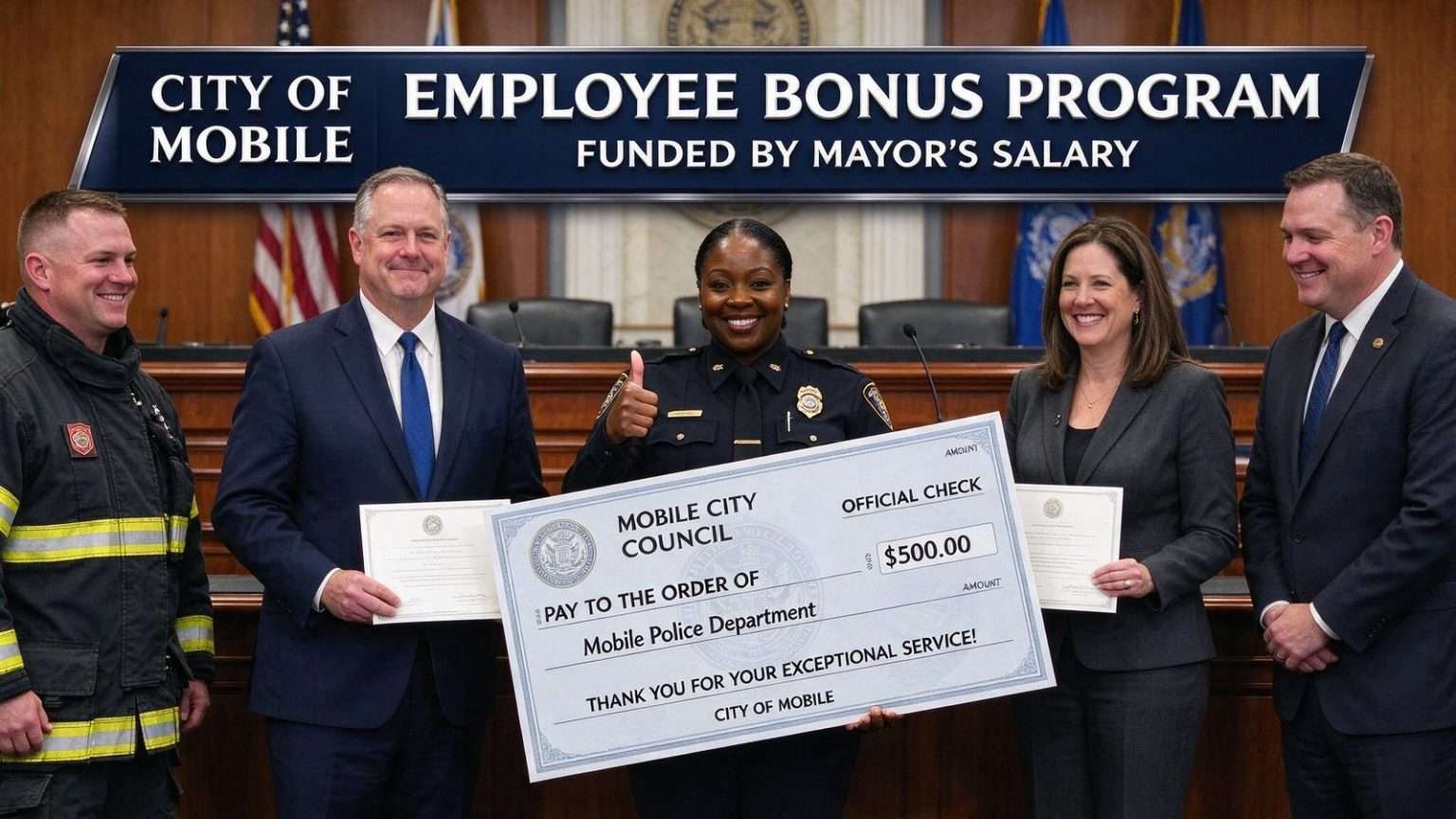
The city of Mobile has relaunched an employee recognition program that puts at least $1,500 a month directly into the pockets of standout city workers, with the funding tied to a campaign promise made by Mayor Sandy Stimpson. Under the revamped policy, the city now awards a $500 check each month to the top-performing employee in the Mobile Police Department, the Mobile Fire-Rescue Department, and general city government. The first checks were handed out during a recent Mobile City Council meeting, recognizing two employees for work completed earlier this year.
The return of the program gives Mobile a formal, public way to honor rank-and-file workers whose efforts might otherwise go unmarked. Recognitions handed out at council meetings put employees in front of the city’s governing body and the public, and the monthly cadence is designed to keep the recognition flowing rather than confining it to an annual awards ceremony that most workers never experience.
Honoring the First Recipients
Colby Cooper, chief of staff to Mayor Stimpson, said the program reflects an ongoing effort to publicly recognize employees who go beyond their normal duties. One of the inaugural honorees was an information technology employee credited with helping ensure a smooth broadcast of a major football event held in Mobile, after quickly coordinating installation of extra network lines in just two days.
A police officer from the department’s Fourth Precinct was separately honored as Officer of the Month for exemplary work during the prior month, according to city officials, though the specifics of her commendation were detailed separately by department leadership.
The pairing of a technology worker and a patrol officer among the first honorees illustrates the program’s breadth. Municipal governments depend on far more than public safety personnel: IT staff keep the systems running that residents rarely see, sanitation crews, engineers, clerks and inspectors all keep the city functioning. By recognizing one honoree from general city government alongside the police and fire departments, the program signals that exceptional work counts wherever it happens.
Funded by the Mayor’s Own Salary
The bonus program is funded through Mayor Stimpson’s own salary. Stimpson, who draws an annual salary well below the six-figure range typical of many municipal executives, pledged during his campaign to contribute $50,000 per year toward employee bonuses, aiming for a total of $200,000 over his first term in office.
Using the mayor’s personal paycheck to bankroll public bonuses is an unusual arrangement in municipal government. Most cities fund employee recognition out of the general fund through budgeted line items. Mobile’s approach ties the program directly to a promise the mayor made on the campaign trail, and it means the awards continue only as long as he continues writing the contribution — a structure that has drawn both praise for its personal commitment and questions about what happens to the program when the funding source leaves office.
Retroactive Honors and Earlier Roots
City officials said the new Employee of the Month honors are retroactive to the start of the year, though the broader bonus effort actually began taking shape in late 2014, when a group of Municipal Garage workers received smaller awards for building equipment that saved the city thousands of dollars in outside costs.
That early episode set the template for the program’s philosophy: reward measurable value to the city, not just visibility. Crews who devise a cheaper way to do a job, or who prevent a costly failure, generate savings that can be counted — and under Mobile’s structure, shared with the employees who produced them.
The Suggestion Track: Pay It Forward
Beyond the monthly awards, the program includes a separate employee suggestion track, sometimes referred to informally as a “pay it forward” initiative, that lets any city worker propose cost-saving or revenue-generating ideas. Employees whose suggestions are adopted can receive a bonus equal to a percentage of the savings or revenue their idea generates in its first year, though state law caps any individual’s total award in a fiscal year.
That cap matters for how the program works in practice. Alabama’s ethics framework restricts public employees from receiving compensation beyond their official salaries in ways that could create conflicts, and states across the country have wrestled with how to reward government workers for savings ideas without opening the door to self-dealing. Mobile’s percentage-based structure, bounded by the statutory ceiling, is designed to give workers a real stake in efficiency while keeping the awards within legal limits.
The suggestion track also distributes the search for savings across the entire workforce. The people best positioned to spot a wasteful process are usually the ones operating it every day, and a structured channel for those observations — with a financial incentive attached — turns thousands of municipal employees into a standing efficiency review.
Why Recognition Matters in City Hall
City leaders describe the program as a low-cost way to boost morale among Mobile’s roughly thousands of municipal employees, particularly in public safety departments where recognition can be rare amid demanding schedules.
Police officers and firefighters work rotating shifts, respond to traumatic scenes, and often receive public attention only when something goes wrong. A monthly mechanism for naming an outstanding officer or firefighter, backed by a tangible reward, gives department leadership a tool for reinforcing the standards they want to see. For general government employees, whose work is rarely visible to the public at all, the council-meeting setting provides a stage their jobs otherwise never offer.
The morale argument also has a practical side for a city Mobile’s size. Replacing an experienced municipal worker costs far more than retaining one, and formal recognition programs are among the least expensive retention tools available to any large employer. A program funded by the mayor’s salary rather than the city budget costs taxpayers nothing while still delivering the message that exceptional work is noticed at the top.
How Nominations Work
Department heads are responsible for nominating employees for the monthly honors, and city officials say the program will continue on an ongoing monthly basis going forward.
That structure puts the responsibility on leadership within each department to identify excellence where it happens — on the street, at the fire station, in the service garage or the IT office. Monthly departments will continue forwarding their picks, and with the program retroactive to the start of the year, city officials have a backlog of early-year accomplishments to recognize as the schedule catches up.
For city workers, the message from the relaunch is straightforward: outstanding performance can now carry a monthly $500 check and a moment before the council, whether it comes from the police department, the fire department, or anywhere else in city government. For the administration, it is a campaign promise converted into recurring practice — one month, three honorees and $1,500 at a time.
Mobile’s Municipal Workforce in Context
Mobile is Alabama’s third-largest city and one of the Gulf Coast’s major port municipalities, with a municipal government that spans police and fire protection, public works, engineering, planning, parks and an array of administrative services. Keeping a workforce of that size motivated is a standing challenge for any administration, and cities across the region have experimented with different approaches — from formal service awards to incentive pay tied to certifications and longevity.
What distinguishes Mobile’s approach is its funding source and its speed. Traditional recognition programs often take the form of annual plaques or years-of-service pins, delivered long after the accomplishment they honor. A monthly cash award of $500, announced at a council meeting within weeks of the work being done, creates a much tighter link between performance and reward. Management researchers have long argued that immediate recognition is more effective than delayed recognition at shaping behavior, precisely because it connects the honor to the specific effort that earned it.
The program also gives the mayor’s office a regular, positive touchpoint with the workforce at council meetings. Rather than appearing before employees only during budget disputes or crises, the administration stands monthly beside workers being celebrated for their daily excellence — a dynamic that can soften the adversarial tone that sometimes characterizes relations between city leadership and its employee associations.
Looking Ahead
Whether the program outlasts the mayor’s salary contributions is an open question that will follow the initiative through future budget cycles. For now, city officials describe it as ongoing, and each month brings three more opportunities: an officer, a firefighter and a general government employee each walking away with a check and a public thank-you.
The early honorees suggest the range of what qualifies. A two-day sprint to install network lines for a major football broadcast saved the city from an embarrassing technical failure in front of a regional audience. A Fourth Precinct officer’s month of exemplary work earned department-level recognition that now carries a monetary bonus attached. Neither contribution would have generated headlines on its own — which is precisely the gap the program is designed to fill.
For Mobile’s municipal employees, the relaunched program revives a channel through which the city says thank you in dollars as well as words, one month at a time, with the mayor’s own paycheck underwriting the gesture he promised on the campaign trail.