Mobile City Council Advances Body Camera Plans, ‘Ban the Box’ Resolution
Mobile's city council approved a 'Ban the Box' resolution and will get a body camera demonstration as police look to replace an aging pilot program.
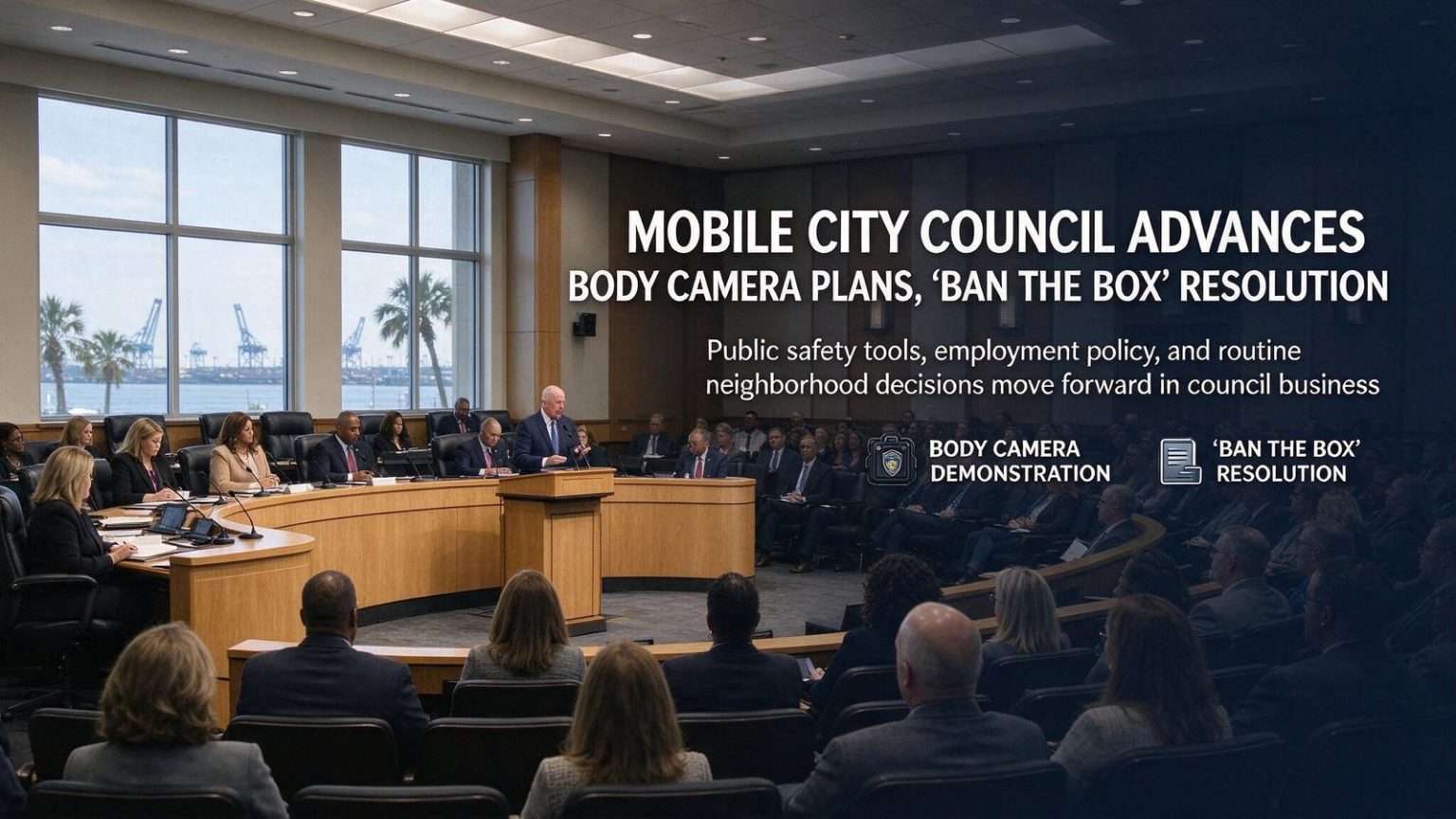
Mobile’s police chief will give city council members a hands-on demonstration of body cameras under consideration for the department’s officers, following months of research aimed at replacing an existing pilot program that has largely gone defunct. The demonstration is expected to let council members handle the equipment, review recorded footage and question the chief directly about costs, storage and policy before any purchase reaches a vote.
The chief pledged to bring the equipment before the council after residents used a recent regular meeting to push for the creation of a citizen’s review board, arguing they wanted to be part of the process when law enforcement issues arise. Speakers at the meeting described a desire for a formal channel through which complaints and concerns about police conduct could be aired and documented, rather than left to informal conversations that produce no record.
The council president said the idea has already been discussed at length in recent months but is not something the council plans to pursue at this time. The remarks did not close the door permanently, but they made clear that a review board is not on the council’s agenda, and that members see other tools as the better path for the moment.
One district councilman argued that expanding body camera use would effectively serve the same purpose residents are seeking through a review board, saying that video footage carries more weight than words when it comes to accountability. In his view, a camera attached to every officer documents the encounter itself, turning disputes about what happened into questions that can be answered by a recording rather than debated for months.
The Push for Accountability Tools
Mobile’s mayor backed the police chief’s research into the technology, saying the city is working to change how it recruits officers, ensure they have the tools needed to do their jobs, and build a more equitable promotion system within the department. The mayor’s comments framed the camera question as one piece of a larger effort to modernize a department that serves a port city of nearly 200,000 residents spread across a wide range of neighborhoods.
Body camera technology had reached the department once before, through a pilot program that was never fully institutionalized. Equipment aged, officers rotated through assignments, and without a permanent budget line or written policy the program faded from use. The months of research now underway are aimed at avoiding that fate, with the chief assembling information on hardware durability, footage storage requirements and the written rules governing when recording is mandatory.
Council members have asked pointed questions about cost, which for body camera programs typically extends well beyond the initial purchase into monthly data storage and management fees. The demonstration is designed to answer those questions in person, and to give members a concrete sense of the equipment before they are asked to fund it.
Advocates for the cameras in Mobile’s neighborhoods have pointed to the technology’s growing adoption by departments nationwide as evidence that it has moved past the experimental stage. Departments that deploy cameras generally report fewer disputes over the facts of encounters, and civil rights groups have supported written policies requiring officers to record traffic stops and arrests from the moment they begin.
“Ban the Box” Advances
In other business, the council unanimously approved a resolution asking the Mobile County Personnel Board to adopt the national “Ban the Box” initiative, which removes questions about criminal history from initial employment applications, giving applicants a fairer shot at being considered for a job before their record comes into play.
The resolution reflects a growing movement among cities and counties across the country to delay criminal history checks until later in the hiring process, when an applicant’s qualifications have already been weighed. Supporters argue that asking about a record on the initial form discourages qualified people from applying at all, and that a conviction that ended years ago says little about whether someone can perform a job today.
Because the measure applies to the county personnel board rather than the city’s own hiring, its practical effect will depend on that board’s willingness to follow the council’s request. The unanimous vote, however, signaled that the council sees employment opportunity as a public safety issue in its own right, tied to the same questions of recruitment and fairness the mayor raised about the police department.
Council members postponed a decision on a separate contract involving outside consulting services meant to improve diversity and efficiency in how the city handles public safety promotions, pushing that discussion to a future meeting. The contract has drawn attention because the promotion system within the police and fire departments has been a recurring subject of complaint, with officers and firefighters questioning how advancement decisions are made and who has a fair shot at them.
Delaying the vote gives members time to examine the scope of the consulting work and how its recommendations would be implemented. Any overhaul of the promotion process touches civil service rules, union agreements and long-standing practice inside both departments, questions that members said deserve more than a single meeting’s consideration.
Routine Business With Real Consequences
The council also handled a range of other routine business. It approved a takeover agreement with an insurance surety company to ensure completion of sidewalk work in the Bottom Community after issues with the original contractor. Under a takeover, the surety that backed the original contract steps in to see the work finished, sparing residents from the long waits that can follow a contractor’s failure and giving the neighborhood the improvements it was promised.
The council also appointed a new member to the History Museum of Mobile’s board, and accepted right-of-way deeds needed for the planned McGregor Avenue roundabout project. The deeds clear the land-acquisition groundwork for a project aimed at one of the city’s busiest and most congested corridors, where traffic volumes have long outpaced the intersection’s original design.
On the funding side, the council authorized the mayor to apply for and accept a $50,000 state grant supporting selective traffic enforcement efforts, along with nearly $98,400 in combined grant and city matching funds from the Mobile County Communications District. The traffic enforcement grant funds targeted details aimed at the intersections and corridors with the highest crash rates, while the communications money supports the radio and dispatch systems that tie the city’s first responders to the county’s emergency network.
A public hearing on a proposed rezoning near Springhill Avenue was also announced for early January, aimed at eliminating a split zoning designation on the property. Split zoning, which assigns different categories to portions of a single parcel, is a common source of confusion for property owners and neighbors alike, and consolidating a parcel under one designation is typically a step toward clearer expectations for future use.
A Holiday-Season Schedule Change
Residents were reminded that the council’s Dec. 16 meeting will relocate to the History Museum of Mobile rather than its usual Government Plaza location, and that no meeting will be held the following week due to the holiday. The move is a recurring December tradition that pairs the council’s final meeting before the holiday with the museum, giving attendees a chance to see the institution the city supports throughout the year.
The relocation also carries practical meaning for residents who follow the council’s work. Government Plaza’s familiar chambers will be dark for the evening, and anyone planning to speak on an item will need to head to the museum instead, a detail the city publicizes ahead of the meeting each year to avoid empty chairs and missed testimony.
The combination of items on this meeting’s agenda, from cameras and hiring policy to sidewalks, roundabouts and rezonings, illustrates the breadth of work that flows through the council in a single session. National debates over policing and criminal justice played out in Mobile not as abstract arguments but as specific decisions about equipment purchases, review structures and application forms that determine how city government actually treats the people it serves.
For residents who came to the meeting seeking a review board, the outcome was a partial one: no board, but a concrete commitment to bring camera equipment before the council and a public debate now underway about how accountability should work in the department. The demonstration in the weeks ahead will show whether the council and the chief converge on a permanent program, nearly a decade of debate over recording technology in Mobile policing will reach a decision point.
What happens next depends on the answers to questions the demonstration is designed to settle: what the equipment costs, what policy governs its use, and whether the council believes cameras can deliver the accountability residents sought. Either way, the meeting made clear that Mobile’s conversation about policing has moved from whether the city should act to which tools it should use.