Wildfire Near Magnolia Springs Contained After Burning 400 Acres
A south Baldwin County wildfire near Magnolia Springs burned roughly 400 acres before crews contained it, protecting nearby homes with no damage.
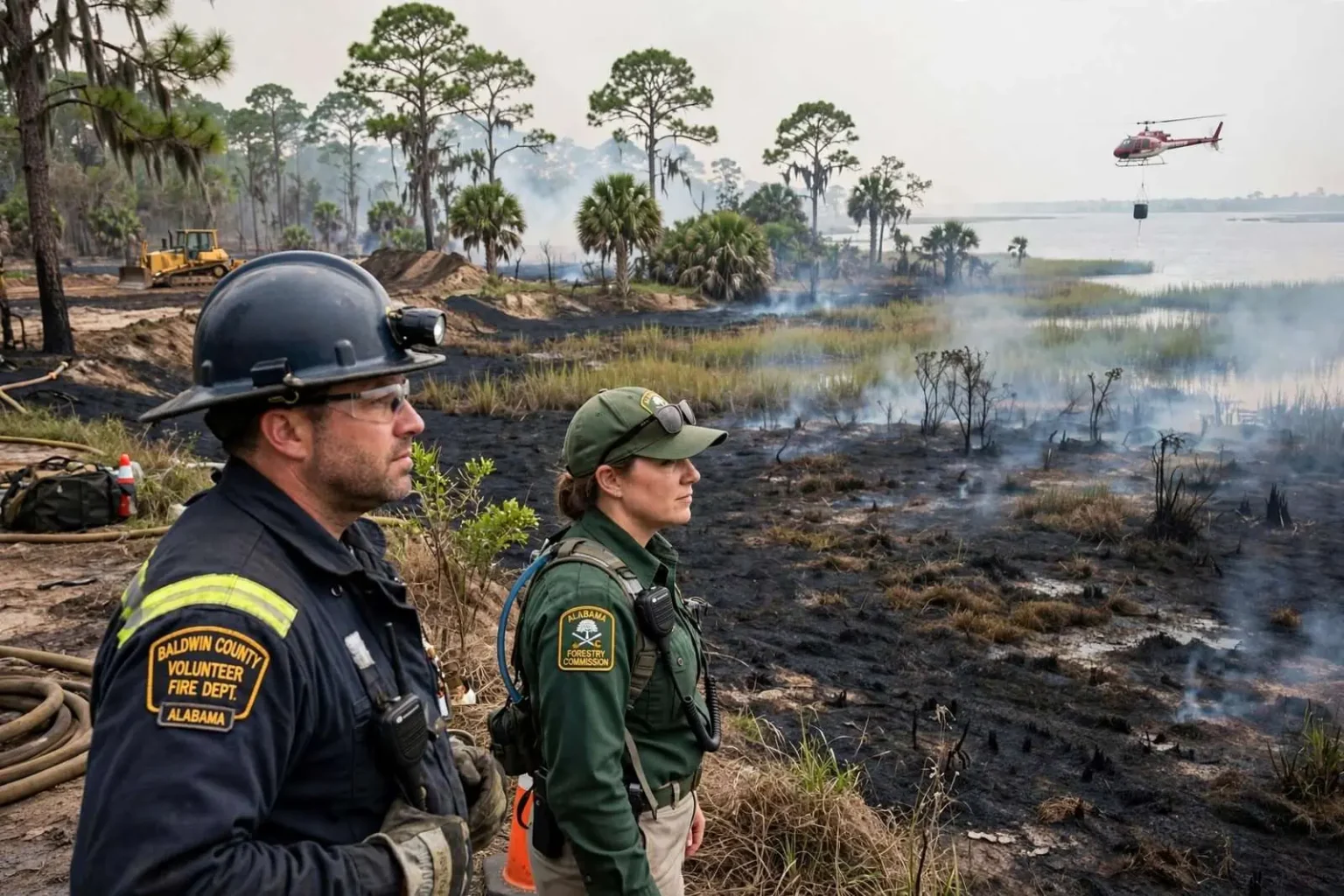
A wildfire that burned through roughly 400 acres of wooded, swampy land in south Baldwin County has been contained, fire officials confirmed, with crews continuing to monitor the site for any flare-ups. The blaze, which broke out near Magnolia Springs and sent smoke drifting across a large stretch of the Eastern Shore through Fairhope and Daphne, initially appeared larger than it turned out to be. For more than a week, the fire smoldered through marsh and woodland along Bon Secour Bay, testing the region’s volunteer fire network and reminding coastal residents that wildfire is not just a western-state problem.
Recalculating the Burned Acreage
An early estimate from the Alabama Forestry Commission’s southwest regional forester put the burned area at 700 acres, but that figure was later corrected to around 400 acres once officials accounted for roughly 300 acres consumed by the controlled burn that originally sparked the fire. The accounting matters: the difference between 700 and 400 acres changed the story from a rapidly growing wildfire to a controlled burn that escaped its boundaries and burned an additional couple hundred acres of wildland. Early fire-perimeter estimates are always provisional, especially in wetland terrain where smoke and standing water make aerial assessment difficult.
The fire’s origins trace back to a permitted controlled burn on private property that got away from the landowner more than a week before it was fully contained. Prescribed burning is a routine and legally encouraged land management practice in South Alabama — used to clear underbrush, manage wildlife habitat and reduce the fuel loads that make future wildfires catastrophic — but even a permitted burn carried out in the right season can escape when conditions shift. That is precisely what happened here, and the episode has become a cautionary example for landowners across the county.
Protecting Homes on Bay Road South
Forestry crews, working alongside about a dozen Baldwin County volunteer fire departments, protected around 10 homes along Bay Road South south of Magnolia Springs by intentionally burning roughly 100 acres surrounding the residences to create a buffer. Officials said the tactic worked as intended, with the fire’s threat to homes on the western side largely eliminated by the time crews declared it contained. Backburning — deliberately burning the fuel between a fire’s edge and what it threatens — is one of the oldest and most effective tactics in wildland firefighting, and its success here spared every one of the homes in the fire’s path.
The response drew on a network that South Alabama has spent decades building. Baldwin County’s volunteer fire departments — the small, locally funded companies that protect most of the county’s unincorporated land — work alongside the Alabama Forestry Commission, the state agency responsible for wildfire suppression on forested land, in a partnership that fires like this one put to the test. When the call went out, a dozen departments answered.
An Escape Into the Marsh
Magnolia Springs Volunteer Fire Department crews first responded to the blaze the Friday after Thanksgiving, but found it had already spread into inaccessible marshland along Bon Secour Bay, limiting what firefighters could do at the time. Marshland along the bay is terrain where engines and bulldozers simply cannot go — soft ground, standing water and dense vegetation make vehicle access impossible — and crews on the scene could do little more than monitor the perimeter and protect structures while the fire worked through the wetland on its own schedule.
Moisture in the area appeared to slow the fire’s progress for several days before it picked back up. The Gulf Coast’s saturated soils and humid air are natural brakes on fire spread, and for days the blaze crept rather than raced. Fire officials watched the weather the whole time, knowing that the region’s typical late-fall pattern — occasional rain punctuated by dry, windy spells — could change the equation at any time.
Conditions changed over the following weekend when the fire reached higher, drier ground and a steady breeze fanned the flames, prompting a larger response. Alabama Forestry Commission crews brought in four bulldozers to cut firebreaks around threatened homes, while an Alabama Department of Public Safety helicopter dropped water from a bucket onto key hot spots to slow the fire’s spread. The combination of ground-based firebreaks and aerial water drops is the standard heavy response for a coastal plain wildfire, and the sight of the helicopter shuttling between the bay and the burn zone drew onlookers to the roads around Magnolia Springs.
Smoke Across the Eastern Shore
For residents of Fairhope and Daphne, the fire’s most visible signature was the smoke — a haze that drifted across the Eastern Shore and prompted inquiries to fire officials from residents miles from the burn zone. Wildfire smoke travels far on the prevailing winds off the bay, and the smell of burning marsh grass reached neighborhoods that never saw a flame. Officials fielded questions throughout the week about the smoke’s source, the fire’s direction and whether homes farther north were in any danger, and repeated the reassurance that the blaze was contained to the wildland south of Magnolia Springs.
The air-quality dimension matters for vulnerable residents as well. Smoke from even a modest wildfire can aggravate asthma and other respiratory conditions, and health officials’ standing advice applies during any smoke event: keep windows closed, limit outdoor exertion and check on elderly neighbors until the haze clears.
Lessons in Living With Fire
The Magnolia Springs fire offers lessons that Baldwin County landowners and homeowners would do well to absorb. First, prescribed burns work — the state encourages them for good reason — but they demand planning, permits and constant attention to weather, because a burn that escapes its boundary becomes a community problem rather than a private one. Landowners who burn should notify the Alabama Forestry Commission, have adequate help and equipment on hand, and never leave a fire unattended until it is cold out.
Second, defensible space saves homes. The houses along Bay Road South were protected not by luck but by a deliberate buffer burned around them, and homeowners can create the same protection in miniature: clearing brush and debris from around structures, keeping lawns trimmed and trees limbed up, and maintaining access for fire apparatus. On the coastal plain, where wildfires move through pine stands and palmetto thickets, a well-prepared parcel gives firefighters the same advantage the backburn gave the crews on Bay Road South.
Third, the volunteer fire system depends on the community it protects. Baldwin County’s volunteer departments are staffed largely by neighbors who train on nights and weekends, funded by fees and donations, and equipped through fundraising as much as through county budgets. A response that draws a dozen departments is only possible when those departments have members and money — and every new volunteer makes the next response stronger.
Monitoring Continues
With containment declared, the work shifted from suppression to monitoring. Forestry and local crews continued to check the burn area for flare-ups, a standard practice after any wildfire, since peaty soil and deep organic beds can hold embers for days and reignite when wind and weather align. Residents near the burn zone were asked to report any new smoke they see rather than assuming the fire is finished, and officials said the site would remain under observation until the threat of reignition passed.
The roughly 400 acres that burned along Bon Secour Bay will recover — coastal marsh and pine flatwoods are fire-adapted ecosystems that green again within seasons, and in some respects benefit from the burn. What the community takes from the event is more lasting: a demonstrated playbook for cooperation between state forestry crews, a dozen volunteer departments and a bucket helicopter; ten homes that never burned; and a reminder that along the Gulf Coast, wildfire preparedness belongs in every season’s plans.
The Role of the Forestry Commission
The Alabama Forestry Commission’s role in a fire like this one extends well beyond the bulldozers. The state agency maintains the statewide wildfire detection and dispatch system, staffs the regional foresters who coordinate suppression across county lines, and provides the heavy equipment — the plows and dozers that cut firebreaks through terrain volunteer departments cannot reach. Its southwest region covers some of the most fire-prone coastal terrain in the state, and the commission’s partnership with volunteer departments is the backbone of rural fire protection across South Alabama.
The commission also administers the permitting system for controlled burns, offering landowners both the legal framework and, in many cases, the technical assistance to burn safely. Certified prescribed burn managers learn weather thresholds, fuel conditions and contingency planning — knowledge that turns a risky practice into a routine one. The Magnolia Springs escape is the exception that illustrates the rule: most prescribed burns in Alabama close out exactly as planned, thousands of times a year, and the landscape is safer for them.
For the residents of Magnolia Springs, Fairhope, Daphne and the communities along Bon Secour Bay, the contained fire closes an anxious chapter. The smoke has cleared from the Eastern Shore, the dozers have pulled back from the firebreaks, and the marsh along the bay is already beginning its quiet recovery. The monitoring will continue until crews are satisfied no embers remain, and then south Baldwin County will get back to the business of the season — a little more prepared, and a little more aware, than it was before the Friday after Thanksgiving.