Baldwin County Schools Detail Millions in Campus Upgrades
Baldwin County school officials outlined millions in campus improvements, including new roofs at three high schools and building upgrades countywide.
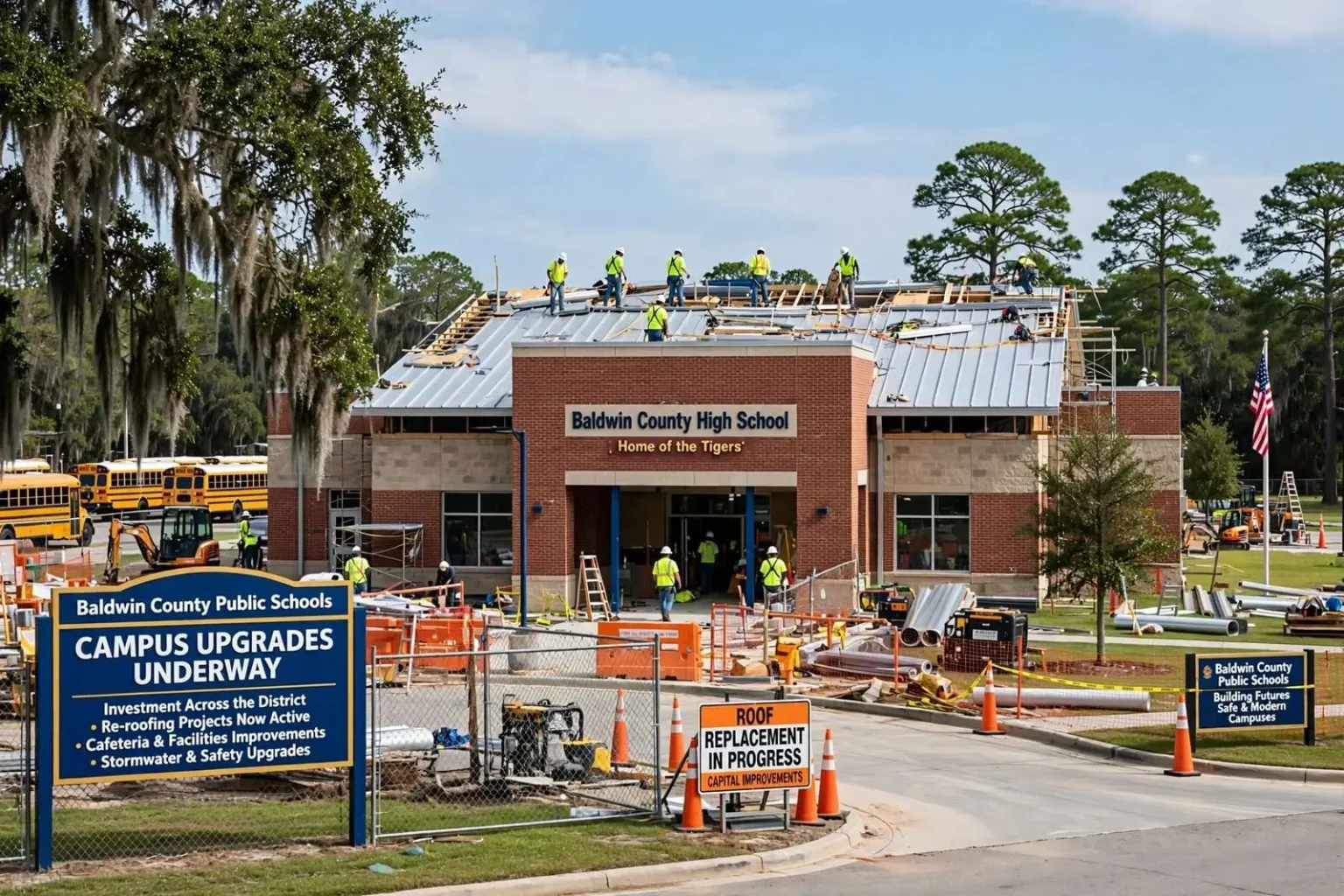
The Baldwin County school board received a detailed rundown of capital improvement projects underway across the district at its December meeting, with the facilities and maintenance department outlining millions of dollars in work spanning nearly every corner of the county’s school system.
Baldwin County Public Schools is one of the largest school districts in Alabama, covering a county that stretches from the Mississippi line to the Florida state line and from the Gulf beaches to the timber lands of the north. Maintaining school buildings across that geography is a year-round job, and the December report gave board members a campus-by-campus view of how maintenance dollars are being spent.
Re-Roofing the County’s High Schools
Among the largest projects are re-roofing efforts at three of the county’s high schools. Baldwin County High School’s project, which involves installing a new standing seam metal roof over the existing structure, carries a price tag of $1.1 million. Fairhope High School’s similar re-roofing project comes in at $1 million, while Robertsdale High School’s version is budgeted at $929,311.
All three mirror earlier re-roofing work already completed at Daphne and Foley high schools, part of a deliberate, school-by-school strategy to replace aging roofs across the district’s largest buildings rather than waiting for leaks to force emergency repairs. Metal roofing has become the standard choice for school systems across the Gulf Coast for good reason: it stands up to hurricane-season winds, sheds the torrential rains that sweep through the region and outlasts traditional shingle roofs by decades, even though the upfront cost is higher.
Roofs are the single most consequential maintenance decision a school district makes in a coastal county. A failed roof does not just leak — it soaks ceiling tiles, flooring, electrical systems and the technology inside classrooms, turning a roofing budget line into a much larger renovation bill. Getting ahead of that curve, one high school at a time, is the approach the facilities department laid out.
Smaller Projects, Real Differences
Smaller but still significant projects are scattered throughout the district. Perdido School and Pine Grove Elementary are getting new bleachers for a combined $33,250. Bleacher replacement is a recurring need in gymnasiums across the state, where decades of use and safety standards that have tightened over the years make older units candidates for retirement.
The North and South Baldwin Centers for Technology are each receiving welding department upgrades, including new fume collectors and ductwork, along with new exhaust fans and exterior painting, at a cost of roughly $93,700 and $80,600 respectively. The two technology centers serve career and technical education students from high schools across the county, and welding shops require aggressive air handling to pull fumes and particulates out of the workspace. Investing there keeps one of the district’s most employable programs operating at modern safety standards, in a region where industrial, shipbuilding and construction employers actively recruit skilled welders.
Elberta Middle School is addressing a more urgent need: cafeteria windows that inspectors found showed excessive rust and rot. That project, along with a restroom renovation and new canopy at the school, totals more than $76,000 combined. Inspection-driven repairs like these are the unglamorous core of facilities work — catching deterioration before it fails entirely.
Elsanor Elementary is in line for the district’s most expensive single project on the list, a $1.3 million cafeteria addition that will include new kitchen equipment and a stage. Cafeteria additions do double duty in elementary schools, expanding seating for lunch waves while creating an assembly space that doubles as an auditorium, a multipurpose need that growing south Baldwin County campuses feel first.
Drainage and Stormwater Work
Drainage and structural work is also underway at several campuses. Fairhope Elementary is adding a retention wall on a slope near its playground for $95,000, while Fairhope Middle School is investing $185,427 in detention ponds and piping to better manage stormwater on site.
Stormwater management is a perpetual concern in Baldwin County, where heavy rains and low-lying terrain can turn poorly drained campuses into flooded parking lots and soggy play areas. Detention ponds and proper piping protect not only the grounds but the buildings themselves, directing water away from foundations and preventing the kind of repeated flooding that shortens the life of everything it touches.
Foley Elementary’s Broader Renovation
Foley Elementary is undergoing a broader renovation package, including new flooring, paint, intercom and ceiling work, according to the report the board reviewed. Interior renovation projects like this one refresh the daily environment students and teachers work in — better acoustics, working intercoms for campus communication, updated lighting and finishes — and they tend to be scheduled between the big structural items so classrooms stay usable.
Foley is one of the fastest-growing cities in Baldwin County, and its schools have absorbed much of that growth. Keeping an established elementary campus modern through incremental renovation is far cheaper than replacement, and it extends the working life of buildings that anchors a neighborhood.
What the December Report Shows About District Strategy
Taken together, the project list illustrates how a large county district stretches its facilities budget. The big-ticket items — the $1.3 million Elsanor cafeteria addition and the three high school re-roofing projects totaling more than $3 million combined — dominate the totals, but the long tail of smaller work is where most campuses meet their needs: bleachers at Perdido and Pine Grove, welding shop ventilation at the technology centers, windows and restrooms at Elberta Middle, drainage at the Fairhope schools.
Facilities departments in growing counties like Baldwin face a double pressure. On one side is new construction, as residential growth fills classrooms in Foley, Fairhope, Daphne and along the Highway 181 and 104 corridors. On the other is the aging stock of older campuses — Bay Minette, Robertsdale, Elberta, Perdido — where buildings constructed generations ago need roofs, windows and systems replaced on schedules that wait for no one. A December briefing like this one is how the board balances those demands in the open, project by project and dollar by dollar.
The numbers themselves tell the story of construction economics in coastal Alabama. Roofing a high school costs around a million dollars whether it sits in Bay Minette, Fairhope or Robertsdale; a standing seam metal roof is priced for decades of Gulf weather. The facilities staff’s decision to repeat the Daphne and Foley model at the next three high schools suggests the earlier projects delivered what they promised.
Why Maintenance Spending Matters for Classrooms
Every dollar in the report eventually reaches a classroom. A dry roof protects the computers and books beneath it; working ventilation keeps a welding student learning instead of standing outside; a renovated restroom and new cafeteria affect attendance, behavior and even how families view their neighborhood school. Research on school facilities consistently links building quality to student outcomes and teacher retention, which is why boards that invest in maintenance are investing in instruction.
The timing matters too. Work like roofing and drainage is best scheduled during summer and holiday breaks, and the December meeting gave the board and the facilities staff a checkpoint heading into the months when major exterior projects can be planned for the following summer. Cafeteria additions and renovations involve design and permitting lead time well before construction crews arrive.
For parents across Baldwin County, the December rundown is best read as a map of where the district’s attention is going: new roofing over the county’s biggest campuses, modernized career-tech shops training the county’s future workforce, stormwater fixes on the Fairhope campuses and a growing Elsanor Elementary getting the kitchen and assembly space its enrollment demands. The projects range from $33,250 to $1.3 million, but they share one purpose — keeping classrooms across Alabama’s largest geographic school district open, safe and ready for the students who fill them every morning.
A Look at the Campuses Behind the Numbers
The project list is also a tour of the county itself. Baldwin County High School sits in Bay Minette, the county seat in the northern part of the district, where the Tigers have played under roofs that have weathered decades of coastal storms. Fairhope High serves one of the county’s most desirable communities on the eastern shore of Mobile Bay, and Robertsdale High anchors the central county along the Highway 59 corridor. Each re-roofing project protects hundreds of students and staff and millions of dollars in building content beneath it.
Perdido School, in the county’s northwestern corner, and Pine Grove Elementary serve some of the smallest and most rural communities in the district, which makes even a modest shared line item for bleachers meaningful to their campuses. The North Baldwin and South Baldwin Centers for Technology, meanwhile, draw career-tech students from across the county, so the welding upgrades at both centers pay off in every high school’s graduation class.
Elberta, in southern Baldwin County, has been one of the fastest-growing areas in one of the fastest-growing counties in the United States, and its middle school’s window, restroom and canopy work shows how the district keeps older core buildings sound while growth continues around them. Elsanor Elementary, between Robertsdale and the Bay Minette with its own feeder pattern nearby, gains the county’s single largest project on this list with its cafeteria addition — new kitchen equipment and a stage that will serve the school for decades.
The Board’s Role in Oversight
Reports like the one delivered in December also serve the board’s oversight function. Capital projects paid for with public money are subject to state bidding laws, and the board’s regular briefings let members track whether work is on schedule and on budget before problems become public. Detailed line items — $929,311 for a Robertsdale roof, $185,427 for Fairhope Middle’s detention ponds — reflect the level of specificity the facilities staff brings to those reviews.
The December timing is no accident. School boards typically review capital plans at year’s end so that contracts can be let, materials ordered and contractors scheduled in time for summer construction windows. Roofing a high school or adding a cafeteria cannot happen while students occupy the buildings, so the calendar between a December briefing and a June groundbreaking is where these projects are actually won.
As Baldwin County continues to grow, the district’s facilities challenge will keep scaling with it. New schools get the headlines, but the December report shows the quieter, steady work that keeps the existing system running — roofs over 1,000-student high schools, fume collectors over welding booths, drainage ponds under Fairhope playing fields — a maintenance program measured in millions and paid for in the confidence of families who send their children to these campuses every day.