Baldwin County Schools Switch Parent Alert Providers to Cut Costs
Baldwin County's school board is switching parent notification providers, saving about $30,000 a year while improving alert speed for families.
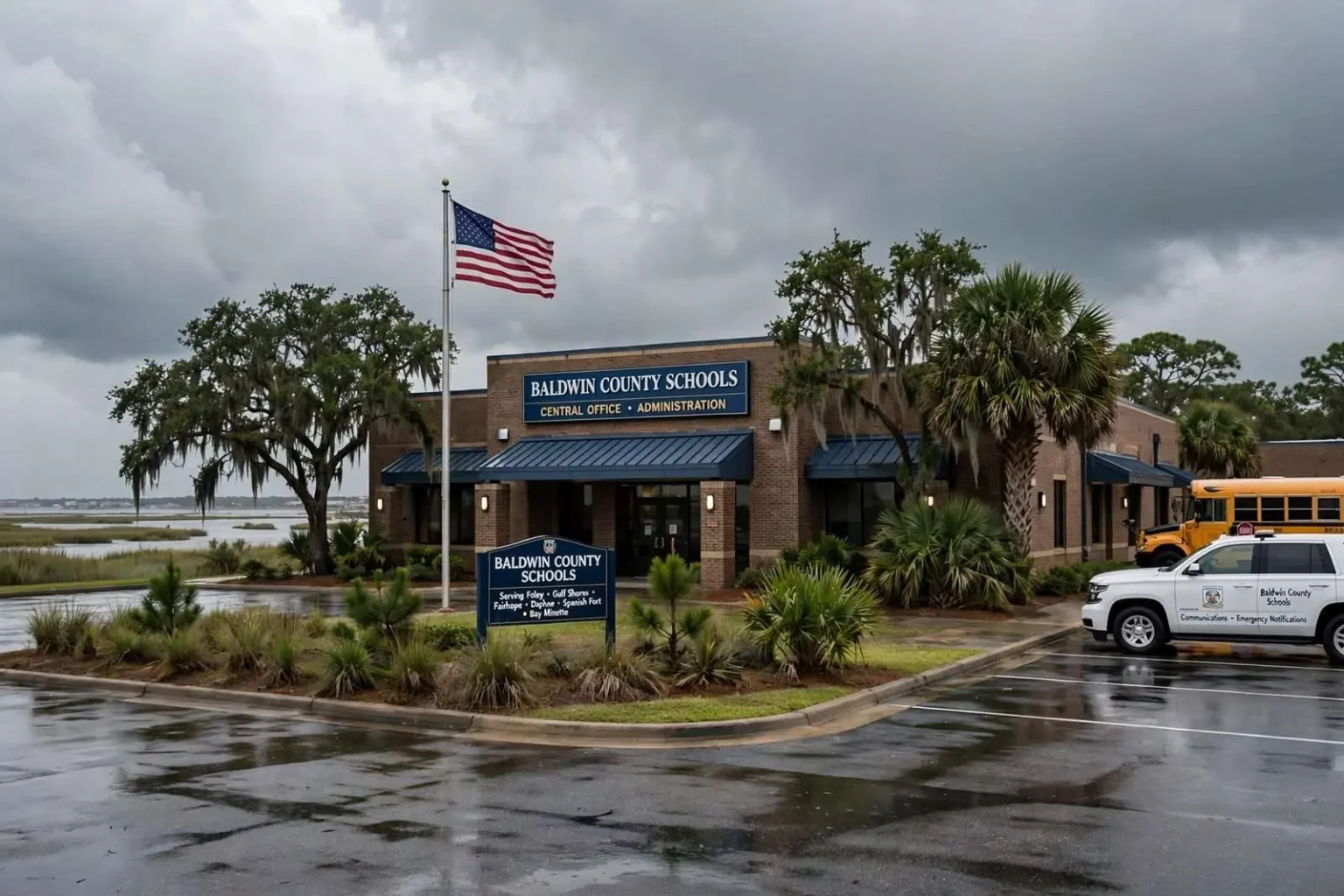
The Baldwin County school board has decided to switch parent notification providers for the coming year, moving away from a system it adopted just over a year ago in favor of a service the district previously relied on for years. The board approved a one-year contract worth $63,800 to bring back School Messenger as the district’s rapid-alert provider for 2015, replacing ParentLink, whose $94,400 contract is set to expire.
The switch is expected to save the district roughly $30,000 annually, a meaningful reduction for a system responsible for keeping thousands of families informed during emergencies.
Parent notification systems like these are used by school districts to send out fast, widespread alerts covering everything from severe weather closures to safety threats and other urgent situations that require immediate communication with families. For a coastal county like Baldwin, where hurricane season and severe storms are a recurring concern, the speed and reliability of these systems carries real weight for parents who need timely, accurate information about school closures or emergencies.
The recommendation to switch came from the district’s communications director, who told board members during a work session that School Messenger’s platform was more efficient at pushing out alerts quickly compared to ParentLink. He also noted that the ParentLink contract included a range of services the district wasn’t actually using, meaning families and taxpayers weren’t getting full value for the higher price tag.
A Course Correction After One Year
Baldwin County Schools had used School Messenger for several years before switching to ParentLink under the direction of a previous superintendent. The return to the earlier provider suggests district officials found the newer system didn’t deliver enough improvement to justify the added cost, prompting a course correction back to a platform with a longer track record in the county.
Vendor changes of this kind are rarely dramatic in the moment but loom large when the alerts matter. A notification platform is the district’s voice during a hurricane warning, a lockdown or a sudden road closure, and the staff who operate it build templates, contact lists and working habits around its particular tools. Re-learning those routines costs time and introduces the possibility of error during the transition — which is why the communications director’s pitch centered not on new features but on demonstrated speed with a system the staff already knew.
The unused services under the ParentLink contract are a familiar pattern in school procurement. Vendors bundle a broad suite of tools — survey modules, translation services, social media integrations and analytics among them — and districts discover after signing that their daily needs are narrower than the package they bought. Paying $94,400 a year for capabilities that sit idle is exactly the inefficiency the switch eliminates.
Baldwin County operates one of the largest school systems in Alabama, spread across a county that stretches from the Mobile Bay shore to the Florida line, with campuses in Foley, Gulf Shores, Fairhope, Daphne, Spanish Fort, Bay Minette and the communities between them. Geography multiplies the importance of a notification system: a single storm can close some schools and leave others open, flooding can block specific routes, and parents scattered across 1,600 square miles of county depend on the district’s alerts for information they cannot get anywhere else that fast.
Coastal emergencies test these systems hardest. During a hurricane threat, the sequence of closures, early dismissals and reopening decisions unfolds over days, and rumors fill any gap in official communication. A platform that delivers messages quickly to phones, email accounts and text devices — and that staff can operate confidently under pressure — is part of the county’s storm readiness in the same way as sandbags and evacuation routes.
The roughly $30,000 in annual savings matters beyond the line item. School budgets across Alabama have faced years of pressure between rising costs and fluctuating state funding, and Baldwin County’s rapid student growth forces constant investment in classrooms, buses and facilities. Money recovered from an unused vendor capability is money available for those priorities — one reason the board moved quickly on a recommendation framed around both performance and price.
The Broader Lesson for School Districts
The board’s vote reflects a broader pattern school systems face when evaluating vendor contracts for essential services: balancing cost savings against reliability and functionality. In this case, board members determined that a proven, less expensive option outweighed the newer system’s features, particularly since many of ParentLink’s additional services went unused.
That calculus repeats itself across districts nationwide every budget season. Technology vendors promise capabilities that sound valuable in a demonstration, but the test that matters is how the system performs at 5:30 on a stormy morning when a superintendent needs ten thousand families to know school is closed. Districts that evaluate vendors on that real-world moment — speed, deliverability and staff familiarity — tend to circle back, as Baldwin County did, to the platform that has proven itself.
The new contract with School Messenger is set to take effect for the 2015 school year, giving the district’s technology and communications staff time to transition contact databases and notification protocols ahead of the switch. Parents can expect to continue receiving alerts through the district’s usual channels, though the underlying platform sending those messages will change.
The transition window is where the practical work happens. District staff must migrate contact records for thousands of families, rebuild message templates, verify that phone numbers and email addresses in the system are current, and test delivery across the county before the first real emergency arrives. Districts typically encourage parents to update their contact information through the school registration process, and families in Baldwin County can expect those prompts as the 2015 school year approaches.
For parents, the change should be seamless in content even if the sender’s formatting shifts. Alerts will still arrive for weather closures, safety incidents, early dismissals and the routine announcements that flow through district channels. The difference families may notice is subtle: messages built on templates the communications office has refined over years, sent through a platform whose delivery speed the district has already vetted under real storm conditions.
The one-year term of the $63,800 contract also preserves flexibility. Rather than locking into a long agreement with either vendor, the board kept the option to reassess annually as technology and district needs change — a prudent stance for a service category that evolves quickly, and one that keeps both current and future vendors accountable to performance rather than habit.
By the time the 2015 school year opens, Baldwin County’s alert system will be running on familiar ground: a provider the district knows, at a price $30,000 below the year before, tested against Gulf Coast weather and ready for the next time a storm threatens the school week. The episode stands as a small but clear example of a district correcting course when a change stopped making sense — and of taxpayers’ money following the service that actually got used.
The one-year-plus life of the ParentLink era left its own mark worth noting. Adopted under a previous superintendent’s direction, the switch was the kind of leadership-driven change that districts make when a new administration brings new vendor relationships or new ideas about communication technology. The board’s decision to reverse it under the current team shows a different virtue: the willingness to admit a change isn’t working before sunk costs make the decision for you.
ParentLink’s $94,400 contract expiring on its own schedule made the transition cleaner as well. The district was not breaking a contract mid-term or negotiating an early exit penalty; the renewal deadline simply arrived at the same moment the performance review did, allowing the board to choose the next year’s provider from a position of no leverage lost. Timing like that is worth as much as the discount itself.
Notification platforms sit at the intersection of several school department responsibilities — communications, technology, transportation and safety — which is why the recommendation for a change came from the communications director rather than from procurement alone. The person who writes and sends the alerts is the best judge of which platform performs at 5:30 a.m., and boards that listen to that operator’s judgment tend to make the selection the staff can actually execute under pressure.
The switch also lands in a moment when parent communication expectations are climbing. Families increasingly expect district messages on their phones, in real time, with the same polish as the private apps they use daily. Meeting that expectation does not necessarily require the most expensive platform, as Baldwin County’s experience suggests — it requires the platform whose core alert function works every single time, run by a staff that knows its quirks. That is the standard School Messenger returns to the county having already met, and the standard the $63,800 contract is now paid to keep meeting.