Baldwin County Schools Survey Parents on Growth, Possible Tax Hike
Baldwin County school officials are phoning hundreds of parents to gauge support for new buildings and a possible property tax increase amid growth.
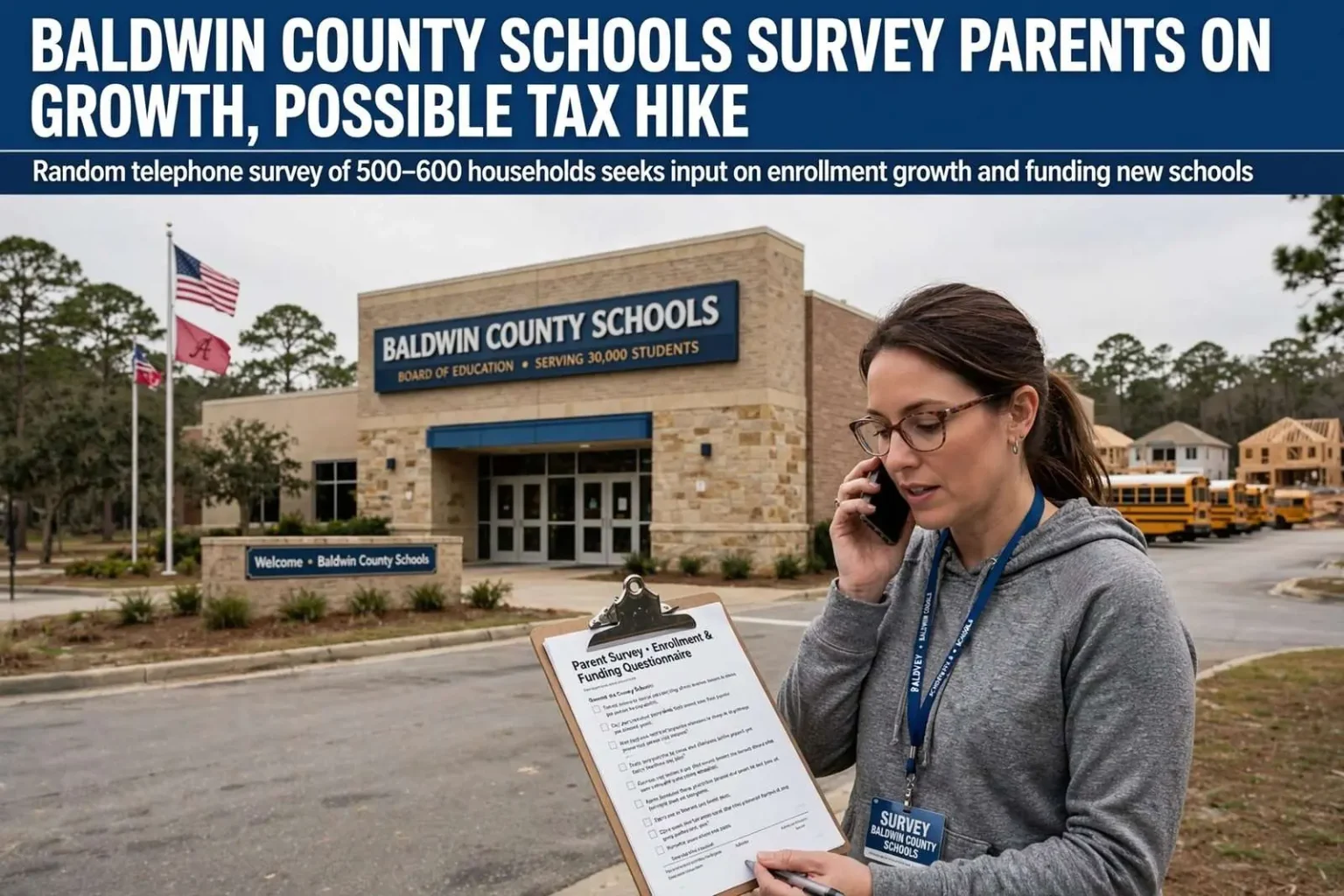
Baldwin County school officials have launched a random telephone survey of parents, seeking input on how the fast-growing district should handle years of steady enrollment increases, including whether residents would support higher property taxes to pay for new buildings. The survey will reach an estimated 500 to 600 households within the 30,000-student system, according to district spokesman Terry Wilhite. It marks the second phase of a broader outreach effort that began last spring with community meetings held across each of the system’s six geographic districts, where administrators laid out capacity constraints, capital needs and enrollment projections.
The questions being asked are the ones Baldwin County has been circling for years: where to build next, which campuses can absorb more students, and who should pay for it. A random-sample phone survey is the classic tool for answering the last question, because it reaches not just the parents whose children fill the classrooms but the homeowners whose tax bills would carry the cost. District leaders wanted a statistically defensible read on public willingness before asking elected board members to put a tax question on a ballot.
Growth That Outpaced the Projections
District leaders have watched enrollment climb by roughly 2 percent annually since around 2000, but this year’s growth has caught officials off guard. Final numbers for the current school year won’t be finalized for several more weeks, but the district already counts more than 600 additional students compared with the same point last year. In past years, enrollment typically dipped slightly in the opening weeks of school before climbing back up; this year, Wilhite said, the increase showed up immediately on the first day of class.
That detail matters more than it might seem. School districts plan staffing, bus routes and classroom assignments around enrollment projections, and the traditional early-September dip gives Baldwin County administrators a little breathing room each fall as families trickle in late. When the growth arrives on day one instead, the district has nowhere to absorb it — teachers must be hired immediately, portable classrooms ordered, and boundary discussions reopened in the middle of a school year rather than before it starts.
Two percent a year sounds modest until it compounds. Applied to a system the size of Baldwin County’s, annual growth of that pace adds the equivalent of a new school’s worth of students every few years, and the students do not arrive evenly — they concentrate along the Eastern Shore and the county’s coastal communities, where residential development has been heaviest. The district’s six geographic feeder patterns mean growth in one corridor can leave a campus overflowing while another school twenty miles away sits below capacity.
Capacity Concerns Are Not New
Capacity concerns are not new. A 2013 analysis from the district’s geographic information systems coordinator warned that several Gulf Shores-area schools were already at or near maximum enrollment, that an elementary school on the eastern side of the county would reach full capacity within a couple of years, and that a Foley-area high school could swell to roughly 2,000 students within five years. The GIS-based approach — mapping where new subdivisions were platted against where classroom seats existed — gave the district an early-warning system that has since proven accurate.
The geography of Baldwin County makes those warnings easy to understand. The county is one of the largest east of the Mississippi River by land area, stretching from the Mobile Bay shoreline across pine forests and farmland to the Florida line, and its population is concentrated in a handful of fast-growing corridors — the Eastern Shore communities of Daphne, Fairhope and Spanish Fort, the Foley-Gulf Shores-Orange Beach axis along the coast, and the Interstate 65 corridor running north to Bay Minette and Robertsdale. A family that moves into a new subdivision in one corridor can add three students to a school district that must find them seats, teachers and buses within weeks.
The phone survey is designed to give school board members a clearer sense of what taxpayers are willing to support as the district weighs its options, Wilhite said, including the politically sensitive step of asking voters to approve a property tax increase dedicated to school construction. “It’s unquestionably a community issue,” Wilhite said, adding that resident input is essential before the board moves forward with any funding plan. In Alabama, where local property tax support for schools is constitutionally limited and historically among the lowest in the nation, the difference between a district that can build and one that cannot is usually a vote of the people.
The Money Question
Any new-school construction plan in Baldwin County would carry a price tag in the tens of millions of dollars per campus, and a high school substantially more. The district’s options are constrained by the same forces driving its growth: rising land costs in the corridors where new schools would actually be needed, construction costs that climb faster than school revenues, and a funding base split between state allocations that follow enrollment and local taxes that require voter approval to increase. Bond issues backed by new property taxes are the standard mechanism, which is why the survey’s findings will matter so much to the board’s deliberations.
Survey methodology matters here too. A random telephone sample of 500 to 600 households is large enough to produce results with a margin of error of a few percentage points — sufficient to distinguish, for example, whether a majority would support a dedicated construction tax or whether support falls short of the level a bond referendum would need. Because the sample is random rather than self-selected, it filters out the predictable skew of an online petition or a public-comment microphone, where the people most affected by a particular school’s crowding respond at far higher rates than the average taxpayer.
The Budget Clock
The outreach comes as the school board works through a proposed budget exceeding $300 million for the coming year. A second public hearing on that spending plan was scheduled this week at the system’s central office in Bay Minette, giving residents another opportunity to weigh in before board members finalize their decisions on both the budget and any long-term facilities strategy. The budget hearings and the survey are running on parallel tracks deliberately: annual spending decisions are being made while the longer-term question of how to fund growth remains open.
The sequencing is significant for taxpayers watching the process. A budget above $300 million for a 30,000-student system underscores the scale of the operation the board manages daily — salaries, transportation across a county of this size, utilities and maintenance for dozens of campuses. But operating budgets and construction are separate streams, and no amount of careful annual budgeting can conjure the capital needed for new schools without a dedicated revenue source. That is the gap the survey is designed to illuminate.
What Comes Next for Baldwin County Families
For families across Baldwin County, the survey results could shape decisions in the coming months about where new schools get built, which existing campuses get expanded, and how the district pays for it all. Those decisions ripple outward in ways that go beyond classrooms: school quality is a primary driver of the residential growth that is causing the crowding in the first place, new campuses reshape traffic patterns and land values across entire corridors, and attendance zones determine which communities share facilities and which get their own.
Parents who attended the spring community meetings heard the same projections the board is weighing now, and the telephone survey extends that conversation to households that never made it to a gymnasium. Together, the two phases give the board a record that any future tax referendum would stand on — evidence that the district explained the need, listened to residents, and acted on what it heard. School officials have consistently framed the process that way: gather the facts, share the projections, ask the public, then decide.
The alternative — doing nothing — has costs of its own that the district’s data already quantify. Overcrowded campuses mean portable classrooms, rezoning disputes as boundaries shift, longer bus routes, and teachers stretched across more students. Baldwin County’s reputation for good schools is one of the engines of its growth, and allowing capacity to fall behind the population curve risks eroding the very asset that draws families to the county. School leaders across Alabama have watched fast-growing systems try to build their way out of a deficit after the fact and pay dearly for the delay.
What happens after the survey depends on what it finds. If residents signal willingness to support a construction tax, the board’s path runs toward a referendum, with the spring meetings and this survey as the groundwork. If the results show resistance, the district will have to stretch existing facilities further, prioritize the most pressing capacity needs, and make harder choices about which corridors wait. Either way, the input of those 500 to 600 randomly dialed households will carry more weight in the board’s deliberations than any amount of anecdote from the busiest public-comment microphone — which is precisely why the district spent the time and money to make the calls.