On the Eve of the 2012 Vote, Mobile-Baldwin Insiders Handicap Obama vs. Romney
On the eve of Election Day, attorneys, officials and operatives across Mobile and Baldwin County offered sharply divided predictions on whether President Obama or Mitt Romney would prevail in 2012.
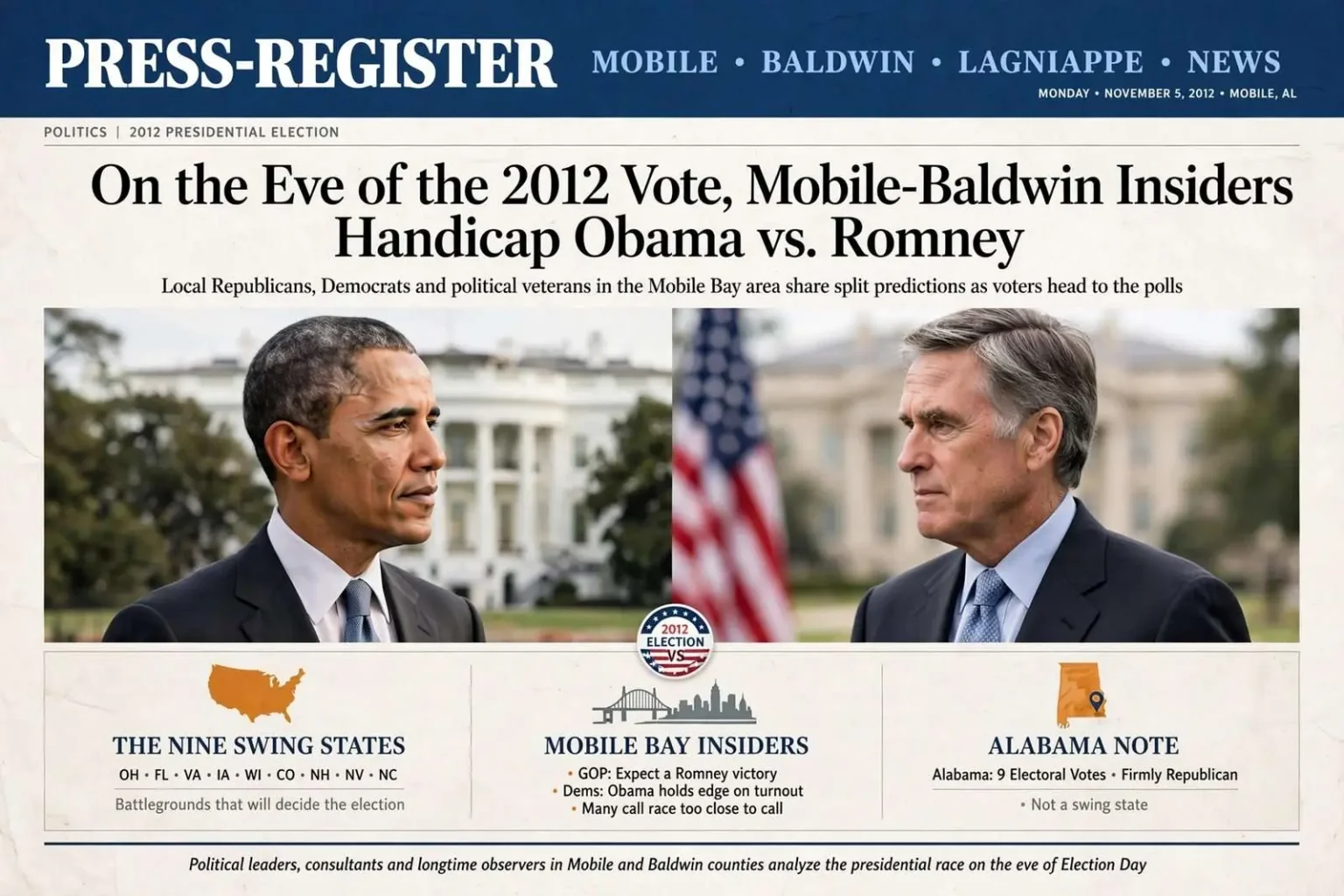
As the 2012 presidential election bore down on the country, the outcome hinged on a handful of battleground states and, by nearly every account, on turnout. In the Mobile Bay area, a cross-section of attorneys, elected officials, party operatives and political veterans offered their predictions on whether President Barack Obama would win a second term or Mitt Romney would return the White House to Republican hands. Their forecasts diverged sharply, but the reasoning revealed how closely local observers watched a race decided far from Alabama.
Republicans see a Romney wave
Many of the area’s Republican voices predicted a decisive Romney victory, most often crediting the sluggish economy and a perceived enthusiasm gap. Matt Simpson, chairman of the Baldwin County Republican Executive Committee, forecast Romney reaching well past 300 electoral votes.
Jerry Lathan, a state GOP committeeman, predicted Romney would clear 300 as dissatisfied voters broke for change, and that Republicans would sweep Alabama, leaving no Democrat in statewide office.
Bradley Byrne, a Mobile attorney whose daughter was volunteering for the Romney campaign in Ohio, cautioned the contest was genuinely close and would turn on ground-game mechanics as much as enthusiasm.
Chris Elliott, a Baldwin County political consultant, pointed to early-voting figures showing more Republicans and fewer Democrats casting ballots than four years earlier, calling it an advantage for Romney even as he warned the result might not be known before Election Night ended.
The confidence among local Republicans reflected more than wishful thinking. Southwest Alabama has been a Republican stronghold for a generation — Baldwin County delivered some of the party’s largest margins in the state — and the 2010 midterm wave had left the GOP holding every statewide office. From Mobile and Baldwin, a Romney victory looked less like a forecast than an extrapolation.
Democrats and skeptics bank on incumbency
A substantial group predicted the president would prevail. Danny Sheridan, the nationally known odds maker, said his numbers still made Obama a three-to-one favorite, winning most of the nine swing states and likely the popular vote as well.
Armand Dekeyser, a former Washington lobbyist, argued that the power of incumbency and the residual hope Obama once symbolized would carry him across the line even if he lost the popular vote. Reggie Copeland Jr., a former chairman of the Mobile County Democratic Executive Committee, expected a narrow re-election powered by the president’s battleground advantage and his get-out-the-vote operation.
Several observers refused to commit. Baldwin County Commissioner Bob James called it simply too close to call. Retired congressman Jack Edwards, a Republican, lamented that the winner-take-all system had confined the campaign to a few states and said the outcome would come down to independents and disaffected Democrats.
Edwards’s observation carried the weight of experience. He represented southwest Alabama in Congress for two decades, much of it as one of the few Republicans in the Alabama delegation during the era when the state’s Democratic conservatives still held most offices, and he had watched presidential politics long enough to distrust wave predictions from either direction.
Ohio, Sandy and the auto bailout
If one thread ran through the responses, it was Ohio. Former Alabama House Speaker Seth Hammett predicted the state would prove decisive, with the president’s rescue of the auto industry the deciding factor. State Sen. Trip Pittman of Baldwin County echoed the point, framing the auto bailout as a referendum on the role of government.
The argument mattered to Alabama observers for a second reason the national commentary rarely noted: the auto industry had become a pillar of the state’s own economy. Alabama’s assembly plants had made the state a Southern hub for foreign automakers, and the health of the industry’s supply chain ran through hundreds of Alabama jobs. Local observers understood the bailout’s politics in a way that connected Ohio’s factory towns to Alabama’s own factory floors.
Hammett, who had spent years in state government during the period when Alabama recruited its major automotive investments, knew that story from the inside. Pittman’s framing — a question about what government owes a struggling industry — matched the ideological debate Romney and Obama were running nationally, but both men agreed on the map: whichever candidate carried Ohio and its neighbors would likely carry the election.
Retired journalist Ray Jenkins projected Obama to lose Florida, North Carolina and Indiana yet still reach a comfortable 312 electoral votes. Others weighed the late-breaking effect of Hurricane Sandy, which several felt had blunted Romney’s momentum by allowing the president to appear presidential in the storm’s aftermath.
Sandy’s timing was the kind of variable no polling model anticipated. With the storm bearing down on the Mid-Atlantic in the campaign’s final week, the sitting president’s obligations as head of state — briefings, emergency declarations, visits to damaged communities — displaced candidate Obama. Romney’s campaign, suddenly secondary to the storm coverage, lost the final days of its closing argument, and observers on both sides of the aisle in Mobile and Baldwin counted that displacement among the race’s more consequential accidents.
The race as Alabamians saw it
A few respondents cast the contest in blunt and even racially charged terms, a reminder of the raw feelings the election stirred; most kept their analysis trained on the economy, turnout and the mechanics of the swing states.
Alabama itself was never in play — neither campaign advertised in the state, and its nine electoral votes were conceded to Romney months in advance. That made the area’s engaged commentary all the more striking: Mobile Bay’s political class followed Ohio’s early-voting numbers and Florida’s ad buys with the attention of residents of a battleground, even though their own ballots were, in the presidential contest, preordained by the state’s electorate.
A community divided, like the country
Taken together, the predictions mirrored the national uncertainty. Confident Republicans saw a country ready to reject the status quo; equally confident Democrats saw an incumbent protected by a superior organization and a slowly healing economy. Nearly everyone agreed the popular vote would be close and that the electoral map would determine the winner.
The split also tracked the observers’ vantage points. Those closest to party machinery — committee chairmen, committeemen, consultants — read the election through the enthusiasm and early-voting numbers their organizations collected. Those who had watched elections for decades, like the retired congressman and the retired journalist, hedged. The odds maker, whose profession rewarded calibration rather than conviction, landed on the assessment that proved closest to the consensus of the professional modelers: a modest but real Obama edge.
The national forecasters largely agreed with the skeptics. Polling averages showed the president holding narrow leads in the industrial states — Ohio, Wisconsin, Iowa, Pennsylvania, Michigan — that would prove decisive, and the election’s ultimate outcome would fall within the range the cautious local predictions had described. Romney would carry Alabama and the Deep South comfortably, sweep the Gulf Coast’s electoral votes, and fall short in the industrial Midwest, exactly the map Ohio-focused observers had sketched.
What the evening meant locally
As Alabamians prepared to vote the following day, the Mobile Bay area’s political class had said its piece and, like the rest of the nation, would wait for the returns.
Local stakes shadowed the national ones. The same November ballot carried Alabama’s constitutional amendments, local offices and congressional contests, and both parties’ local organizations were working their own turnouts as intently as the presidential campaigns worked Ohio. A presidential election that mobilizes volunteers, fills headquarters and empties yards of signs is also the election that sets the ground game for every race beneath it.
The predictions gathered from Mobile Bay’s attorneys, commissioners, legislators and party officers would age unevenly — some sweeping forecasts proved overconfident, some hedges proved wise — but collectively they captured a community engaged with a national election it could influence only from the sidelines. Alabama would vote overwhelmingly for Romney; the nation would re-elect Obama; and the day after, the local political world would return to the county commissions, legislative seats and municipal races where its influence is exercised directly.
The battleground map behind the debate
The nine swing states the commentators kept invoking — Ohio, Florida, Virginia, Iowa, Wisconsin, Colorado, New Hampshire, Nevada and North Carolina — accounted for nearly every plausible route to 270 electoral votes, which is why local predictions differed mainly in how many of them each candidate would win. Sheridan’s three-to-one assessment implied the president holding almost all of them; Simpson’s and Lathan’s Romney forecasts implied the opposite.
The mathematics explained both the confidence and the caution. With most states locked into predictable columns, a challenger needed to convert nearly every competitive state at once, while an incumbent could lose several and still survive. That asymmetry is why Byrne’s emphasis on ground-game mechanics — the volunteers, field offices and early-vote programs that decide a state by tens of thousands of votes — was closer to the professional consensus than any wave forecast, in either direction.
Early voting had taken on added weight in 2012, with more than a third of the eventual electorate expected to cast ballots before Election Day. The figures Elliott cited — Republican absentee and early-vote counts running ahead of 2008 in several states, Democratic counts running behind — were the same numbers the campaigns themselves obsessed over, and they fed the late-October conviction in Republican circles that the polls were missing their voters.
The final days delivered the correction that campaign professionals had expected all along. The candidate who led on Election Day in the states where the organization had banked votes early would win them, and the late surge the optimistic forecasts required never fully materialized. For the Mobile Bay observers who had hedged — the ones who pointed to Ohio, to incumbency, to the mechanics — the returns would vindicate the caution over the conviction.