Foley and Gulf Shores Host Baldwin County’s First Sanctioned Wrestling Match
Foley and Gulf Shores high schools made history with Baldwin County's first state-sanctioned wrestling match, drawing more than 100 spectators.
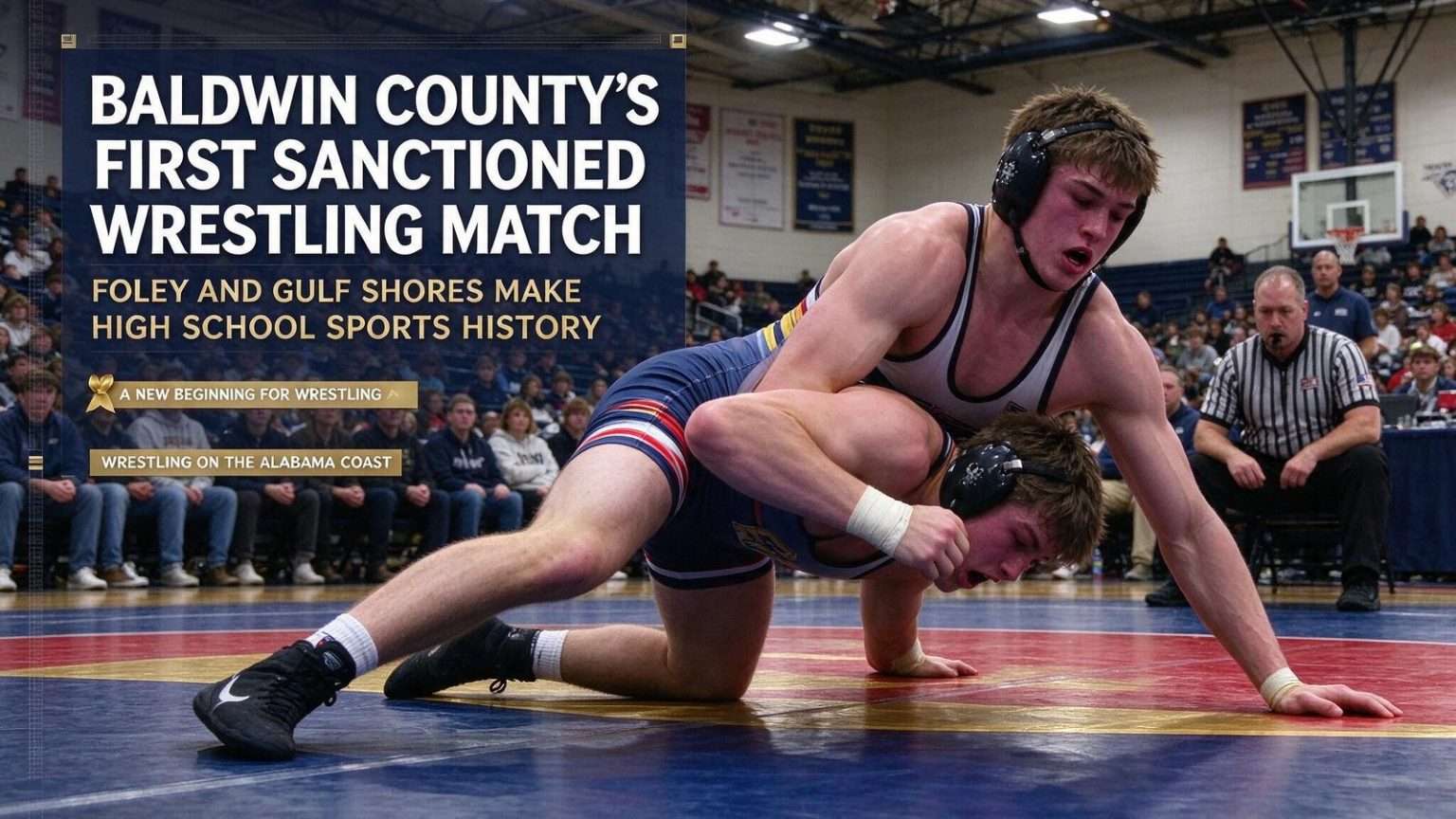
Student-athletes from Foley and Gulf Shores high schools made local sports history this week, taking part in the first state-sanctioned wrestling match ever held in Baldwin County. The gymnasium at Foley High School hosted the milestone, and everyone involved understood they were doing something no Baldwin County wrestlers had done before them.
Wrestling has been a recognized high school sport in Alabama for more than 50 years, but it has traditionally been concentrated in the northern half of the state. Programs in the Huntsville, Birmingham and Tuscaloosa areas built deep traditions — producing state champions, college wrestlers and generations of coaching expertise — while south Alabama remained, with scattered exceptions, a blank spot on the sport’s map.
Previous efforts by schools in the Mobile area to establish lasting wrestling programs never quite took hold, leaving south Alabama largely absent from the sport’s competitive landscape for decades. The reasons were practical more than cultural: starting a wrestling program requires mats, a coach who knows the sport, transportation to distant opponents and a schedule built around schools that are hours away by bus. For coastal schools with established football, baseball and basketball pipelines, wrestling was always the program that could start next year — and never did.
How the push started
That began to change after Baldwin County school officials started discussing the idea of introducing wrestling roughly a year ago. The county’s assistant superintendent over athletics said the push came in part from staff members, including himself, who had previously worked in states where wrestling programs were well established and had seen the benefits firsthand for student participation and overall school culture.
That experience mattered. Administrators who have watched a wrestling program operate — the way it fills a winter sports calendar, the way it draws athletes who might not make the basketball roster, the way it builds discipline in a sport with no teammates to hide behind — understand the pitch in a way a memo cannot convey. Baldwin County’s district, one of the largest geographic school systems in Alabama, stretched from the Mobile Bay shore to the Florida line, had the enrollment base to support the sport once someone made the case.
While most of the county’s high schools expressed interest, only Foley and Gulf Shores managed to field full teams in time for this inaugural season, and their competition will remain local for now. Getting a team on the mat by the first sanctioned match required equipment purchases, coaching assignments, weight certification for every wrestler and a season schedule — a lift each school managed in a matter of months. Other county schools will follow as they clear the same hurdles.
A packed gym for a first
More than 100 spectators packed Foley’s gymnasium to watch the historic match, a turnout that surprised even some of the coaches and administrators involved. For an inaugural meet between two new programs, the crowd size signaled something organizers had hoped but not assumed: that the community was curious, and that curiosity could become support.
Gulf Shores High School’s principal was among those in the crowd, calling the moment exciting both for the novelty of the sport locally and for the way it has drawn in students who hadn’t previously found a fit in other athletic programs. He noted that wrestling appeals to a wide range of body types, from smaller-framed students to bigger athletes, giving more kids a chance to be part of a team.
That inclusiveness is one of wrestling’s oldest selling points. Because competition is organized by weight class rather than a single roster, the sport accommodates a 106-pound freshman and a 285-pound senior on the same team, with each competing against opponents their own size. Football and basketball, by contrast, select for a narrower range of builds. Athletic directors in states with established wrestling traditions routinely describe the sport as the one that gives the most students a reason to stay involved in school athletics through the winter.
The individual nature of the sport carries its own lessons. A wrestler steps onto the mat alone, with no substitution and nowhere to hide, and the result belongs entirely to the preparation that preceded it. Coaches in established programs say that accountability — win or lose, the match is yours — builds a maturity that transfers to the classroom, which is part of why wrestling programs tend to hold the loyalty of their athletes season after season.
Where Alabama wrestling stands
The Alabama High School Athletic Association sanctions 14 weight classes in wrestling, spanning from 106 pounds up to heavyweight classifications above 285 pounds. Statewide participation has grown steadily, with more than 100 schools now fielding wrestling teams, up from fewer than 100 just a few years earlier.
The AHSAA’s weight-class structure mirrors the national federation model, and the classification system organizes postseason competition so that wrestlers advance through sectionals to state tournament brackets divided by enrollment class. For the new Baldwin County programs, joining that structure means their athletes now have a defined path — dual matches, then sectional and state competition — exactly as wrestlers in the northern part of the state have had for decades.
Nationally, wrestling ranks among the most popular boys’ high school sports, well ahead of other programs that have traditionally been staples along the Alabama Gulf Coast, such as golf and cross country. National federation participation surveys consistently place wrestling among the top ten boys’ sports by participation, with hundreds of thousands of wrestlers competing across the country each winter — a scale that surprises Alabamians who grew up where the sport barely exists.
The gap between national popularity and Alabama’s coastal absence is what made the Foley gym crowd notable. Wrestling’s strongest states form a band across the Midwest, the Plains and Pennsylvania, and southern states have lagged for generations. When participation numbers were drawn on a map, south Alabama was among the emptiest regions — a fact the assistant superintendent and his fellow wrestling advocates set out to change, county by county.
The plan for growth
County athletics officials say the long-term goal is to have wrestling programs running at all of Baldwin County’s high schools within the next year. The county system operates a large roster of high schools — from Fairhope and Daphne on the bay to Robertsdale, Spanish Fort, Elberta and others across the county — and each conversion means mats, headgear, a certified coach and a schedule.
The economics are part of why wrestling appeals to growing districts. Compared with football, a wrestling program is inexpensive: a team competes on a couple of mats, the equipment list is short, and a single coach can shepherd two dozen athletes. For a district whose enrollment growth keeps demanding new athletic offerings, wrestling delivers participation opportunities at a fraction of the cost of adding another marquee sport.
Because the sport remains unfamiliar to many local fans, organizers are also considering rotating matches between different school campuses to build broader community awareness and support as the program continues to grow. The strategy borrows a page from how other emerging sports built followings: bring the event to the audience rather than waiting for the audience to find the gym. A match at Daphne one week and Fairhope the next puts the sport in front of parents who may never have watched a takedown explained.
Building a fan base is the necessary next step. Wrestling is technical — scoring on takedowns, reversals, escapes and near-falls is opaque to newcomers — and programs that survive in new territory are the ones whose coaches and administrators take the time to teach the crowd as well as the athletes. The surprise turnout at Foley suggested the appetite exists; sustaining it through the season will determine whether the county’s other schools get their programs on schedule.
What the first match means
For the Foley and Gulf Shores wrestlers themselves, the evening was the kind of memory high school sports exists to provide. Every sport has someone who was first, and these athletes will carry the designation permanently: the first sanctioned wrestling match in Baldwin County history ran through their hands — and their takedowns, pins and decisions — in a Foley gymnasium that had hosted decades of basketball games but never a wrestling match.
The milestone also joins a broader pattern of athletic expansion across south Alabama, where school systems have steadily added sports — lacrosse, bowling, competitive fishing among them — in response to student demand and national trends. Districts that expand participation opportunities tend to keep more students engaged in school athletics overall, and wrestling’s low barrier to entry made it a natural next addition for a county that has grown into one of the state’s fastest-developing systems.
The challenge now is continuity. First seasons are full of energy; second seasons are where programs are proved. Foley and Gulf Shores will need returning wrestlers, youth and middle-school feeder interest, and results that justify the investment. If the county reaches its goal of wrestling in every high school within a year, the historic match at Foley will be remembered as the night the sport finally took root below the Alabama River — and the athletes on the first mats will be the founding names in every program that followed.