Baldwin County Rejects $285,000 Settlement in Wrongful Termination Case
Baldwin County commissioners turned down a proposed $285,000 settlement in a former employee's unlawful termination lawsuit, sending it back to court.
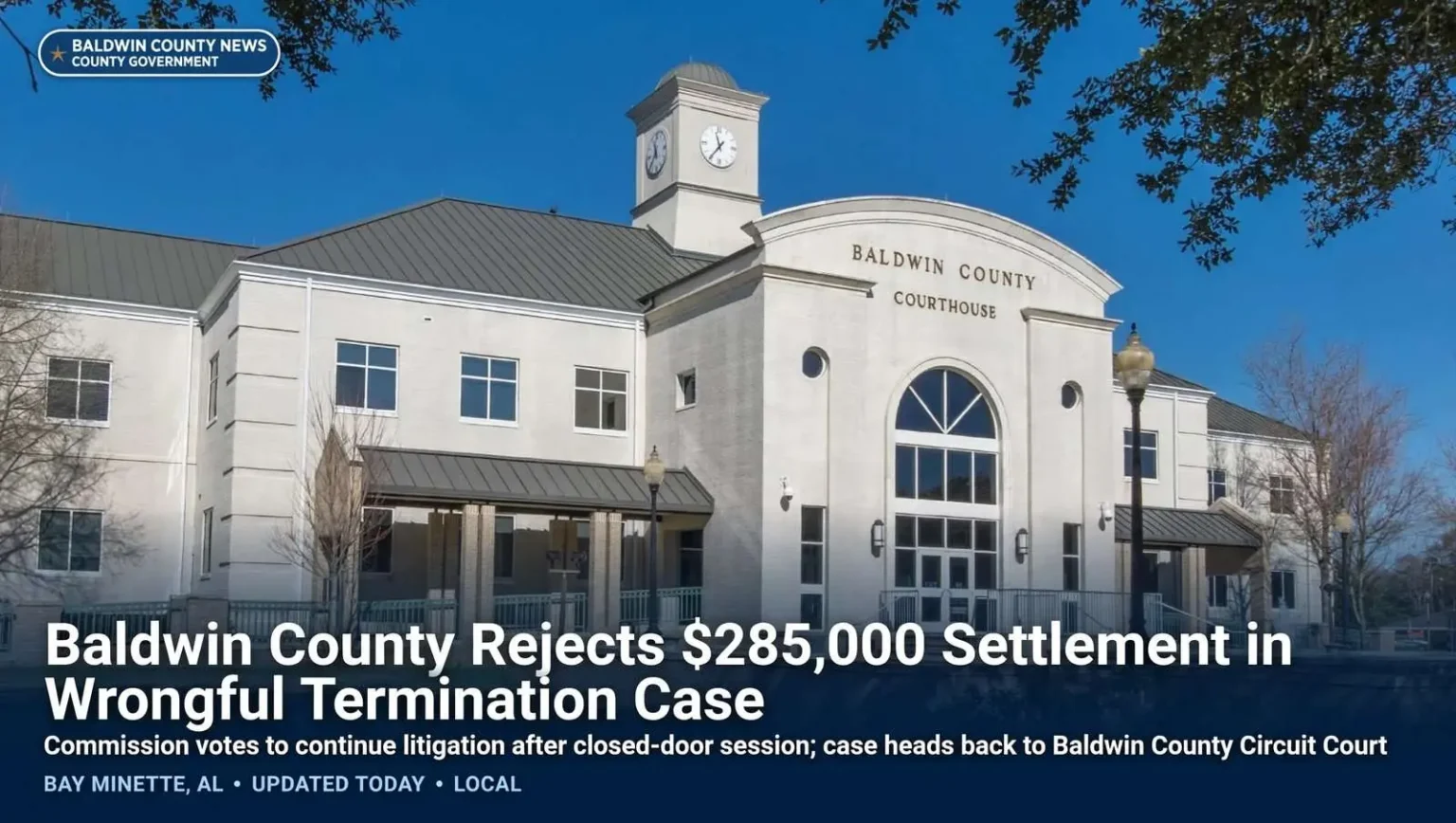
The Baldwin County Commission voted to reject a proposed $285,000 settlement in a lawsuit brought by a former county employee who claims he was wrongfully fired in 2012 without being given a chance to appeal. The vote keeps alive a lawsuit that has now stretched more than a year past its original filing and leaves county taxpayers on the hook for continued legal fees as the case heads deeper into litigation rather than resolving at the negotiation table.
Commissioners made the decision following a closed-door executive session lasting more than half an hour at their regular meeting in Bay Minette. Alabama’s open meetings law allows public bodies to meet privately with their attorneys to discuss the legal strategy in pending litigation, and personnel lawsuits are among the most common reasons the Baldwin commission convenes such sessions. Residents attending the regular meeting waited out the private discussion before the vote was taken in public.
With the settlement off the table, the civil case returns to Baldwin County Circuit Court for further proceedings, though a new hearing date had not yet been set at the time of the vote. The case will now continue through the standard civil litigation track in Alabama state court, which typically includes motion practice, depositions of current and former county employees, and scheduling orders set by the trial judge. Depending on how those stages unfold, the case could still settle later, be dismissed by the court, or proceed all the way to a jury trial.
Commission President Charles Gruber said afterward that the matter is now in the hands of the presiding judge. Gruber’s brief comment signaled that commissioners did not intend to discuss the details of the litigation publicly, a stance counties routinely take while a case is active. The county’s legal position and its trial strategy will now play out in court filings rather than at the commission table in Bay Minette, the historic county seat where the commission has met for generations.
The Allegations Behind the Lawsuit
The lawsuit, originally filed in May 2013, alleges the former employee was targeted for termination by certain commissioners ahead of losing his job and that his request to appeal the firing was denied by county officials, including a former county administrator and the personnel director at the time. County employees in Baldwin County, as in most Alabama counties, are typically granted a process for contesting disciplinary decisions, and the lawsuit centers on the claim that the standard route for reviewing the termination was closed off in this instance.
Court records tied to the case also allege that the former administrator pressured the employee to find a way to terminate a different county worker who had ties to a sitting commissioner, out of reluctance to fire that employee directly. That allegation, if pursued in depositions and testimony, could draw current and former county leaders into the case as witnesses, extending the discovery process and raising the stakes of what might otherwise be a routine personnel dispute. Court records in civil cases contain allegations only, and nothing in the file has been tested by a jury.
The county has disputed the characterization of events and has not conceded wrongdoing in the case. County attorneys have consistently maintained through the litigation that the employment decision was lawful and properly handled. Rejecting the settlement signals that at least a majority of commissioners, after hearing their attorney’s assessment in executive session, believe the county’s position is strong enough to take its chances in court rather than pay a six-figure sum to make the case go away.
Decisions like this one are rarely simple for county commissions. Settling a personnel case brings certainty and avoids the unpredictable cost of a jury verdict, but it can also invite additional claims if a county develops a reputation for paying to end disputes. Fighting a case costs money in legal fees and staff time, but preserving a documented record of contesting claims can deter future litigation. Commissioners weighed that balance in private with counsel before casting their votes in public.
The timeline of the case illustrates how slowly personnel litigation moves through Alabama courts even when the underlying events are a single decade old. The termination occurred in 2012, the lawsuit was filed in May 2013, and the case has spent the time since working through early motions and negotiation attempts. Courts encourage settlement at every stage, and the $285,000 figure that commissioners rejected likely represented the product of mediation or direct talks between the two legal teams. When those talks collapse, judges often push the parties toward a trial date, since a firm date on the calendar has a way of reviving negotiations.
Similar disputes across Alabama offer a rough guide to the stakes. Wrongful termination cases against county governments can produce verdicts ranging from nothing at all when the employer’s process holds up, to substantial awards when juries conclude that written policies were ignored. At-will employment remains the default in Alabama, but counties that adopt employee handbooks effectively promise the process those handbooks describe, and plaintiffs’ attorneys build their cases around the gap between the written policy and what actually happened. That is precisely the theory at work in this case, and it is why the alleged denial of an appeal sits at the center of the dispute rather than the termination itself.
The coming months will show whether the commission’s gamble pays off. County officials return to their regular agenda in Bay Minette with the case unresolved, the legal meter running, and a judge now responsible for deciding how the next chapter unfolds. Residents of a county that has grown accustomed to seeing its government praised for growth and financial management will be watching to see whether that same confidence holds up in a Baldwin County courtroom.
A Second Termination Case Looming in the Background
The rejected settlement comes roughly a month after the commission approved a separate $150,000 settlement in an unrelated 2012 wrongful termination lawsuit filed by a former county building department supervisor. That employee, who worked for the county for more than a decade, alleged he was let go without sufficient grounds and in violation of the county’s own employee handbook policies. The two cases, arriving on the commission’s agenda within weeks of each other, have put the county’s personnel practices under an uncomfortable spotlight.
Both plaintiffs are represented by the same Foley-based attorney, though he did not respond to requests for comment on the latest development. Foley sits in the fast-growing southern end of Baldwin County, an area that has produced much of the county’s population boom and, with it, a steady stream of employment disputes as local governments have expanded their workforces to keep pace with growth.
The county’s attorney has said the two cases are unrelated and stem from separate personnel decisions, adding that additional wrongful termination claims have been threatened or filed against the county in recent years. For a commission managing one of Alabama’s fastest-growing counties, the pattern has elevated personnel policy from a back-office concern to a recurring item on the public agenda. County officials have periodically reviewed hiring, discipline and termination procedures to ensure they match the employee handbook and state law, since deviation from written policy is often the strongest evidence a plaintiff can present.
Baldwin County’s government has been stretched by growth that has few parallels in Alabama. The county’s population has swelled for years as families relocate from Mobile and beyond for its schools and coastal lifestyle, and county departments — from building inspection to road maintenance — have hired rapidly to serve new subdivisions. Rapid hiring often surfaces personnel friction, and employment lawsuits against county governments in Alabama frequently turn on whether employees received the process the handbook promises.
What Comes Next
With the settlement rejected, the former employee’s legal team and the county’s attorneys will await the circuit court’s scheduling orders. The discovery phase is likely to be the most consequential, giving both sides the chance to question commissioners, the former administrator and the personnel director under oath about the events of 2012. What emerges from those depositions often determines whether a case settles before trial, gets resolved on summary judgment, or reaches a Baldwin County jury.
For county taxpayers, the immediate effect is continued legal expenses in a case now approaching its second year since filing. Commission President Gruber’s comment that the matter rests with the presiding judge suggests the commission intends to let the court process run its course, with no further public discussion planned while litigation is pending.
The vote also serves as a reminder of how much authority county commissions hold over employment decisions and settlements of this kind. In Alabama, settlement payments from county funds require a vote in a public meeting, which is why residents in the Bay Minette chamber heard the outcome even though the deliberations that produced it happened behind closed doors. The balance between transparency and litigation strategy is a familiar tension for county governments, and Baldwin County’s commissioners navigated it again with this vote.
Whatever the eventual outcome, the case is likely to shape how Baldwin County handles future terminations. If the county prevails, its stance will embolden officials to contest similar claims; if it loses, the resulting judgment and the testimony revealed along the way could force a reworking of the county’s personnel procedures. Either way, the former employee’s claim that he was denied an appeal has already done what lawsuits of this kind often do: forced a public examination of how a county government treats the people it employs, at a moment when the county needs to recruit and retain more workers than ever to keep up with its growth.