Baldwin County Commission Rejects $285,000 Wrongful-Termination Settlement
Baldwin County commissioners rejected a $285,000 settlement in a wrongful-termination lawsuit, sending the case back to court for further consideration.
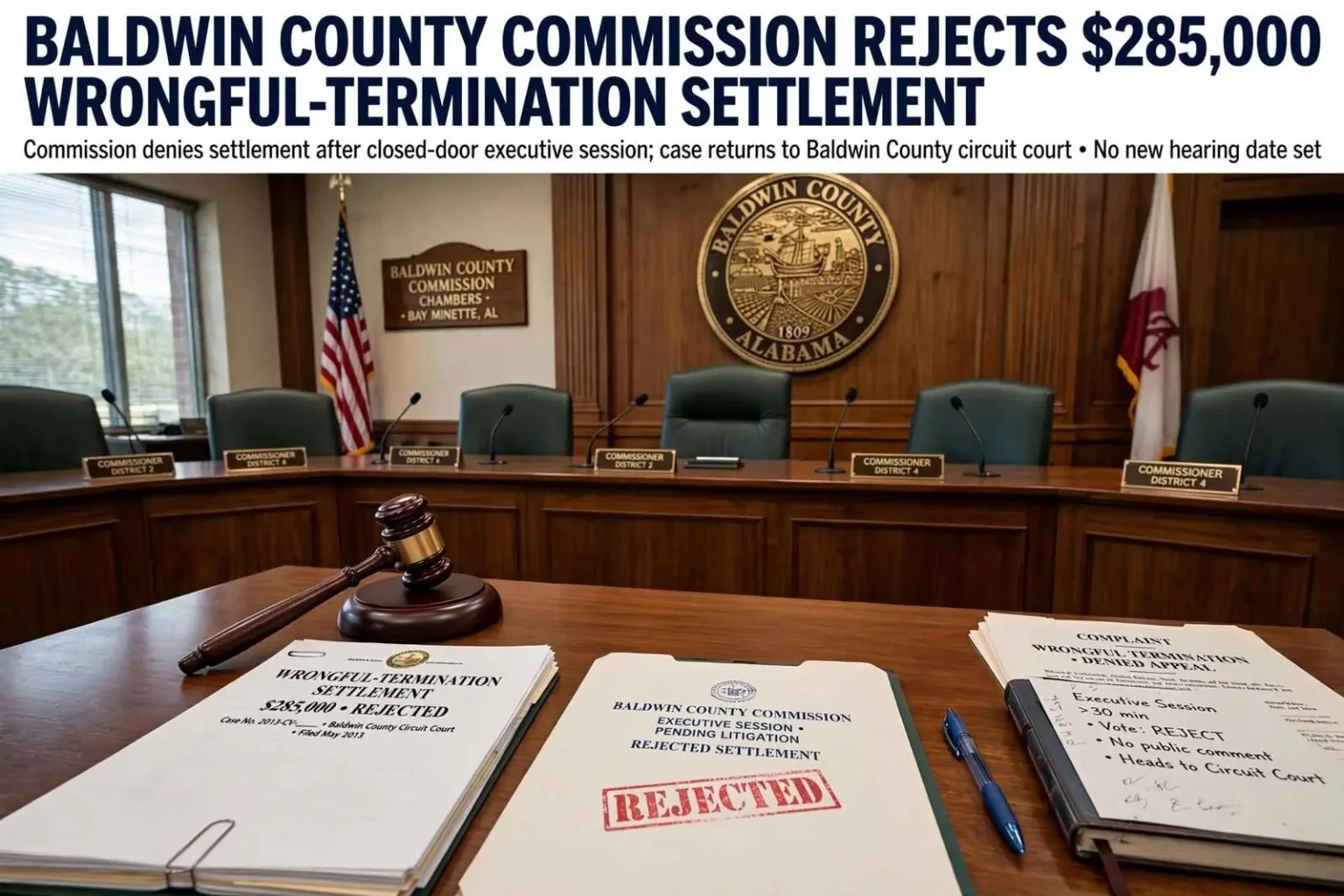
The Baldwin County Commission has rejected a proposed $285,000 settlement in a lawsuit brought by a former county employee who claims he was unlawfully fired and denied any opportunity to appeal. The decision, reached after a closed-door executive session that lasted more than half an hour, sends the civil case back to a Baldwin County circuit judge for further consideration. No new hearing date has been set.
The vote leaves the county’s largest pending employment claim unresolved and keeps alive a lawsuit whose allegations reach into the upper ranks of county administration. Commissioners deliberated behind closed doors — the setting Alabama law provides for discussing pending litigation — before emerging to reject the settlement without further public comment on their reasoning.
The former employee’s lawsuit, originally filed in May 2013, alleges he was terminated in 2012 and that his request for an appeal was denied by county officials, including the former county administrator and the personnel director. According to court documents, the suit claims he was targeted for termination by certain commissioners before losing his job.
The filing also contains a striking allegation: that the former administrator threatened the employee with the loss of his own job unless he could find a way to terminate another worker the administrator was reportedly reluctant to fire because of that worker’s relationship with a commissioner. The claim, if pursued in court, would place the county’s personnel decisions at the center of the case — and would put commissioners and administrators alike in the position of answering for them under oath.
“It’s in the judge’s hands,” the commission president said following the vote. With the settlement rejected, the county’s exposure in the case will be decided not at the negotiating table but in litigation — through motions, discovery, and, if no agreement ever emerges, a trial in Bay Minette.
A Pattern of Employment Disputes
The rejection comes about a month after commissioners approved a separate $150,000 settlement to close out a 2012 wrongful-termination lawsuit filed by a former building department supervisor. Both plaintiffs are represented by the same Foley-based attorney, a fact that has not gone unnoticed in county government circles as the commission weighs how to handle the remaining claims.
The earlier case involved a supervisor who had worked for the county from 1997 to 2011 and who accused officials of firing him without sufficient grounds and in violation of the employee handbook. That fourteen-year tenure gave the former supervisor’s claim the weight of a long service record, and the $150,000 resolution — approved by the same commission now rejecting a larger settlement — closed the county’s exposure in that case without a trial.
The two cases, filed a year apart and handled by the same attorney, have together raised the cost of the county’s employment disputes to nearly half a million dollars. For a commission that has governed through a period of rapid growth and tightening budgets, the payouts represent real money — funds diverted from roads, capital projects, and operations to settle claims about how the county treats its own workers.
County officials have sought to separate the litigation from a recent leadership shake-up. The county attorney said the settled case involving the building supervisor was unrelated to the commission’s decision last month not to renew the contract of the county administrator, who had held the top administrative post since 2010.
The Administrator’s Departure
The administrator’s exit looms over the employment litigation even as officials insist there is no connection. The administrator, who had run the county’s day-to-day operations since 2010, saw the commission decline to renew the contract in a decision that removed the county’s top unelected officer. Because the pending lawsuit names the former administrator’s conduct in its allegations — including the appeal denial and the alleged threat — the departure inevitably colors how the public reads the cases.
County government’s administrative structure puts the administrator at the center of personnel matters. The office oversees department heads, carries out commission policy, and handles the hiring and firing apparatus through which termination decisions flow. When a lawsuit alleges that a termination was engineered at the administrative level, the question of who was responsible — and who authorized it — becomes the factual core of the case.
The county attorney also acknowledged that additional wrongful-termination claims against the county remained pending. That acknowledgment transforms the two settled-or-litigated cases from isolated incidents into something closer to a docket: multiple former employees, represented in at least two instances by the same Foley attorney, pressing claims about how Baldwin County’s personnel decisions were made during the same general period.
What the Lawsuit Alleges
The rejected $285,000 settlement covered a case with unusually pointed allegations. The former employee claims he was fired in 2012 after being targeted by certain commissioners, and that when he sought the appeal the county’s own procedures promised, the former administrator and personnel director denied it. The lawsuit’s most explosive claim — the alleged threat to the employee’s own job unless he terminated a worker connected to a commissioner — describes, if proven, the kind of politically entangled personnel management that employment lawyers describe as among the most serious civil service failures.
Discovery in the case would give the plaintiff’s attorneys the power to compel testimony and documents from commissioners, the former administrator, and the personnel director — a process that could illuminate exactly how termination decisions were made inside the county’s administration. It is precisely the exposure that settlement offers are designed to avoid, and a plausible reason the county faced a substantial settlement demand in the first place.
For its part, the commission’s rejection signals a willingness to litigate rather than pay. Rejected settlements are calculated risks: trials can produce larger judgments and legal fees, but they also produce a public record that settles never do. The commission, after half an hour behind closed doors, chose the courtroom.
Alabama law gives county commissioners latitude in employment matters, but the state’s courts have long enforced the promises counties make in their own handbooks — the very document the earlier lawsuit invoked. A jury in Bay Minette weighing the case will be asked to decide not just whether the firing was fair, but whether the county followed its own rules in carrying it out.
How Settlement Decisions Get Made
The executive session that produced the rejection followed the standard mechanics of Alabama county government. The state’s open meetings law allows public bodies to convene behind closed doors to discuss the merits of pending litigation, on the theory that public deliberation of legal strategy would compromise the county’s position. What must happen publicly is the vote — which is where the commission’s decision became official.
Such decisions weigh more than the settlement’s face value. Commissioners must consider the strength of the evidence, the cost of continued litigation, the precedent a payment sets for future claims, and the message either choice sends to the county’s workforce. A $285,000 settlement is a significant sum in a county budget, but an adverse jury verdict, with attorney fees and years of delay attached, can dwarf it.
The commission’s split decisions — approving $150,000 in one case and rejecting $285,000 in another — suggest members drew distinctions between the two claims. The settled case involved a long-tenured supervisor alleging a straightforward handbook violation; the rejected one involves allegations implicating commissioners themselves. Voters and taxpayers can draw their own conclusions about which kind of claim the county prefers to fight in public.
The Foley Attorney’s Streak
The same Foley-based attorney representing both plaintiffs now has a settled claim and an active one against the county, with additional claims pending. Attorneys who develop a practice in municipal employment cases build detailed knowledge of a government’s personnel policies, its chain of command, and its litigation posture — knowledge that strengthens each successive case they bring.
For the county, facing a repeat player on the other side raises the stakes of every decision. A settlement rejected in one case becomes evidence of the county’s litigation posture in the next; a settlement approved in one case becomes the benchmark the next plaintiff cites. The commission’s handling of the remaining claims will unfold under precisely that dynamic.
The pending claims also carry a timing element. With the administrator’s contract non-renewed and the commission’s composition evolving, the officials who would answer in depositions for the disputed decisions are already departing the scene — a shift that can complicate litigation for both sides, as testimony must be preserved and institutional memory documented before it disperses.
A Spotlight on Bay Minette
The string of employment disputes has put a spotlight on how the county handles personnel matters and terminations, an issue that has generated both legal exposure and public scrutiny in Bay Minette. The county seat’s commission chambers have become the venue where the questions are aired — in executive sessions, in votes, and in the annual budget that now carries the cost of the county’s employment litigation.
Personnel practices rarely draw public attention until they produce lawsuits, and Baldwin County’s experience illustrates the pattern. What happens inside a human resources office — who is targeted, who is protected, whether an appeal is granted — is invisible to the public until a former employee hires an attorney and the record comes out in filings like these.
For county employees, the litigation sends its own message in both directions. It establishes that terminations will be challenged, that the handbook will be invoked, and that the county will sometimes pay and sometimes fight. That landscape shapes how the county’s workforce views its own protections — and how carefully its administrators document the next termination.
The cost is already real: $150,000 paid, a $285,000 offer refused, and claims still pending. With the largest settlement now off the table, the outcome of the remaining case rests with the court — and with a circuit judge in Bay Minette who will decide whether the case proceeds toward the trial the commission has, for now, chosen to risk.
What Comes Next
With no new hearing date set, the case’s next steps belong to the court’s docket and the parties’ attorneys. The county will answer or move on the claims; the plaintiff will pursue discovery aimed at the commissioners and administrators the suit accuses. Either side can renew settlement talks at any point — the rejected $285,000 proposal sets a floor for those discussions, but nothing prevents both sides from returning to the table as trial approaches.
The county attorney’s acknowledgment of additional pending claims means the commission will face this question again. Each new claim forces the same closed-door calculus: the strength of the specific case, the price of settlement, the risk of a verdict, and the public’s interest in how its county governs its own employment practices. The $150,000 settlement and the $285,000 rejection now frame the range within which those future decisions will be judged.
For Baldwin County taxpayers, the most concrete facts are the simplest: one former supervisor’s lawsuit cost $150,000 to settle; one former employee’s lawsuit remains active with a $285,000 offer refused; and more claims are waiting. However the pending case ends — verdict, settlement, or dismissal — the county’s handling of personnel matters will continue to carry a measurable price.
The commission president’s summary of the vote was brief and accurate: it’s in the judge’s hands. What the judge — or a jury — finds about the allegations in the lawsuit will determine whether the county’s gamble on litigation was prudence or an expensive miscalculation. Until then, the largest of Baldwin County’s employment disputes remains exactly where the commission left it: unresolved, in court, and in the public record of how the county treats the people it once employed.