Baldwin County Approves Rebel Road Rezoning Despite Neighbor Objections
Baldwin County commissioners approved a rezoning near Daphne's Rebel Road for a lawnmower business, overriding residents' concerns about traffic.
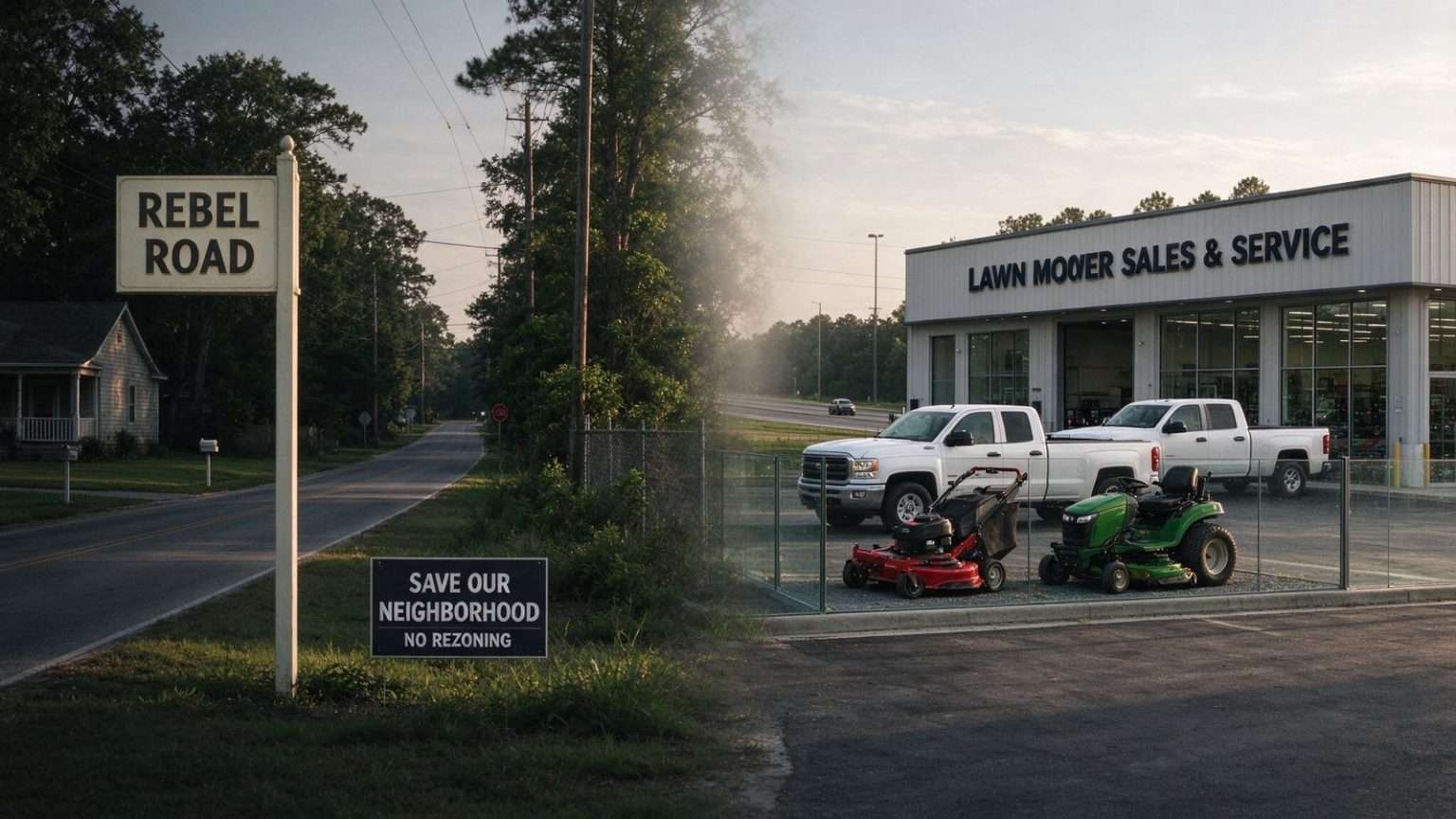
The Baldwin County Commission voted unanimously to rezone roughly four acres of vacant land off Rebel Road near Daphne, clearing the way for a lawnmower sales and repair business despite pushback from nearby homeowners. The vote puts county government’s growth policy to a practical test on one of the fastest-developing corridors in one of the fastest-growing counties in Alabama, and it ends — for now — a neighborhood effort to slow commercial expansion at the edge of a residential area.
The property sits within unincorporated Belforest, just off the increasingly busy Alabama Route 181 corridor. Belforest occupies the unincorporated space between Daphne and Fairhope on the eastern shore of Mobile Bay, a community that has spent two decades transforming from rural crossroads into suburban territory as the eastern shore’s population spreads south and east. Unincorporated status matters in a case like this because zoning decisions rest with the county commission rather than a city council, and the commissioners who represent such areas weigh countywide growth policy against the specific objections of the residents who live nearest the property line.
Residents along Rebel Road, a quiet residential street that feeds into the highway, argued the rezoning would bring unwanted commercial activity into their neighborhood. One longtime resident who has lived in the area for more than a decade told commissioners the coming development threatened to erode the quiet, close-knit character of the community as growth continues along Route 181. That testimony put the case in its simplest form: a street of homes on one side, a zoning map change on the other, and a question about what the transition zone between neighborhood and highway looks like.
What the rezoning allows
The commission’s vote changed the property’s zoning classification from a professional business district to a neighborhood district, a shift that allows a self-storage and retail company to move forward with plans for the site. The project calls for a roughly 4,000-square-foot retail showroom for lawnmower sales, along with associated storage. It closely mirrors a similar facility the same company operates farther south along Route 181, a precedent the applicant leaned on and the objectors studied — proof that the business works on this corridor, and proof of what such a facility looks like once operating.
The professional-to-neighborhood reclassification is the detail that shaped the hearing. In Baldwin County’s zoning scheme, neighborhood commercial districts are designed to serve surrounding residential areas with small-scale retail, which is why a lawnmower sales and repair showroom fits where an office-zoned use did not. Supporters of the change argue that a business selling and servicing equipment homeowners already use is precisely the kind of neighborhood-serving commercial use such districts contemplate; opponents counter that the traffic such a business generates — customers towing trailers, delivery trucks, service vehicles — is heavier than the category’s label suggests.
The commissioner who represents the district defended the decision, saying commercial growth along a major four-lane collector road like Route 181 is a natural consequence of the county’s overall growth and that the proposed use was appropriate for the site. He said he did not expect the development to significantly affect traffic in the area. That assessment tracks the county’s broader position along the corridor: the road has already been widened to four lanes, commercial nodes already exist at its major intersections, and the question is not whether the corridor commercializes but how each parcel at its edge transitions into the neighborhoods behind it.
The neighbors’ case
Neighbors disagreed. About a dozen residents signed a petition opposing the project, citing worries that box trucks and trailers serving the new business could clog the residential road, along with concerns about stormwater runoff and the visual impact of a storage facility next to family homes. The petition’s three concerns map the standard toolkit of neighborhood objections to commercial rezonings — traffic, drainage and appearance — and each is specific to this site: Rebel Road is the residential outlet for the parcel, Baldwin County’s flat sandy soils and heavy rains make runoff a live issue for any cleared acreage, and a storage component puts a non-residential structure in direct view of nearby yards.
In a letter to the commission, residents acknowledged that Belforest has been identified for future commercial growth in county planning documents, but argued the pace and location of that growth deserved more scrutiny. The concession-and-objection structure of that letter is typical of mature zoning fights in fast-growing counties: residents rarely dispute the growth plan itself, they dispute its application to a particular street, and they ask the commission to slow the boundary between commercial and residential until infrastructure catches up.
Route 181 has drawn steady developer interest since a stretch of the highway was widened in 2011, and county planners continue pushing the Alabama Department of Transportation for additional widening further south. The four-laning a decade-plus ago converted the road from a rural two-lane into a collector capable of carrying the eastern shore’s growth traffic between the I-10 corridor and the Fairhope and Foley areas, and the development that followed the widening is a textbook case of the transportation-land use cycle: capacity attracts rooftops, rooftops attract commercial services, and the commercial services generate the traffic that eventually demands more capacity.
Officials say those broader improvements remain years away, but the corridor’s growing traffic volume has already made it an attractive target for commercial investment, a trend Tuesday’s rezoning decision reflects. Planners working ALDOT’s project pipeline know the gap between a corridor study and a construction contract can run a decade, and in that gap the private market does not wait. Each rezoning along the route — this one included — is effectively a bet that the road will be improved to match the demand the development creates, and each objection from residents is effectively a request that the sequence run the other way.
What the vote means for Belforest
The vote adds to a string of zoning decisions along the Route 181 corridor as Baldwin County continues to grapple with how to balance residential character with commercial expansion in one of its fastest-growing areas. For the commission, the unanimous vote signals that the district’s representative and his colleagues see the Rebel Road parcel as part of the corridor’s commercial future rather than its residential holdout territory. For the company behind the project, the decision unlocks a second Route 181 location modeled on the facility it already operates farther south, pairing a showroom business with the storage demand that comes with rapid neighborhood growth.
For the residents of Rebel Road, the outcome establishes the template they will likely see repeated as the corridor’s commercial edge advances: petitions, letters and testimony that get acknowledged on the record but rarely stop a parcel rezoning that fits the county’s growth plan. The concerns they raised — truck traffic on a residential street, stormwater from a cleared site, storage structures beside family homes — will now be addressed, or not, through the site-plan review process, where drainage plans, access points and buffering requirements are set. That stage is where Baldwin County’s experience with corridor growth shows up in concrete terms, and it is where Rebel Road’s residents will be watching next.
The case ends with a familiar Gulf Coast conclusion: the four acres off Rebel Road will develop, the showroom will open, and Belforest will keep becoming what the county’s planning documents have said it would become — a suburban community stitched along a four-lane corridor whose next chapter depends on how well the road, the drainage and the neighborhoods keep pace with the zoning map.
The lawnmower business itself is worth understanding as a category, because it explains both the company’s confidence and the neighbors’ concern. Sales and service of outdoor power equipment is a trailer-driven trade: customers tow zero-turn mowers and riding tractors in for purchase and repair, dealers receive palletized inventory and regional deliveries by box truck, and service departments generate a steady loop of pickups and drop-offs. A 4,000-square-foot showroom with associated storage fits that profile — bigger footprint than a storefront, lighter traffic than a car dealership — which is why it sits exactly at the boundary of what a neighborhood commercial district is meant to allow, and why the hearing turned on where that boundary should sit.
Storage is the second half of the business plan and the source of the sharpest objections. Self-storage demand tracks population growth almost mechanically, and Belforest’s influx of new households has created exactly the market that storage developers chase. Storage facilities are low-traffic once built, but their long metal buildings and drive lanes are visually unlike anything on a residential street, which is why buffering, setbacks and landscaping requirements become the decisive design questions in projects like this one.
How county zoning hearings work
The process that produced Tuesday’s vote follows the standard Alabama county sequence: a rezoning application, public notice to surrounding property owners, a planning commission review that formulates a recommendation, and a final vote by the county commission at a public meeting where supporters and opponents speak. The unanimous final vote suggests the commissioners saw the planning staff’s analysis and the district commissioner’s local judgment as aligned, and it forecloses the kind of split vote that occasionally sends corridor rezonings back for reconsideration.
What residents can still influence is the site plan. Drainage engineering for a four-acre cleared site, the location and design of the Rebel Road access point, hours of operation for the service department, fencing and landscape buffers along the residential edge — all of these are set in the development review that follows the rezoning, and Baldwin County’s ordinances give staff leverage over each. In growth-corridor disputes, the rezoning vote settles what can be built; the site plan settles what it will look like and how it will behave. Rebel Road’s neighbors lost the first vote, and their attention now shifts to the second.
The wider lesson of the case is the one Baldwin County has been learning for a decade: the commission’s growth decisions are made parcel by parcel, but their cumulative effect is a corridor’s character. Route 181’s next segment of development is being decided in hearings like this one, four acres at a time, and each vote — like Tuesday’s — moves the eastern shore’s map a little further from the rural crossroads it was and a little closer to the suburban corridor its planning documents promise.